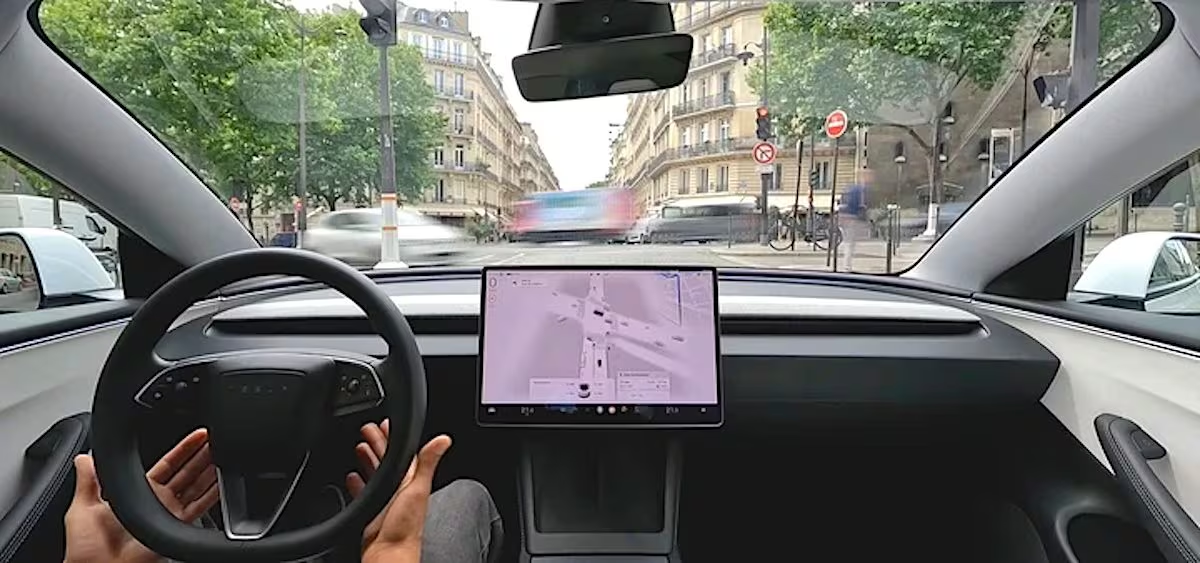
Even in Italy, Teslas will soon be able to tackle intersections, roundabouts and lane changes with the help of artificial intelligence. The Ministry of Infrastructure and Transport has in fact authorized the use of Tesla Assisted Driving, the advanced driving assistance system developed by Elon Musk’s company. This is the European version of Full Self-Driving Supervised already available in the United States, designed to handle most everyday driving situations.
Be careful, however: it does not mean that it will be possible to speed along the streets and motorways of our beautiful country, leaving the steering wheel to dedicate yourself to something else. In fact, the system requires the constant supervision of the driver, who remains responsible for the vehicle and must be ready to intervene at any time. In fact, in a note, MIT clarified:
Even when the system carries out the manoeuvre, the driver remains responsible for driving: he must always keep his hands on the steering wheel, keep his attention on the road and be ready to intervene.
Italy is the 12th country to anticipate the European green light
The Italian authorization arrived on November 19, after the technical checks carried out by the Motorisation. More precisely, the Ministry recognized on the national territory the provisional approval issued by the Netherlands, the first European state to approve this technology last April.
Italy thus becomes the twelfth European Union country to authorize the system. It is also first among the four most populous member states, ahead of Germany, France and Spain. Overall, the twelve countries that have already given the green light represent around 30% of the European population.
The announcement was made by Matteo Salvini, Minister of Infrastructure and Transport, who defined the decision as a step forward towards innovation and mobility of the future. Elon Musk also welcomed the news, thanking the minister through the X platform.
The authorization, however, is provisional. The Dutch recognition on which it is based is valid until 10 April 2029. European standards allow other member states to extend its effects on their territory while the evaluation for an approval valid throughout the Union is still underway.
The MIT authorization sets the stage for December, when the European Union Technical Committee for Motor Vehicles will be called to vote on the approval extended to all 27 EU member countries. Final approval at community level will require the support of at least 15 EU states (out of a total of 27) representing at least 65% of the European population. In fact, this is the so-called “qualified majority”: it is not enough that the majority of member countries vote in favour, but the countries in favor must also be particularly populous, representing at least 65% of the total population of the European Union (i.e. at least 292.5 million out of a total of 450 million citizens).
What Tesla Assisted Driving is and how it works
Let’s now see what Tesla Assisted Driving is and how it works. Basically, it is a set of advanced driver assistance functions, which allows the car to manage various operations, following the route set by the driver.
The system can intervene on steering and speed, negotiate intersections, navigate roundabouts and change lanes. It is therefore not limited to automatically maintaining the distance from the vehicle in front or following the lines of the road: it can also assist the driver in more complex situations, including those typical of urban traffic.
To interpret the surrounding environment it mainly uses external cameras, which offer 360-degree visibility, and a computer with AI integrated into the car. The processing of the images and data collected takes place directly on board the vehicle.
At the heart of the system is a neural network end-to-endi.e. an artificial intelligence model that has been trained to interpret driving situations and directly generate the commands necessary to control the car. Rather than relying solely on a set of predefined instructions for every possible situation, this model learns from real-world driving examples to recognize traffic signs, pedestrians, vehicles and road markings.
According to Tesla, this system “is trained on the equivalent of more than 100 years of anonymous real-world driving scenarios from our fleet of more than six million vehicles.”
Capabilities can also be improved through software updates via the Internet and fleet learning: a process using anonymous data from vehicles, with participation conditional on consent.
It’s not autonomous driving: what are the limits?
Tesla Assisted Driving is a supervised driving assistance system, not a technology that makes the car fully autonomous. This means that, as already anticipated in the introduction of the article, the driver must always keep his attention on the road, keep the steering wheel steady and be ready to immediately regain manual control of the vehicle. Even when artificial intelligence manages a maneuver, the responsibility for traffic remains, in fact, with the motorist.
More rigorous control parameters have also been introduced for use of the system in Europe compared to the North American version. Among the adjustments indicated are the reduction from 50% to 10% of the tolerance margin on the set maximum speed, with automatic resetting every time the car is restarted, and early visual and audible warnings to attract the driver’s attention.
The Dutch provisions also provide that, above 130 km/h, the hands must remain firmly on the steering wheel rim.
It costs 99 euros per month: which Tesla models will be able to use it
For Italian motorists, the activation of Tesla Assisted Driving will come through an OTA software update (Over The Air), i.e. downloaded and installed directly via the Internet, without necessarily having to take the car to the workshop.
Initial availability concerns Tesla Model 3 and Model Y equipped with the HW4 hardware platform, the most recent generation of the on-board computer indicated for this function. The price announced for Italy is 99 euros per month.
Tesla Ministry of Infrastructure and Transport ANSA MIT