For some years, the summer trend of Italians has always been the same: it is no longer just August that is the month in which the country gets moving, but a much longer arc that starts with the last school bell at the beginning of June and extends until September. It is no coincidence that July was classified as a highly critical month by Viabilità Italia, while after the end of school, 16 million Italians set off on the road.
A change that does not only concern holiday dates, but which is reflected in a chain on three different levels – the streets, the cities that remain empty and even the fruit and vegetable stalls in the markets. Three factors hold the picture together: the now structural deseasonalization, a growing attention to costs and a heat that affects both travel and dining.
Red sticker traffic: 12 critical days in July and two black stickers in August
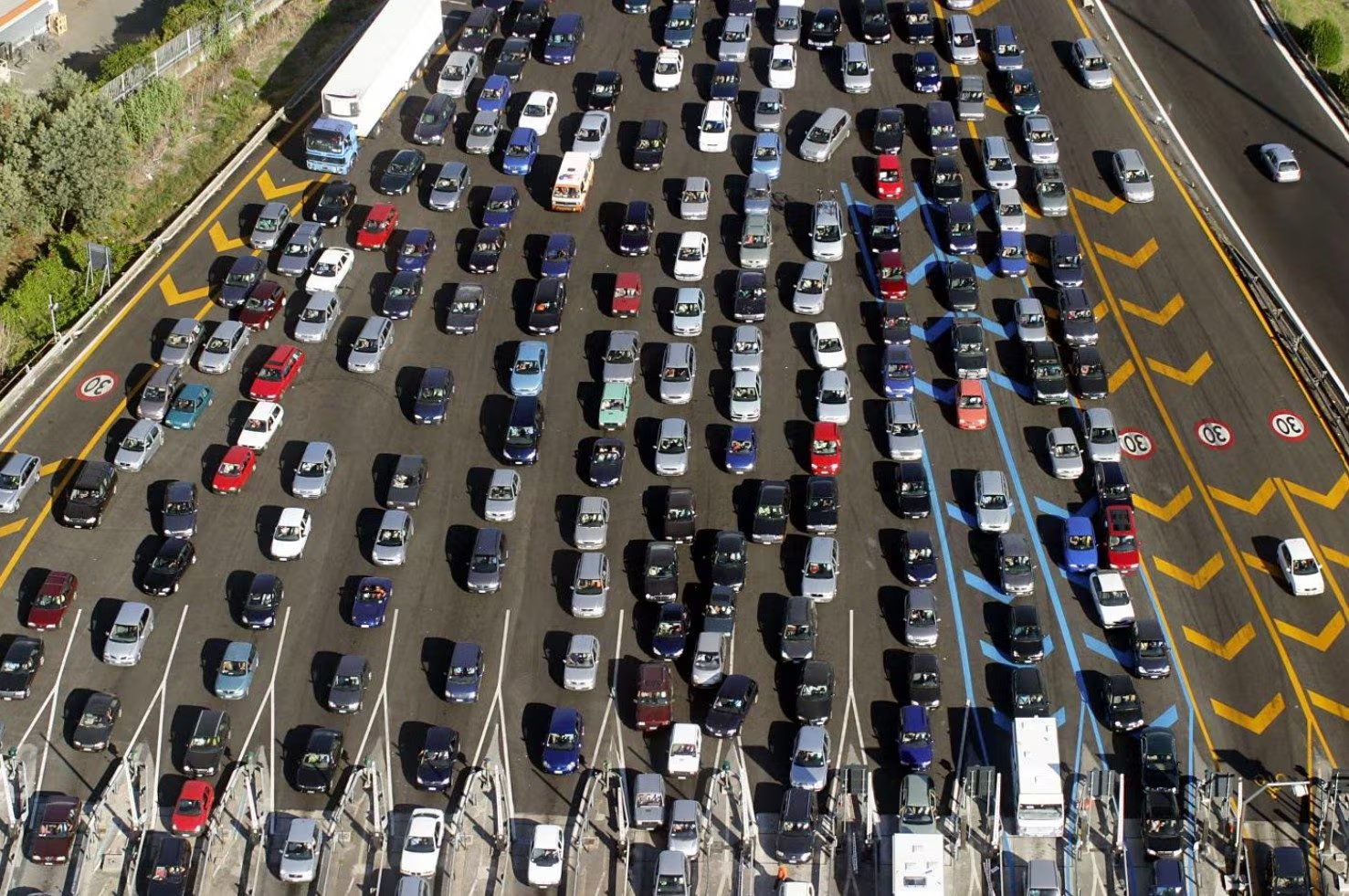
On the traffic front, the picture is equally intense. Viabile Italia, the national coordination center of the Traffic Police, has classified July as a highly critical month: the first four weekends concentrate a total of 12 red flag days, i.e. intense traffic with possible criticality.
The pattern repeats itself almost identically every weekend, according to the forecasts reported by Quattroruote. More specifically:
- Friday mornings start in yellow for flows leaving large cities, which trigger the red flag in the afternoon;
- The red dot remains even on Saturday mornings;
- Sunday afternoons are also in red, but this time in the direction of the cities, for returns.
The last weekend of the month is the most complex, with the intertwining of exodus and counter-exodus: red stamps already foreseen in the afternoon of Thursday 30th and for the entire day of Friday 31st July. To complete the picture, the ban on heavy vehicles weighing over 7.5 tonnes every Saturday and Sunday of the month.
The only two black stamps of the season – the maximum level of criticality – are expected on the mornings of Saturday 1st and 8th August, according to Viabilità Italia’s forecasts for the month. Considering that almost three out of four starters travel by car, the routes most exposed to congestion remain the same as always: A1, A14, A4 and A22 of Brenner.
Summer departures brought forward to June: 7.5 billion turnover
The first data comes from the survey carried out by Tecnè for Federalberghi: in June, after the end of the 2025/2026 school year, 16 million Italians were ready to leave, of which 4.9 million were minors. A movement with a strong family imprint, which according to the president of Federalberghi Bernabò Bocca was planned at least a month in advance, a sign of those who plan ahead and want to avoid unexpected events.
The estimated turnover for this first taste of summer holidays is around 7.5 billion euros. The picture of preferences is clear: 90.7% of those who leave remain in Italy, with seaside resorts in the lead, followed by mountains, places of art and lake destinations; only 9.3% choose abroad, with the large European capitals at the top of the ranking.
The main travel mode is the car, chosen by 73.9% of those leaving, a figure which alone explains why the pressure is released above all on the motorway network. Confirming the new geography of the calendar, according to the findings taken by Facile.it/EMG, is the fact that one in two holidaymakers now prefers July and/or September to the classic August.
Who doesn’t leave and why: one in two Italians stays at home for economic reasons
Behind the boom in early departures, however, there remains a significant portion of the population who remain at home, and not by choice. According to Federalberghi/Tecnè data, 50% of those who don’t leave give up for economic reasons. Two factors weigh above all on the travel plans of those who move: price increases, indicated by 65% of those interviewed, and the geopolitical context, cited by 67%, according to the survey taken from Sky TG24.
It is the flip side of the coin of deseasonalization: bringing the holidays forward to June or moving them to September is also a way to contain costs, in a summer in which the holiday remains a postponed luxury for many.
The effect on consumption: empty cities and falling fruit prices, from grapes to plums
The calendar shift also has a tangible consequence on the markets. With cities emptying already in July, rather than in August, the demand for fruit and vegetables in large urban areas drops. Added to this is the scorching heat, which accelerates ripening in the fields and brings part of the production to the market earlier than expected. The result, according to the BMTI and Italmercati shopping exchange reported by ANSA, is a double track that keeps wholesale prices stable but pushes fruit prices downwards, to avoid waste on products that cannot wait.
The drop in summer consumption is in itself a recurring phenomenon: the real news, underlined by the BMTI itself, is that the emptying of cities has now been brought forward from August to July. The fall in prices, however, is by no means a constant. In August 2023, for example, Coldiretti based on ISTAT data recorded the opposite trend, with fruit increasing by 9.4% and vegetables by 20.2% on an annual basis, driven by inflation and climate-related production cuts. This year, on the contrary, it is the combination of early exodus and heat which inflates the supply that is pushing the fruit downwards.
The numbers confirm this: the white grape variety Vittoria marks a wholesale drop of 8.6% compared to a year ago, with prices between 2.10 and 2.40 euros per kilo, while plums lose 18.2%. Bucking the trend are apricots, which rise to 2 euros per kilo because the heat tightens the selection on quality, and courgettes, stable but increasing by 10% over the year. An intertwining of shifting demand and anticipating supply, which this summer’s heat makes even more evident.