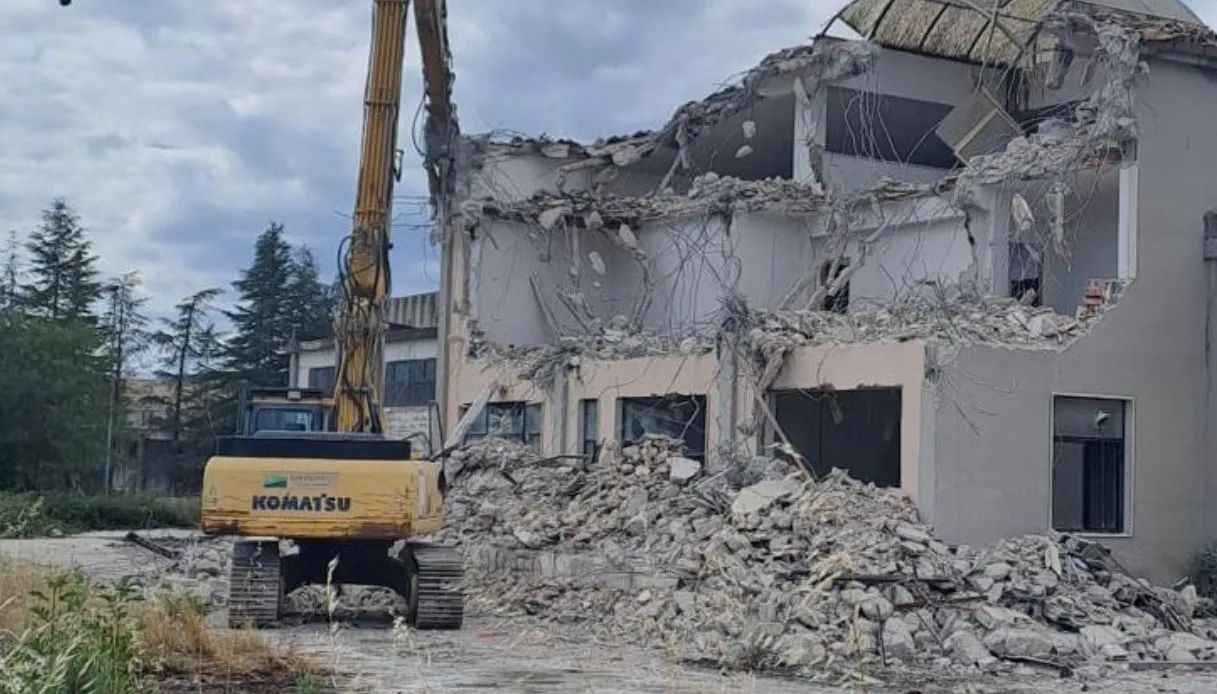
Every demolition, every excavation, every renovation operation produces waste material: concrete, bricks, asphalt, gravel, tons of aggregates which, without adequate management, end up in landfill with high costs and an environmental impact that is difficult to justify.
Inert recovery changes the perspective: those materials are not waste, but resources to be reintroduced into the production cycle. An approach that is beneficial to businesses, the environment and the entire construction sector.
What is meant by aggregate recovery?
Let’s go in order: what is meant by recovery of aggregates? Construction companies and infrastructure companies, as well as earthmoving operators, know this very well: it is the set of operations that allow solid waste materials from construction and excavation activities to be treated, processed and reused.
It is not a marginal or secondary process, but a process regulated by current environmental legislation, which distinguishes between waste destined for disposal and materials suitable for recovery. The latter include demolition debris, excavation materials, concrete conglomerate, bricks, milled asphalt and backfill.
Once subjected to appropriate processing, all these elements acquire new technical characteristics and can be reused in building and infrastructural contexts. It goes without saying, therefore, that aggregate recovery is not simply a good practice: it is an essential element of the circular economy applied to construction.
It allows us to reduce dependence on virgin raw materials, reduce construction costs and comply with regulatory obligations regarding waste management.
The materials affected by the recovery
It should be noted that, even if not all construction materials are the same, the majority of demolition and excavation aggregates are recoverable, provided that they are managed correctly from the early collection stages.
Correct management, in turn, involves the intervention and action of consolidated entities in the building and environmental panorama such as, for example, SO.CO. Ecologica Srl, which offers a complete aggregate recovery service in Potenza and throughout Basilicata, which covers the entire operational cycle.
The company has qualified personnel and equipment suitable for operating on construction sites of different sizes, guaranteeing flexibility and rapid intervention times. It can work directly on site with mobile systems or at its own collection center, depending on the customer’s operational needs.
Compliance with environmental regulations is an integral part of the service: each phase of the process is managed in accordance with current legislation regarding special waste and material recovery. This allows companies that rely on SO.CO. Ecological to operate in full regularity, without administrative risks or sanctions.
How the process works: from collection to reuse
We talked about the operating cycle, but what does it consist of? How does it happen? In fact, the recovery of aggregates is not limited to the simple transport of materials outside the construction site. It is a structured cycle that involves precise phases, each of which affects the quality and usability of the final product.
The first phase is that of collection and selection of materials: the selection allows us to separate the recoverable fractions from the non-treatable waste and to start each flow towards the most suitable treatment. A structured company is able to operate directly on site, optimizing times and reducing intermediate transport. This translates into leaner management and tangible savings for the client.
Afterwards, we move on to crushing and screening: once collected, the materials are sent to specific processes. Crushing reduces large pieces (concrete blocks, brick fragments) into granulates of controlled size. The screening separates the different dimensional fractions, eliminating non-compliant parts and guaranteeing a homogeneous and classifiable product.
These operations can be carried out both on site, with mobile systems, and at equipped collection centres. The result is recycled aggregates with measurable technical characteristics, ready for reuse.
The economic advantages for construction companies
The first aspect that pushes companies to evaluate aggregate recovery is often the economic one. The costs of disposing of construction waste are significant: sending tons of material to landfill involves storage fees, multiple transports and administrative burdens that weigh on the construction site budget.
Sending the material for recovery reduces (or eliminates) these costs, and in many cases allows you to obtain recycled aggregates at a lower price than that of virgin raw materials. Two savings that add up: less expense for disposal and less expense for the purchase of new materials.
There is a third advantage, often underestimated: logistical simplification. An integrated service that manages the collection, treatment and return of processed materials reduces the number of suppliers, the authorizations to manage and the operational variables of the construction site. Less complexity, more efficiency.
The environmental value of aggregate recovery
The construction sector is among the main producers of waste in Europe. Construction and demolition waste represents a significant share of the total generated at a continental level, a part of which can be significantly reduced through recovery-oriented management.
When aggregates are recovered and reintroduced into the production cycle, measurable environmental benefits are obtained: reduction in the volume of waste sent to landfill; less extraction of virgin raw materials (gravel, sand, crushed stone); reduction in emissions linked to transport to disposal plants; contribution to the circular economy objectives envisaged by European and national legislation.
For companies, operating in a sustainable way is no longer just an ethical choice: it is an increasingly relevant requirement in the tender, accreditation and communication phases towards public and private clients.