Garlic European Swimming Championships 2026 of Paris, which began on July 31st, there is also space for dives from great heights (high diving)with the races scheduled for 7 and 8 August on the Seine. In this edition, both men and women will dive from one 20 meter high platforma different choice than the international World Aquatics competitions, where men normally compete from 27 meters and women from 20 meters. Even from this height (albeit reduced) the athletes reach speeds of approx 70 km/h before entering the water. Unlike the classic Olympic dives from the 10 meter platform, in high diving every detail is designed to guarantee the safety of the athletes, from the height of the platforms to the presence of divers ready to intervene in case of emergency.
From the Olympic 10 meters to the 27 meters of high diving
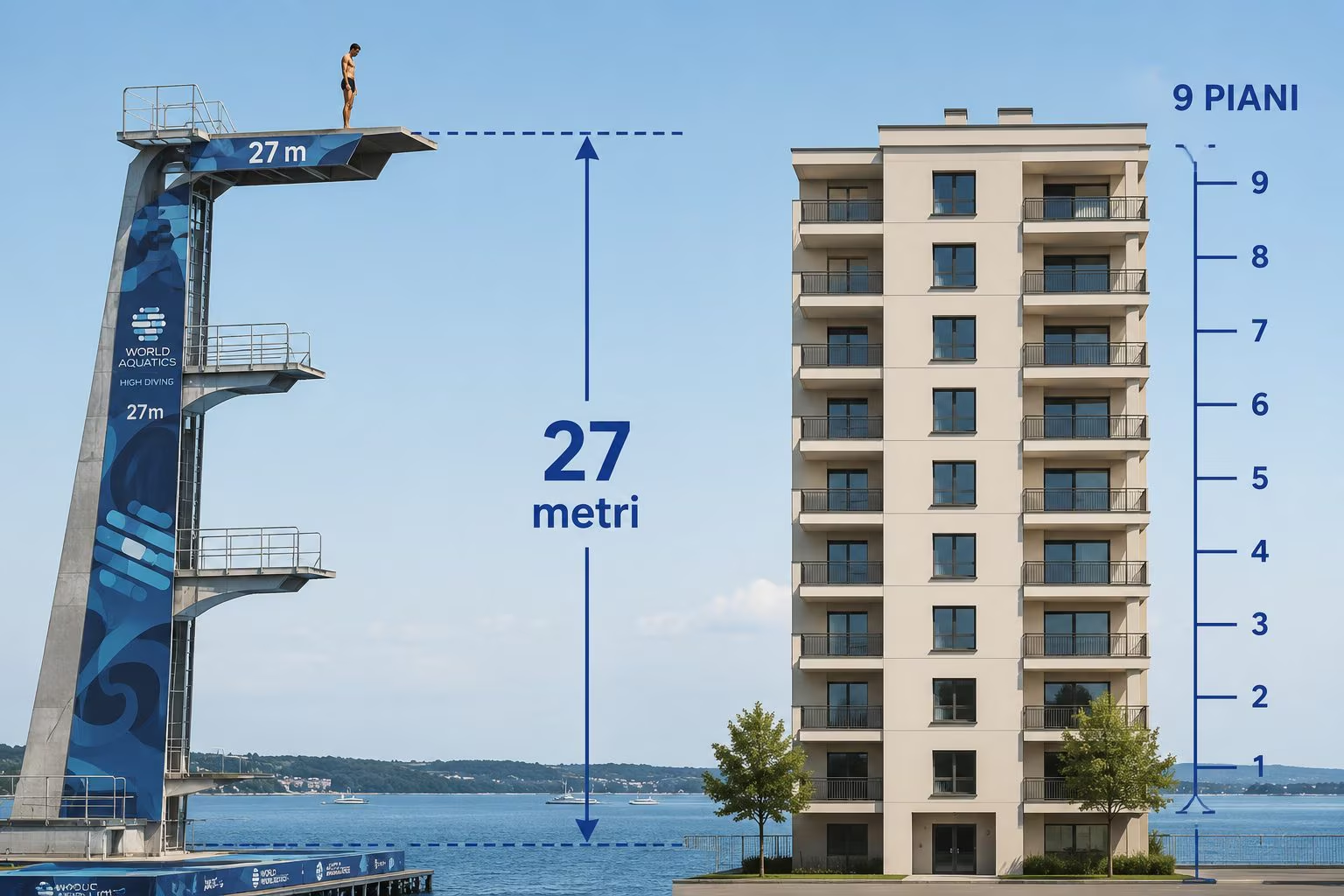
Those who follow the Olympics are used to seeing divers launch themselves from the 10 meter platform, but in high diving the heights are almost three times higher. In competitions organized by World Aquatics, men compete from 27 meterswhile women give 20 meters. These heights arise from the evolution of cliff divingdiving from natural cliffs, and represent the best compromise between spectacularity and safety: further increasing the height would mean increasing the speed of entry into the water and making it much more difficult to control the body during flight. To understand how tall these platforms are, a comparison is enough: 27 meters corresponds to the height of a building of approximately nine floorsor almost three 10 meter Olympic platforms.
Even the way of entering the water changes completely between the two disciplines. In Olympic diving, athletes almost always end with a header to reduce splash and get a better score. In high diving, however, entry takes place exclusively with your feetkeeping the body perfectly aligned. In fact, at speeds above 80 km/h, a head-on entry would entail an extremely high risk of serious spinal injuries.
In just over two seconds the speed is exceeded 85 km/h
Before the jump, each athlete follows their own routine, during which it is common to see the divers drying themselves carefully and throwing the towel from the platform to check the direction and intensity of the wind. Many athletes also dedicate a few seconds to mental visualization, retracing in their mind every phase of the jump, from the run-up to the entry into the water. This technique is widely used in precision sports and helps improve concentration and control of movements.
From the moment they leave the platform until they enter the water they spend approx 2.3 seconds. In this interval the athletes accelerate due to the effect of gravity and, starting from 27 meters, reach a speed of approximately 85 km/h. The most complex part is being able to control the body during flight: in just over two seconds the diver must complete somersaults and twists, constantly maintaining control of his orientation in space. In the final moments he identifies the surface of the water, stops the rotations, realigns the body vertically and stiffens his legs and ankles to prepare for the impact. All this happens thanks to a combination of experience, muscle memory and proprioception, i.e. the ability of the nervous system to perceive the position of the body in space at any moment. It is precisely this precision, even more than the acrobatic component, that makes high diving one of the most difficult disciplines of water sports.
What are divers used for during competitions?
One of the most characteristic images of high diving competitions is that of divers that await the athletes beneath the surface of the water. After a dive from 20 or 27 meters, even a perfectly trained athlete can remain disoriented for a few moments due to the violence of entering the water. In the event of an entry that is not perfectly vertical or a loss of consciousness, intervening in the first seconds is essential. For this reason, the divers remain in the water throughout the race, ready to immediately reach the athlete and accompany him to the surface.
The competition field must also comply with very rigorous requirements. The water entry area must have a depth of at least 5 metersbe free from obstacles and maintain conditions that are as stable as possible. Before the start of the competitions, wind, currents and visibility are also monitored, because even small variations can influence the diver’s trajectory.
A young sport, but already among the most spectacular
Although cliff diving has very ancient origins – a tradition known to Hawaii with the name of lele kawa it has been practiced for centuries – high diving as an international sport is much more recent. World Aquatics has included it in the program for the first time World Swimming Championships in 2013helping to transform a spectacular practice into a regulated sport, with standard platforms, judging criteria and shared safety protocols.
Today judges evaluate both the quality of execution be it difficulty of the diveconsidering the precision of the rotations, the posture during the flight and above all the quality of entry into the water. Despite its growing popularity, high diving it is not yet part of the Olympic programwhile he is now a regular presence at the World and European swimming championships.