The central banks of dozens of countries are accelerating the process of de-dollarization of foreign exchange reserves, systematically increasing the share of physical gold within their balance sheets. The push comes from China, Russia and the emerging bloc, but the dynamic now has a structural and not cyclical nature.
For Italian savers the signal is relevant: when institutional actors rebalance theasset allocation towards gold like hedge against the erosion of purchasing power and the volatility of bond markets, the logic also applies at the private portfolio scale. It is logical, therefore, to ask whether it is correct to look at investment gold as a solution to protect one’s savings and whether it still makes sense to invest today or is it already too late?
Investing in gold today
In fact, according to many observers, the trend has not ended. In fact, gold continues to be considered a strategic asset, capable of protecting capital and, in some market phases, also offering growth opportunities. This is due to a whole series of factors: first of all it does not generate coupons or dividends, but it remains one of the most requested by institutional managers globally.
The reason is clear: unlike a bond, it does not incorporate the credit risk of an issuer and, unlike a stock, it does not depend on the profitability of an individual company. It is an autonomous asset, with global liquidity and transversal demand, which tends to appreciate in cycles of contraction of confidence in traditional markets.
Why is gold considered a safe investment?
Starting from what has been said, it should also be specified that gold is historically the safe haven par excellence. In times of crisis or instability, it tends to maintain its value and protect purchasing power over time. Among the main advantages are the protection from inflation and its independence from governments and financial systems.
Furthermore, it is a physical and tangible asset that maintains value even in complex scenarios. In recent years, however, it has recorded very significant growth, in some cases even around 30% per year. Dynamics linked not only to global uncertainty, but also to strong demand from the central banks of several countries, which are increasing their gold reserves to strengthen currencies.
What is investment gold and what does it look like?
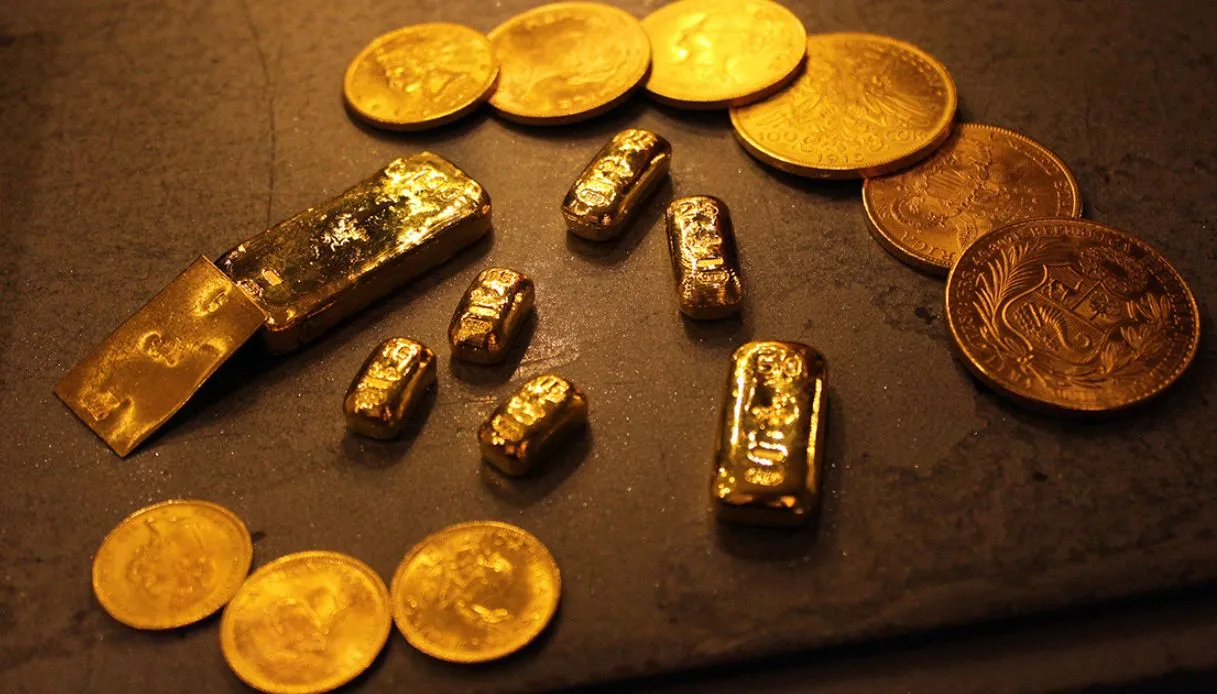
Let’s now get to know the material, the metal, which can be useful especially to those who are approaching investment gold for the first time. Let’s start from an assumption: not all gold is the same. When we talk about investment gold, we are referring specifically to gold with high purity, above 900 parts per thousand, which mainly comes in two forms: ingots (or slabs) of various sizes and gold coins (such as pounds, marenghi, Krugerrands, dollars or pesos).
One of the most frequent questions when thinking about this investment is precisely that relating to the format: is gold bars or coins better? In reality, the answer depends on your goals. In fact, ingots are ideal for pure investment. The ingot is the most direct form of exposure to gold: its cost reflects exclusively the weight and purity of the metal, without surcharges linked to numismatic or aesthetic factors.
This makes it a transparent instrument, where the value is entirely determined by the international price. In terms of financial efficiency, bullion guarantees a more contained spread compared to other forms of physical gold: the gap between purchase price and repurchase price has less impact on the overall return. Over long time horizons, this compression of implicit costs translates into greater efficiency in the long run, for the same exposure to the metal.
Investment gold coins, on the other hand, combine the intrinsic value of the metal with a form that is universally recognizable on international markets: they are instruments with a consolidated circulation history, which makes them more easily recognizable and resalable to professional operators all over the world.
Their most relevant feature on a practical level is flexibility: the smaller and more flexible denominations allow you to modulate the investment according to your availability and to disinvest selectively. This translates into greater ease of even partial liquidation, without having to mobilize the entire capital invested in a single operation.
A balanced strategy can include both solutions, combining efficiency and flexibility.
The best strategy for buying investment gold
Apart from the safety of the investment and the knowledge of the formats, there is one fundamental thing to know if you are thinking of investing in gold: the best strategy is and will always remain to buy gold only from operators authorized by the Bank of Italy, such as Gioielleria Delfino (which has headquarters in via Corsi 7r and in corso Italia 118r in Savona and in Via Pertica 28 in Finale Ligure).
Relying on qualified professionals guarantees authenticity and certified purity, but also transparency in prices and correctness in purchase and sale operations. A consultative approach, and not just a commercial one, is essential to orient yourself correctly.
Physical gold: is it really worth it? The advantages (including fiscal ones)
If you are guided by a qualified operator, investing in physical gold means purchasing a real, compact asset that can be easily stored and resold at any time. From a tax point of view it presents important advantages that distinguish it from most traditional financial instruments. Investment gold is exempt from VAT, unlike silver and other precious metals.
It does not involve any management or “maintenance” costs: once purchased, it does not generate recurring expenses, maintenance fees or administrative charges. Taxation applies only to the capital gain at the time of sale, and only if the sale occurs within five years of purchase. This means that once purchased, there are no additional costs for the investment to mature: time works in favor of the holder, not in favor of intermediaries or managers.
Can purchased gold be taken home?
Being a real asset, one of the main advantages of physical gold is the possibility of taking direct possession of it. Those who purchase ingots or coins obtain direct possession of the asset, without depending on digital platforms, financial institutions or third-party corporate structures.
This opens up various storage options, which can be calibrated according to your needs and the value of your assets: gold can be stored at home, for example in a safe, kept in a bank safe deposit box or entrusted to professional certified storage services.
An often underestimated aspect concerns the physical dimensions of the metal: even significant assets take up little space. A 1kg bar is extremely compact and discreet, representing significant value in a minimal footprint. This feature makes it one of the most efficient physical assets to hold, regardless of the custody method chosen
An asset that can be resold
Finally, one last very important point must be considered: gold is one of the most liquid assets in the world. Unlike a property, which can take months to sell, or illiquid financial instruments tied to specific maturities and market conditions, physical gold knows no blocks or forced waits.
Bullions and coins can be sold at any time to authorized professional operators, with quotes updated in real time which guarantee full transparency on the value of the transaction. Precisely for this reason, in addition to the purchase, it is essential to have a qualified contact also for the sale.
It’s not just about finding a buyer: it’s about identifying the most appropriate moment, based on your financial, tax and liquidity needs. An expert operator knows how to read market conditions and accompany the client in both phases of the investment.