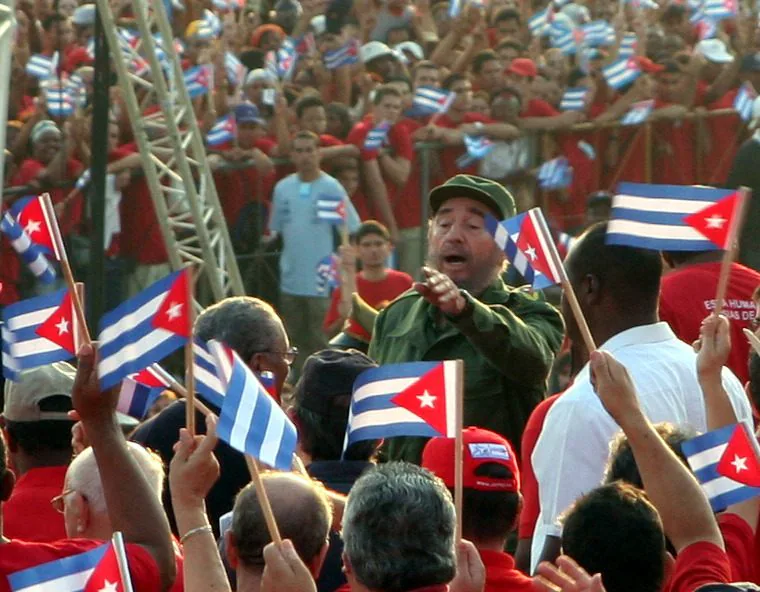
Fidel Castro Ruz, born in Birán in 1926 and died in Havana on 25 November 2016, was a Cuban politician and revolutionary, leader of the country from 1959 to 2006 (the year in which, for health reasons, he delegated the role to his brother Raúl). He was interested in politics from a young age and in the 1950s he organized a revolutionary movement against the dictatorship of Fulgencio Batista. In 1959, thanks to the triumph of the revolution, he assumed power.
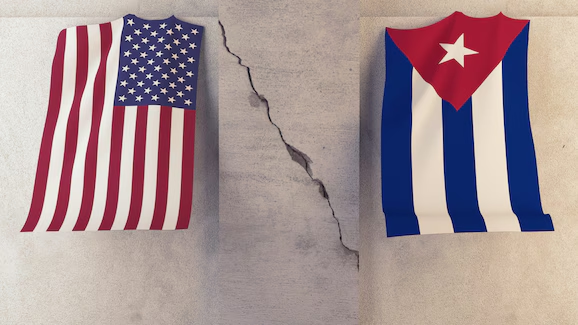
His government introduced important economic and political reforms, but used an iron fist against his opponents. He also had to face hostility from the United States and thus became closer to the Soviet Union. Fidel Castro remained at the helm of Cuba for many years and managed to retain power even after the collapse of the USSR in 1991. Between 2006 and 2011, now elderly, he handed over power to his brother Raúl Castro. He died at the age of 90 in the Cuban capital on November 25, 2016.
Young Fidel: the beginning of his political career
Fidel Alejandro Castro Ruz was born in the town of Birán, in the then province of Oriente (now the province of Holguín) on 13 August 1926. He was the son of a rich landowner, with whom he had very difficult relationships. He spent his childhood in Santiago de Cuba and in 1945 he enrolled in law school in Havana. As a student, he became involved in politics and became interested in conditions in Cuba.
The island had to face many difficulties because, in addition to suffering strong influences from the United States, it was characterized by the corruption of the ruling class. Castro participated in numerous student protests, developing anti-imperialist and left-wing political beliefs. He approached the Partido Ortodoxo, with socialist tendencies, and stood out for his charisma.
In 1948 he married Mirta Diaz Balart, with whom he had a son, Fidelito. In 1950 he obtained a law degree.
The assault on the Moncada barracks
In 1952 a coup d’état brought Fulgencio Batista, already president in the 1940s, to power. Castro, still a member of the Orthodox Party, decided to switch to armed struggle and gathered more than a thousand followers around him. On July 26, 1953, he launched an assault on the Moncada barracks in Santiago de Cuba. The aim was to stock up on weapons and start a guerrilla movement. The assault, however, failed, many revolutionaries were killed and others, including Castro and his brother Raúl, were arrested. Tried for rebellion, Fidel Castro delivered a memorable defense speech, which ended with the words “history will absolve me”.
He was sentenced to 15 years in prison and confined in a prison on the Isle of Pines, but in 1955 he was released thanks to an amnesty and took refuge in Mexico. Having separated from his wife in the meantime, he began several relationships, including the one with Dalia Soto della Valle, who bore him five children and in 1980 became his second wife.
The Cuban revolution
In Mexico, Castro immediately resumed the organization of the revolutionary movement, renaming the group he headed the 26th of July Movement. His brother Raúl and other Cuban exiles were beside him. He also came into contact with a young Argentine doctor, eager to join the revolution: Ernesto Che Guevara. The revolutionary group, composed of 82 people, reached Cuba aboard the ship Granma in December 1956 and began the guerrilla war, establishing its headquarters on the Sierra Maestra, a mountain range in the eastern part of the island. In less than three years the revolution, thanks to the population’s discontent with the Batista regime, managed to triumph: in January 1959 Fidel Castro entered Havana and assumed power.
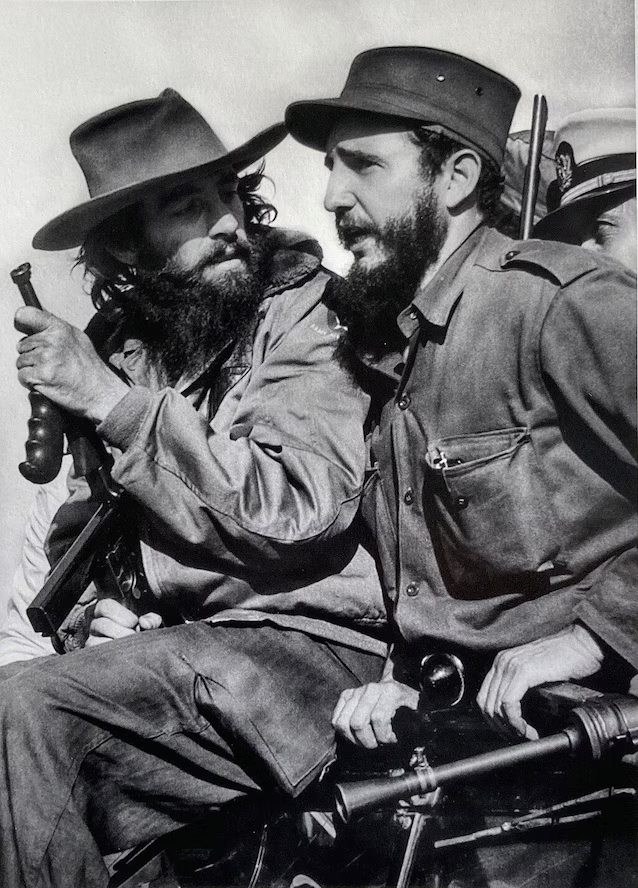
After a transition phase, in which he tried to include representatives of other political forces in the management of power, he established a dictatorship of the 26th of July Movement and had numerous opponents sentenced to death. The new government immediately launched an agrarian reform and introduced other measures to support the poorest population, committing itself particularly to the fight against illiteracy, which almost completely disappeared. The Castro government’s measures, however, harmed the interests of the richest Cubans and US companies.
The Bay of Pigs and the Missile Crisis
Castro’s economic policy and his anti-imperialist attitude aroused strong hostility in the United States, where Cubans opposed to the revolution had taken refuge. In 1961, President Kennedy gave his approval to the invasion of the island by Cuban exiles, supported by the CIA, with the aim of overthrowing Castro’s government. About 1,500 exiles landed at the Bay of Pigs, near Playa Girón, on April 17. Castro personally assumed command of military operations and managed to repel the invasion, also because Kennedy refused to use the US air force. The victory at Playa Girón increased Castro’s popularity not only in Cuba, but throughout Latin America.
To react to the hostility of the United States, the Cuban government approached the Soviet Union, which in 1962 installed medium-range ballistic missiles on the island, capable of hitting US territory. The Kennedy administration reacted harshly, threatening to invade Cuba. Thus began a dangerous international crisis, which ended with an agreement: the United States committed not to organize new invasions of Cuba and to remove their missiles in Turkey in exchange for the withdrawal of Soviet missiles from the island. Cuba’s belonging to the Soviet camp was no longer questioned. In 1965 the 26th of July Movement, together with other parties, created the Communist Party of Cuba, of which Castro was appointed secretary.
The consolidation of the Cuban revolution and the special period
After the missile crisis, Fidel consolidated his power. Cuba, despite being a small country and subject to the United States embargo, managed to play an important role on the international scene and sent its armed forces to support revolutionary movements in several countries, including Angola. It also equipped itself with a cutting-edge healthcare system, guaranteeing medical care for all citizens and even managing to send its doctors abroad during health crises. Inequality in the country decreased, although living standards did not reach Western levels. The Cuban economy, moreover, was dependent on the Soviet Union, which purchased goods at increased prices. Fidel, however, enjoyed the support of the population.
In the 1990s, the collapse of the Soviet Union risked the collapse of socialism in Cuba too, because the United States tightened the embargo, hoping to overthrow Castro’s government. The so-called special period began, during which Cubans faced serious economic difficulties. Surprisingly, the regime managed to resist and, gradually, the country emerged from the crisis. In 1996 Castro visited Italy and two years later received a visit from John Paul II in Cuba.
The handover of power and the death of Fidel Castro
In the 2000s, Castro’s health – now elderly and always an avid cigar smoker – began to deteriorate. Between 2006 and 2011 he handed over, in several steps, his powers to his brother Raúl, who had been one of his closest collaborators since the time of the assault on the Moncada barracks.
One of Fidel’s last political acts was meeting Pope Francis, who was visiting Cuba, in 2015. On August 13, 2016, he appeared in public on his ninetieth birthday. He died the following November 25 in Havana and was buried in Santiago de Cuba.