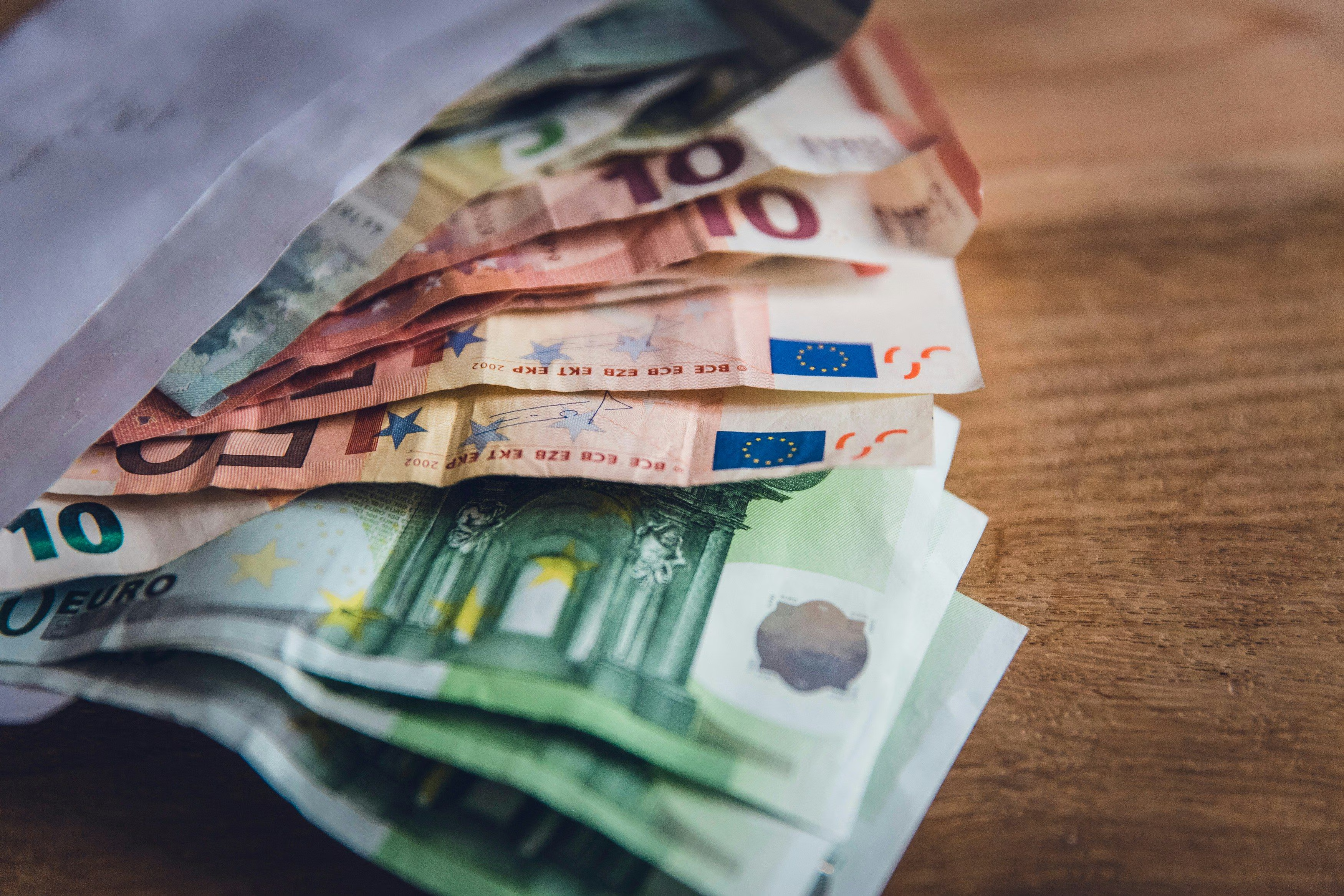
In the South there is less money in the bank than in the North, but not because people save less. In June 2026, Italian families had 1,194.7 billion euros in current accounts, deposits and postal savings accounts, approximately 20,268 euros each: from 23,129 euros in the North-West to 13,645 in the Islands, according to statistics from the Bank of Italy. However, if you compare these deposits with family income, the gap almost disappears: in every area of the country there is the equivalent of approximately 10 and a half months of income in the account.
The real difference between the various macro areas investigated lies elsewhere. Outside the current account, in government bonds, funds and shares: a person from the North-West has on average 37,452 euros, a person from the South 7,802. And inflation weighs on everything: since 2021, deposits have grown by 3.9%, but net of price increases they are worth around 14% less.
How many months of income do Italians in the North, Center and South have in the bank
The comparison starts from two official sources. The deposits are those of consumer families, including postal savings, registered by the Bank of Italy as of 30 June 2026; the population is that resident on 1 January 2026 as recorded by Istat. The income is the disposable income per inhabitant that Istat estimates in the territorial economic accounts: in 2024 it was 27,100 euros in the North-West, 25,900 in the North-East, 24,100 in the Center and 17,800 in the South.
Dividing deposits by monthly income, the result is almost identical everywhere: 10.2 months in the North-West, 10.5 in the North-East, 10.6 in the Center and 10.7 in the South. In proportion to how much they earn, a family in the South has as much in the bank as one in the North. The distance in deposits almost entirely mirrors that in incomes.
The same gap emerges from tax returns. For the 2024 tax year, the Ministry of Economy records an average income of 25,820 euros, from 30,200 in Lombardy to 19,020 in Calabria. The average income from employment is 24,250 euros: approximately 2,000 euros gross per month on twelve monthly payments.
Rental income: how much it is worth and where it is concentrated in Italy
Alongside salaries there is a source of income that does not come directly from work: rent. In 2024, according to the MEF analysis of Irpef declarations, 19.6 million taxpayers declared 26.6 billion in income from ordinary taxed buildings. Added to these are 23.4 billion in flat rate fees, declared by approximately 3.3 million people. In total, there are around 50 billion a year, equal to 8.5% of what Italians declare as employees (585.5 billion).
The 21% coupon, used for free rent and for the first short-term rental property, is chosen above all in Lombardy, where 22.7% of those who apply it are concentrated. The 10% rate, due to the agreed rents, is more widespread in Lazio (17.6%). However, the fastest growth is in the South: between 2023 and 2024 flat rate incomes increased by 13.5% in the Islands and by 9.1% in the southern regions, against the national 8.4%.
It’s not just large owners: almost half of those who apply for the tax rate declare a total income of between 20 thousand and 50 thousand euros. For many families, an inherited apartment or second home is a supplement to their salary.
Securities, funds and shares: because in the North money comes out of the bank account
As we have already explained previously, the real difference between North and South is made by the banks that hold government bonds, bonds, shares and fund units for families: the so-called indirect collection. In June 2026, according to the Bank of Italy, it was worth 1,299 billion for families and non-profit institutions, more than deposits. But it is distributed very differently: 37,452 euros per inhabitant in the North-West, 27,370 in the North-East, 19,830 in the Center and 7,802 in the South.
Thus in the North-West deposits are only 38% of the financial savings held in banks, while in the South and on the Islands they exceed two thirds (67%). Adding up accounts and securities, a person from the North-West has the equivalent of almost 27 months of income saved up, a person from the South 16.
This is why the North seems “still” in the deposit rankings. Since June 2021, securities held for families have grown between 56% and 71% in all areas, also due to the price trend. In the same period, deposits in the North-West remained almost unchanged (+0.4%). With the rise in rates from 2022, government bonds have returned to yield, while family current accounts pay an average of 0.09% per year under 50 thousand euros.
Interest, dividends and capital gains are almost always taxed at source and do not appear on tax returns. Those who have investments therefore receive an income that salary statistics do not record in a timely manner.
Inflation, deposits and salaries: how much they have lost since 2021
The growth of deposits also hides another problem: inflation. Between June 2021 and June 2026, household deposits increased by 3.9% in nominal terms, according to the comparison between Bankitalia statistics for 2021 and those of 2026. In the same period, consumer prices increased by approximately 21% (our calculation on the annual changes in June of the Istat NIC index; in June 2026 inflation was at 3%). Net of price increases, money in the bank is worth around 14% less.
The loss is stronger where deposits have grown less: -17% in the North-West, -15% in the North-East, -14% in the Centre, -11% in the South, -9% in the Islands. The “run” of deposits in the South is therefore not an enrichment, but a more limited loss of purchasing power. Demography also has an impact: in 2025 the South lost 3.1 per thousand of its residents, and this slightly inflates the values per inhabitant.
Salaries have only partially held up. According to Istat, hourly contractual wages grew by 11.3% between December 2021 and December 2025. Only in 2024 and 2025 did they rise more than prices: +3.1% per year, against 1.7% harmonized inflation in 2025. With an account that yields 0.1% and prices that grow by 3%, 20 thousand euros left unchanged they lose around 600 euros of purchasing power in a year.
The average is deceiving: who really owns the wealth in Italy
All these averages tell only part of the story. According to the distributional accounts of the Bank of Italy, at the end of 2025 the richest 10% of families owned 60.6% of net wealth, while the less well-off half stopped at 7.2%. For these families, over 90% of what they own consists of the house (73.6%) and deposits (17.5%). In the higher ranges, however, the assets are diversified between shares, funds and securities.
The current account, in other words, is the savings of those who have less: liquid and safe, but which does not allow you to truly create wealth. It is here that territorial and social reading meet and collide. The South does not save less in proportion to income, but keeps its money in the form that inflation erodes the most. In the North, however, a much larger share works as capital and produces income. The same mechanism that concentrates wealth in the hands of a few, as also shown by the Oxfam report on inequality in Italy.
This is why the increase in deposits in the South, alone, is not a sign of convergence. Without higher incomes and tools that bring savings towards productive investments, that liquidity remains stagnant and loses value year after year.