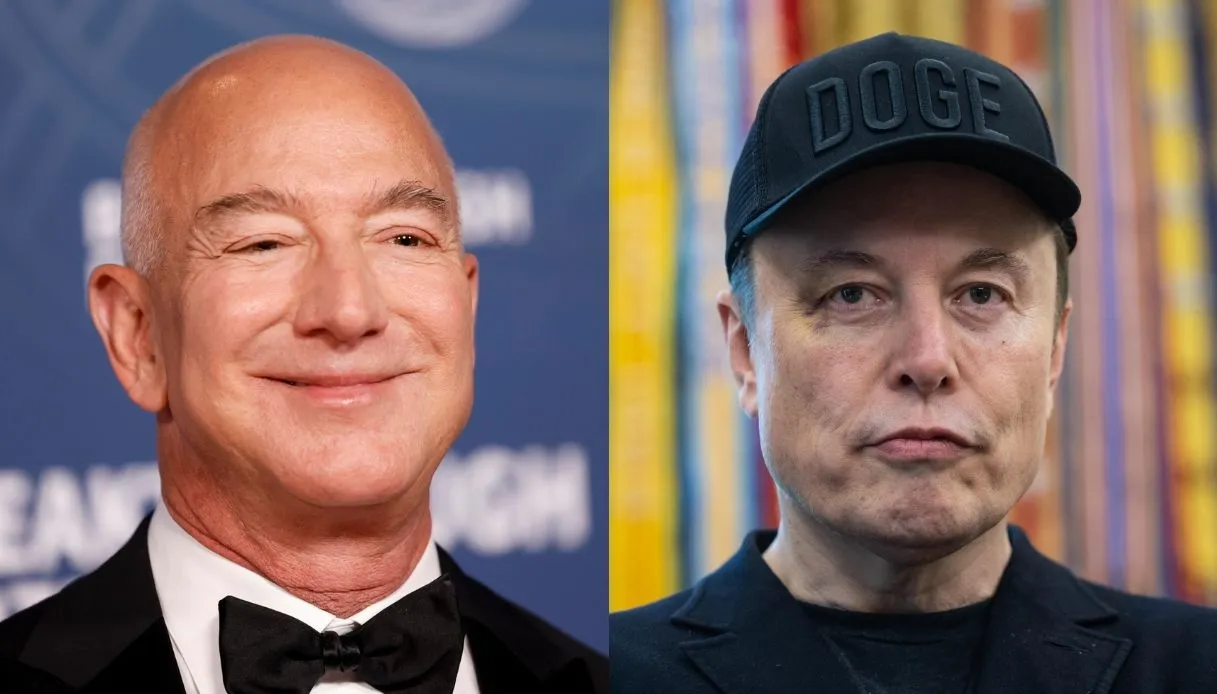
The challenge between Elon Musk and Jeff Bezos is increasingly shifting from the conquest of space and technology markets to that of stock valuations. In 2026 the comparison also moves to the stock market, with investors trying to understand which of the two empires – SpaceX or Amazon – has the best chance of growing in the coming years.
For Amazon, the main driver of the new phase of growth is Amazon web services, while for SpaceX the market looks above all to Starlink, space activities and new exposure to artificial intelligence.
Amazon and SpaceX shares compared
On the one hand there is SpaceX, a company founded and led by Musk, which landed on the stock market in the summer of 2026 and is characterized by very rapid growth, but also by strong volatility and enormous investments. On the other there is Amazon, the giant founded by Bezos, listed for years and today supported above all by the extraordinary expansion of the Amazon web services cloud business, AWS.
But where is it best to invest? The analysis today is interesting because the two companies represent two very different growth models:
- Amazon stock (Amz) is currently benefiting from Wall Street’s positive expectations linked to AWS’ growth prospects. Morgan Stanley expressed a favorable opinion, confirming an “overweight” recommendation (i.e. better performance than the average of the market or reference sector in the medium-long term) and a target price set at $335. Furthermore, the most optimistic scenario outlined by the investment bank foresees even more marked growth, with the possibility that the value per share reaches 500 dollars by the end of 2027. This eventuality would materialize if the AWS cloud division managed to expand its business volume to generate around 1,000 billion dollars in annual revenues;
- SpaceX, on the other hand, presents a completely different profile. Elon Musk’s company, listed in 2026 according to the information underlying the comparison, has shown very high volatility since the first months. After reaching a peak, the stock lost over 20%, before recovering some ground. The price indicated in the analyzes considered is around 140 dollars, while JP Morgan has identified a possible target of 240 dollars. If achieved, it would mean an increase of more than 70%, while the average analyst target is around $221. The operating data also shows a company experiencing strong acceleration. Quarterly revenue nearly doubled from the same period a year earlier, reaching $7.8 billion. Starlink recorded 66% growth and the number of subscribers reached approximately 12 million.
Amazon is trying to leverage artificial intelligence to increase the profitability of an already established business, while SpaceX is investing huge amounts of capital to build new businesses capable of supporting a very high valuation. Elon Musk’s company would have spent around 18 billion dollars on capital in the second quarter alone, while Jeff Bezos in the second quarter AWS recorded revenues of 42.2 billion dollars, up 37% on an annual basis. The division’s operating profit rose 63% to $16.6 billion, representing about 60% of Amazon’s overall operating profit.
Musk vs Bezos, who grows more
If you look exclusively at the speed of growth, today SpaceX’s story is more sustained, and this is also because the company starts from a much smaller base than Amazon. As a result, it can see much higher percentage increases.
Furthermore, Musk has indicated an extremely ambitious goal, to bring annualized turnover to around 100 billion dollars by the end of 2026, starting from just over 30 billion. If such a trajectory were confirmed by future results, the market could continue to give the company a very high valuation.
Growing quickly, however, does not necessarily mean creating value for shareholders. On the contrary, it is precisely here that the first risk factor emerges. If to increase revenues a company must make increasingly larger investments, it is necessary to verify how much of that growth actually remains in the form of profit and cash.
Amazon, on the other hand, does not have to convince investors of the existence of a profitable business model, because it has already demonstrated it. The question is how much more it can grow. If its cloud continues to benefit from the spread of artificial intelligence, it could maintain sustained growth without having to rely solely on e-commerce.
Where it is best to invest
Currently, Amazon and SpaceX represent two different risk profiles. The investment choice, therefore, depends above all on:
- the time horizon;
- the ability to withstand strong oscillations.
Amazon appears best suited to those seeking exposure to the growth of artificial intelligence through an already established and profitable company. SpaceX presents even higher potential, but also a higher level of risk.