On 4 September 476, the barbarian leader Odoacer deposed the last Western emperor, the young Romulus Augustulus, and, instead of appointing a successor, sent the insignia of imperial power to Constantinople, recognizing the Eastern one as the only legitimate emperor. The event is considered the moment of the fall of the Western Roman Empire, the western part of the Roman Empire officially born in 395 AD with the death of Emperor Theodosius I – as opposed to the Eastern Roman Empire. At the time of the events, however, no one perceived the deposition of the emperor as a significant change and only as the years passed was it recognized as an important event. Today historians recognize the continuity between before and after and consider the fall of the empire as a gradual process.
The date of 4 September 476 AD is therefore only a convention, although the deposition of Romulus Augustulus and the end of the succession of emperors constituted a fracture at least on a symbolic level.
What happened on September 4, 476 and who defeated the Western Roman Empire
September 4 is the conventional date that marks the fall of the Western Roman Empire. In the most widespread subdivision of historical eras, the date represents the end of the ancient age and the beginning of the Middle Ages.
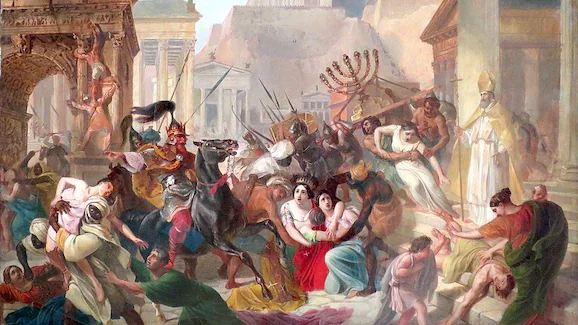
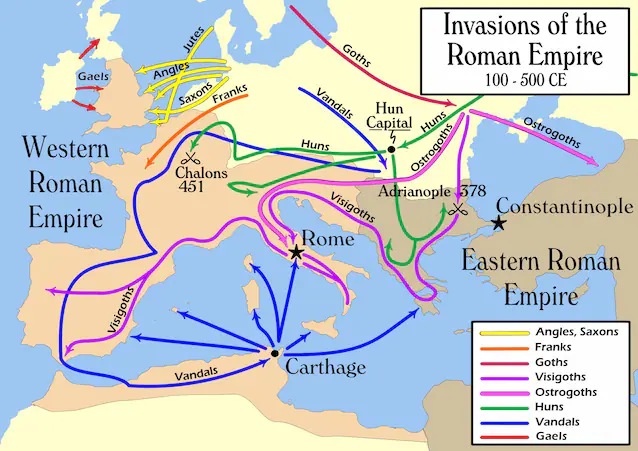
To understand what really happened on 4 September 476 it is necessary to consider the conditions the Empire was in. Since the 4th century, the territory had been divided into two large independent sectors: the Western empire and the Eastern one, with Constantinople as its capital. The Western empire in the 5th century was reduced to a shadow of itself: it controlled only the Italian peninsula and had to face economic difficulties, political instability and attacks by barbarian peoples. Even the city of Rome was not safe, to the point that in 410 it was sacked by the Visigoths led by King Alaric: it was the first invasion of the eternal city since the attack of the Senone Gauls in 390 BC. C., that is, 800 years before.
In the 5th century the empire formally continued to exist, but the power of the emperors was greatly reduced. The real holders of authority were the barbarian military commanders, who could depose emperors at will.
In 476 Odoacer, leader of the mercenary militias, led a revolt against the emperor, the fourteen-year-old Romulus Augustulus (who was acting on behalf of his father, the general Flavius Orestes). However, unlike other barbarian leaders, after deposing him he did not appoint a new emperor, nor did he assume the imperial title for himself, but sent the insignia of imperial power to Constantinople, recognizing the one of the East, i.e. Zeno, as the sole emperor. The latter at the time accepted Odoacer’s “coup d’état”, recognizing him, in fact, as his representative in Italy.
The deposition of Romulus Augustulus was not a traumatic rupture, but it marked the end of the succession of Western emperors and had long-term consequences.
What did the deposition of the last emperor represent: the perception of collapse
At the time, almost no one perceived the change that Odoacer’s choice entailed. Only starting from the 6th century did some intellectuals recognize that the deposition of Romulus Augustulus represented a significant event. No one, however, thought that the Empire had collapsed: in fact, the Eastern Empire (at the time simply called the Roman Empire) survived, which represented continuity with the past.
The idea that 476 constituted a change in civilisation, with the collapse of the ancient world and the beginning of the “dark ages” of the Middle Ages, became established only in relatively recent times, starting from the eighteenth century and the Enlightenment, and today it is considered only a convention: it serves to divide historical eras, but it is not considered a radical fracture.
The causes of the fall of the empire: a slow process of internal and external crises
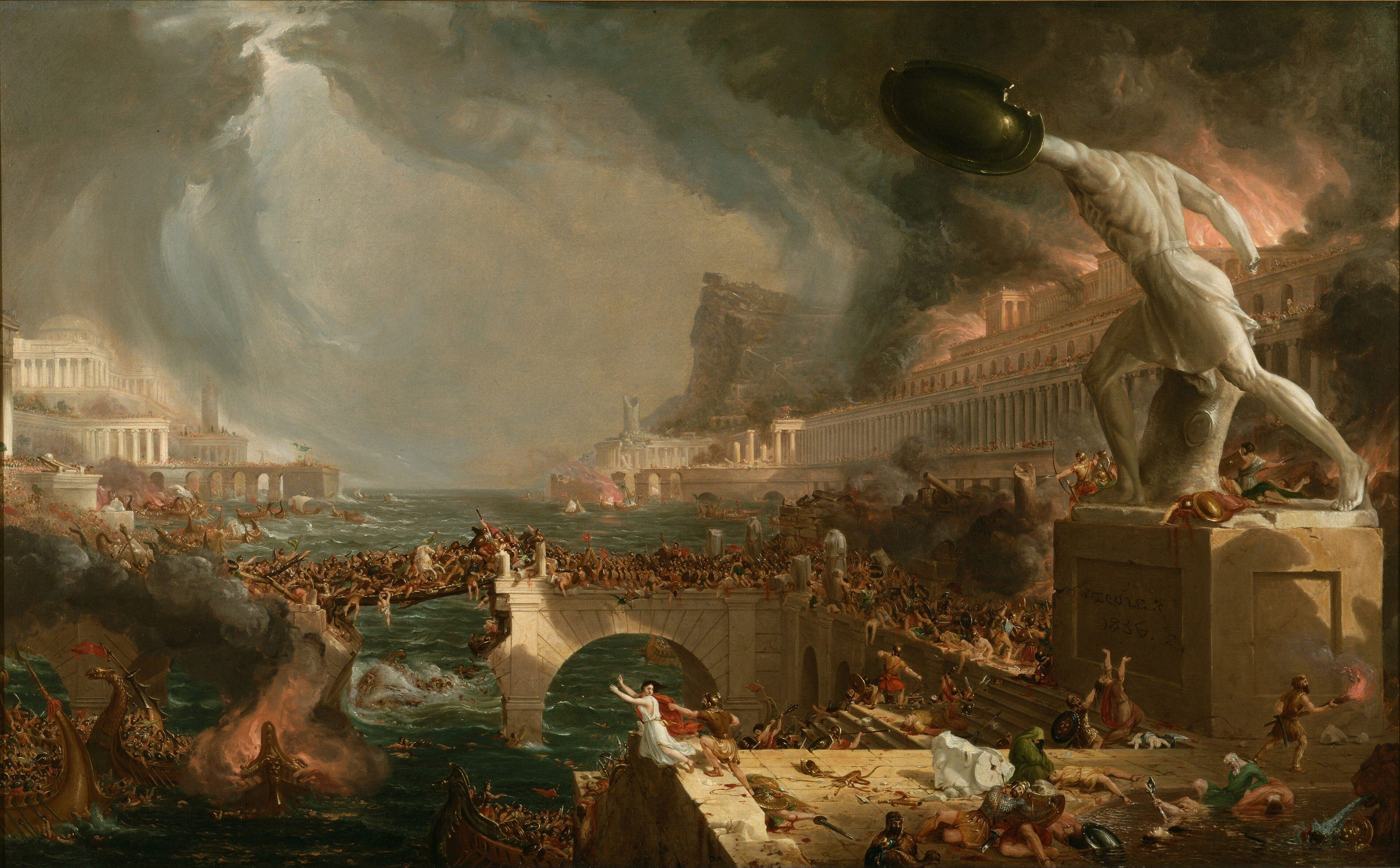
The most authoritative historiography recognizes that the fall of the empire was a gradual process, in which external reasons (the rise of barbarian peoples) and internal causes (economic-social crisis, political instability, etc.) were associated, causing, between the 4th and 5th centuries, a slow but inexorable erosion of imperial power, the end of which led Western Europe to be divided into various Roman-barbarian kingdoms.
Furthermore, historians also underline the continuity between before and after: in 476 a world did not collapse to make room for a new one and many things remained unchanged. It is no coincidence that the concept of late antiquity was introduced in the 1970s to designate the period roughly between the 4th and 6th centuries AD. C., in which we gradually passed from the ancient world to the Middle Ages: an era marked by the fall of the last Western emperor, but also by the continuity of numerous economic, social and cultural characteristics.