Every year, at the end of August, tens of thousands of people meet in the Nevada desert to build a temporary utopian city from scratch which, after just over a week, is made to disappear, without a trace, by those who built it and inhabited it for a few days. More than a festival, it seems to be a sort of social experiment, as well as an open-air museum of art and architecture. Its name, Burning Man, derives from the ritual of burning the wooden man (“the Man”) which closes each edition.
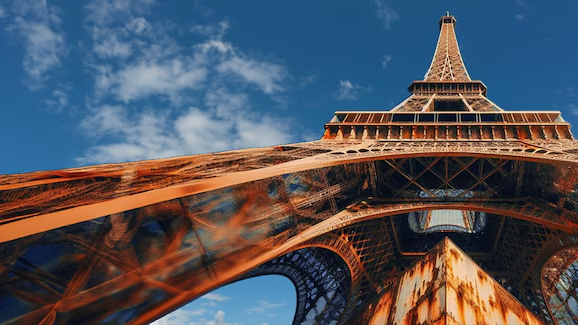
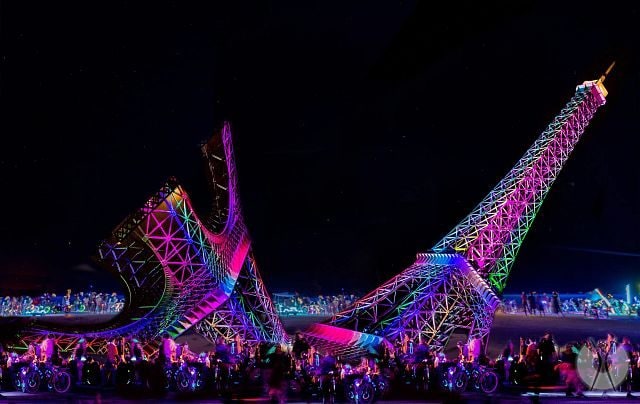
Also this year the themed gathering Axis Mundi (the axis of the world that in mythology connects the earth, the sky and the underground world) takes place in the Black Rock Desert, an ancient dried up lake bed about 200 kilometers north of Reno (in Pershing County, Nevada), from August 30th to September 7th. The symbol that is going around the world is a scale Eiffel Tower, weighing around 30 tons, emerging broken from the ground.
The story of Burning Man: from a San Francisco beach to the desert
June 22, 1986: Larry Harvey and Jerry James, on Baker Beach in San Francisco, build a wooden man just over two meters tall and then set him on fire in front of a small audience of people. An instinctive gesture without real motivations, which Harvey will philosophically define as “radical self-expression”.
This ritual was repeated the following year, and then again, with an increasingly larger man: he reached 5 meters in 1987 and almost 10 in 1988, while the beach now became too small to contain the curious and the police who were too present.
In 1990, a new location was found for the bonfire, where it wouldn’t bother anyone, the Black Rock Desert, one of the flattest and most desolate surfaces in North America, where it still takes place today, attracting more and more participants, with a record attendance in 2019 of 78,850 people – although in the last two years, for the first time since 2011, some tickets remained unsold.
In 2013 the organization became a nonprofit, “Burning Man Project”.
How the festival works: from construction to disappearance
Every year the heart of the event is the Black Rock City, a city that is built, piece by piece, inhabited for eight days and then dismantled again, piece by piece, within a 15 km long perimeter network, which helps contain waste even in case of wind. In the city, where the 8 km/h limit is in force, you move around on board mutant vehiclesvehicles approved one by one by the organization and with imaginative shapes, which are a bit reminiscent of carnival floats, but on a small scale.
The city plan is now iconic: it is a semicircle of concentric streets cut by radial streets, indicated as hours on a clock from 2:00 to 10:00. At the center is him, The Man, the wooden man who is burned on the Saturday before the end of the festival. This year his “sacrifice” will take place today, September 5th.
Governing the society created around the ritual are the Ten Principles codified by Harvey in 2004, including that of the gift economy (gifting) and decommodification: in Black Rock City, in fact, practically nothing is sold or bought, there are no brands, sponsors or advertising, but food, objects and services are exchanged without expecting anything in return – with two exceptions: ice and coffee. From 2022, the sale of coffee has also been canceled within the festival.
Another golden rule, Leave No Trace, «leave no trace»: when the city disappears, the desert must return exactly as it was and without environmental impact. The festival’s slogan reads: “Burning Man isn’t something you attend, it’s something you do.”
Among the other principles there is radical inclusion (everyone has the right to participate and be welcomed), common effort, in the name of collaboration and cooperation, civic responsibility, immediacy (understood as the ability to recognize oneself and the surrounding reality), radical self-sufficiency and, last but not least, radical self-expression, from which everything was born.
And there is also a survival guide, with all the information you need to orient yourself in this experience.
The most beautiful sculptures: from the Temple to the tightrope walkers on the Eiffel Tower
In addition to the wooden man who gives the event its name, the second great protagonist is the Temple: a non-denominational structure, often the work of the artist David Best, in which participants leave messages, photos and memories of their deceased loved ones. It is burned on Sunday evening, the day after the man was burned, but in silence.
What makes Burning Man iconic are the monumental installations, partially financed by the organization through the Honoraria funds: among the most famous, the gigantic female figures by Marco Cochrane, such as Truth is Beauty (2013), a steel woman over 16 meters tall, part of a trilogy dedicated to the theme of vulnerability and strength.
This year’s symbolic work is the Eiffela-Broken Dreams by the French artist Philippe Maindron, a scale reproduction (30 meters long by 15 meters high) made up of approximately 5,000 pieces of steel and 10,000 bolts, for a total weight of approximately 30 tons. It was made in two years of work in France and 72 hours of assembly on site. The tower is deliberately broken: the lower part, according to the artist, represents “the fall of a civilization”, while the upper part represents hope. The slackline stretched between the two halves, on which the tightrope walkers move, represents the fragile bridge between collapse and rebirth, a lost civilization poised between chaos and the hope for a better future.
The accidents of recent years: mud, uncontrolled flames and an unsolved mystery
Burning Man is governed by principles of altruism and respect, but it is not without risks: in 2023 in early September it fell on playa a rain that transformed the alkaline dust into a mud that made it impossible to move and forced the roads to be closed: 70,000 people were stranded for days, ordered to remain in camp and with water and food rationed. In those days also occurred the death of Leon Reece, a 32-year-old Californian man who, according to investigations, died from suspected substance intoxication.
Also in 2017 there was a dramatic episode: Aaron Joel Mitchell overcame the security workers and threw himself into the flames during the fire and died from burns. His death was classified as a suicide. The most disturbing case dates back to 2025: on the evening of August 30, during the fire, the lifeless body of Vadim Kruglov, 37 years old, was found in a pool of blood. The murder, a year later, still remains an unsolved case.