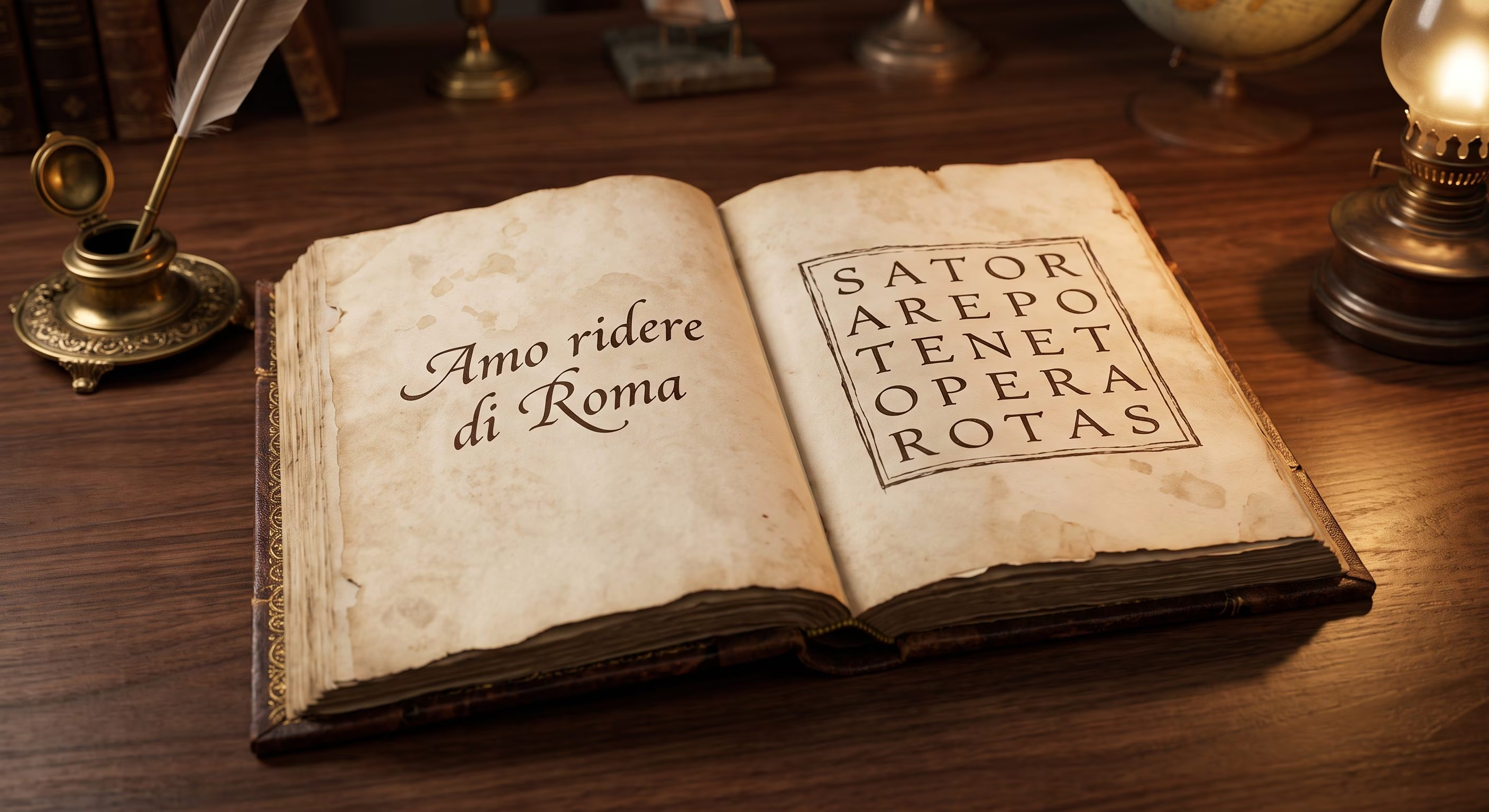
Take the name “Anna”, or a phrase like “I love laughing at Rome”, and read them backwards, starting from the last letter and returning to the first. You will get exactly the same word or phrase, because the letters will appear in exactly the same order, in perfect symmetry. In both cases, these are palindromes, that is, sequences of letters (syllables, numbers, words or sentences) that remain the same even when they are read backwards, from right to left. A fun and fascinating phenomenon that has obsessed poets, puzzlers and mathematicians of the past, but also contemporary directors, such as Christopher Nolan.
What are palindromes and why are they called that
The word palindrome comes from Greek παλίνδρομος (palíndromos), which literally means «running backwards», from the union of pálin («again», «backwards») and drómos («running»).
According to the technical definition provided byEncyclopedia of Italian Treccania palindrome is «a sequence of letters or syllables that can also be read in a retrograde sense, resulting in either the starting sequence or another sequence also endowed with meaning». According to the rules of this “game”, in reading backwards we do not take into account spaces, accents and punctuation, but only of the letters and their order. This is why «I love laughing at Rome» remains valid even if, reading backwards, the words break at different points due to the spaces.
In Italian palindromes also have two more ancient and picturesque names: two-faced verses (because they have two “faces”, like the god Janus) and canker versesfrom Latin cancerthe crab, the animal that, as we know, walks backwards. Both images that effectively convey this mechanism.
Italian words and palindromic names: from «Anna» to «onorarono»
The most obvious palindromes are those formed by a single word, such as “oro”, “ama”, “Anna”, “Ada”. In the Italian vocabulary there are approximately a hundred palindrome words.
There are short words, such as «ala», «otto», «osso», «esse», longer words, such as «radar» (English acronym radio detection and ranging). Then there are increasingly longer words, including verbs, adjectives, nouns, such as “had”, “aerea”, “aniline” (a chemical compound), “ingeni”, “obsessed”, “octet”, “endorsed”, “wadding”.
The record for length, among words in common use, is held by the third person plural of the past tense of the verb honour, «they honored», with nine letters.
Long and short palindrome sentences: when symmetry becomes poetry (and cinema)
If finding a palindromic word in the dictionary is a small stroke of luck, the construction of an entire meaningful sentence that works in both directions is instead a real art that has its specialists, the palindromists. Among them, for example, Primo Levi, who composed several, including this double decasyllable of 40 letters: “motor heroin in Italy / to the erotomaniac Latins now”.
Below, some of the most curious or funny palindromes:
- “Was I a criminal or was I a king?”
- «I love laughing at Rome»
- «Here are some nice showers»
- “It was peaceful, it seems”
- «Typical biceps»
- «On the sides of Italy»
- «Bar corner in Bologna»
- «I was a maniac in love»
- «And sanitize the cups»
- «Either I bite your daughter-in-law or I plow a racetrack»
- «It’s short and it’s not sadistic and it’s not acidic if it’s not atrocious»
Each of these sentences, minus spaces and punctuation, reads identical in both senses. The longer the sentence, the more surprising the effect of the palindrome.
From the walls of Pompeii to Nolan’s cinema: the most famous example
The obsession with these symmetries is not recent and the first codification of the genre is attributed to the Hellenistic poet Sotade (3rd century BC), from which the “Sotadic verse” takes its name.
The most famous palindrome of all time, however, is Latin, and has passed through the centuries remaining shrouded in an aura of mystery: it is the Sator square. These are five words – SATOR AREPO TENET OPERA ROTAS – arranged in a 5×5 grid.
In this case it can be read in four directions: from left to right, from right to left, from top to bottom and from bottom to top, always returning the same sequence.
The oldest known example of this square was found in Pompeii in 1925 and therefore dates back to before the eruption of 79 AD; since then examples have popped up in many places in Europe, from Spain to Hungary.
Its meaning remains debated: a possible translation is “the Arepo sower carefully holds the wheels of the plow”; there are those who have tried to anagram it, obtaining the word PATERNOSTER (Our Father) repeated, and two TO and two OR which advance and probably represent Alpha and Omega – first and last letter of the Greek alphabet and beginning and end according to the Apocalypse of John. This question has fueled magical and esoteric readings for centuries. Umberto Eco even dedicated an entire essay to him (Sator arepo etc., 2006), and in 2020 Christopher Nolan derived the names of the film’s characters from it Tenet: Sator, Arepo, the «Rotas» passage, and the key word that gives the title.
Then there is a Latin palindrome that dates back to the Middle Ages, «In girum imus nocte et consumemur igni»that is, “we go round in circles in the night and are consumed by fire”, which at the time was assigned the magical power of revealing the formula of the philosopher’s stone. The shortest «Rome immediately motibus amor“, that is, “Love will come immediately to Rome thanks to the movements.”
Even numbers have their symmetry: the mystery of 196
The numbers can also be palindromes, such as 121, 1331, 11111 or 45654, identical if read in the two verses.
We had written an article on 11111, Repunit’s number: this number is called “magic” because its square is itself a palindrome: 123454321. The same happens for all numbers composed exclusively of the repeated digit 1: 11 squared gives 121, 111 gives 12321 and so on.
But the magic of mathematics is not over yet: if you take any number, invert the digits and add the result to the original and then repeat the operation with the sum obtained, in the vast majority of cases, after a few steps, you will arrive at a palindromic number.
E.g. Take a positive integer (e.g. 52); reverse the order of its digits (25); add the two values (52 + 25 = 77). If the result is a palindrome, the process stops. Otherwise, take the result and repeat the operation.
This does not happen for example with the 196: despite billions of computer-calculated iterations, it has never produced a palindrome. This makes it the smallest of the so-called Lychrel numbers, that is, those natural numbers that never manage to become palindromes, and understanding whether they will become palindromes is still an unsolved problem.
There is food for thought behind palindromes: they remind us that even within something linear, or that we take for granted, like the letters, words or numbers with which we speak and count every day, another point of view can hide.