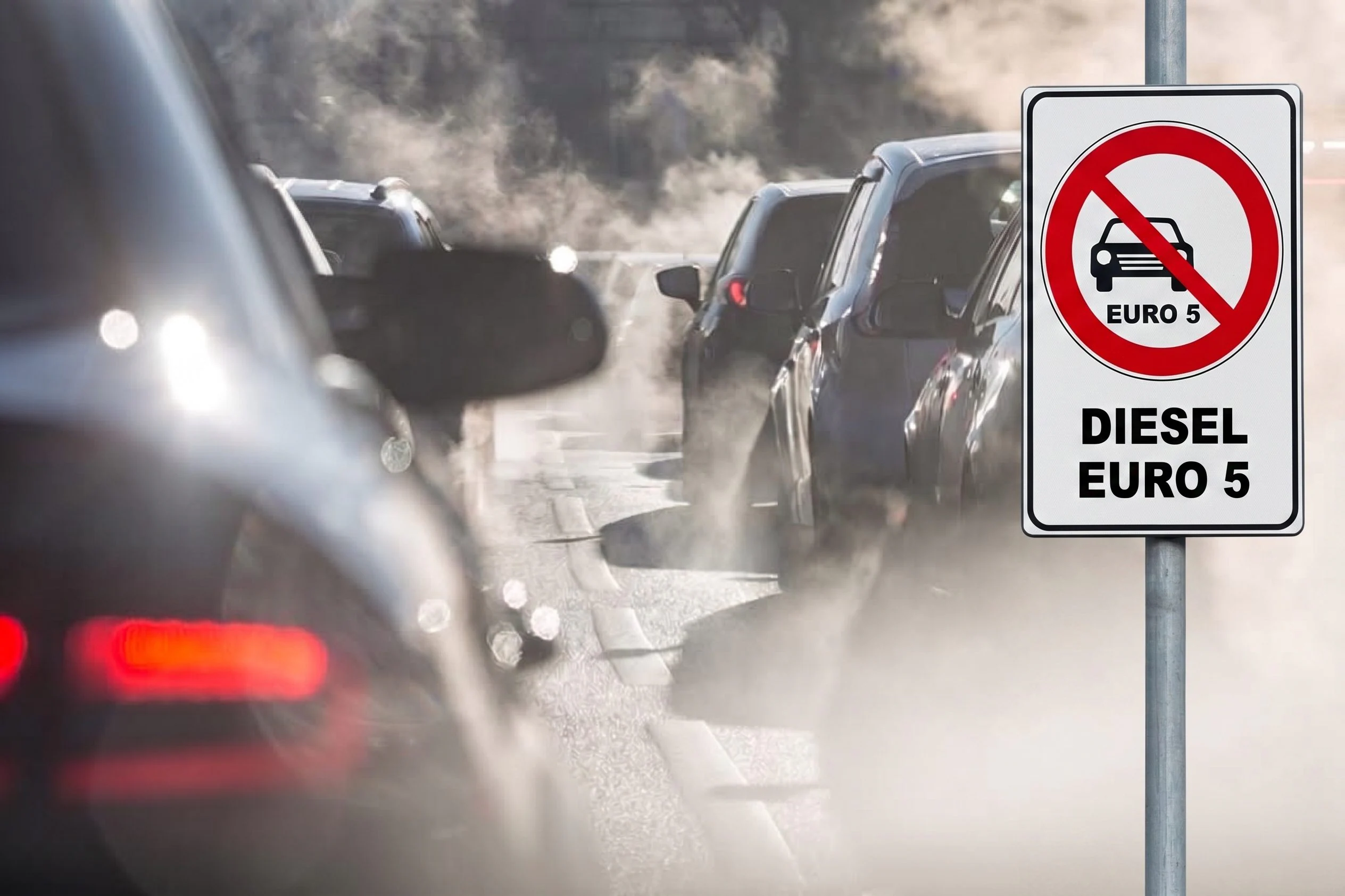
New traffic limits for Euro 5 diesel vehicles in some regions of Northern Italy starting from 1 October 2026: the stop will only concern cities with more than 100,000 inhabitants (compared to the initial 30,000), although the Regions will also be able to extend the bans to smaller towns. The provision, provided for by Legislative Decree 121/2023, concerns (in theory) the regions of the Po Valley, i.e. Lombardy, Veneto, Piedmont and Emilia-Romagna: the objective is to try to reduce air pollution and align with European standards.
The ban on Euro 5 class diesel cars was due to come into force on 1 October 2025, but was postponed by a year to provide more time for motorists and the Regions to identify alternatives. Some Regions, however, will not introduce the block thanks to a series of alternative anti-pollution measures: Piedmont, in fact, has canceled the structural block which would have affected 307,000 Euro 5 diesel cars in the metropolitan area of Turin and Novara, while Veneto and Emilia-Romagna are working to find a similar solution.
In case of violation of the ban, however, the fine could range from 168 to 679 euros, with suspension of the license from 15 to 30 days in the event of a repeat offense (i.e. two infringements in the same two-year period).
In which regions is there a risk of a ban from 1 October due to the Euro 5 diesel block?
The legislation provides that the ban on Euro 5 diesel cars will only be triggered “in the absence of compensatory measures”. In other words, each Region actually has the possibility of avoiding it, as long as it implements other interventions capable of reducing pollutants to the same extent as the traffic ban.
Piedmont, for example, managed to completely overcome the problem, becoming the first region in the Po Valley to cancel the structural block, replacing it with a package of anti-smog measures. Veneto has instead started a similar process to suspend it, while Emilia-Romagna is working on replacement interventions. At the moment, therefore, Lombardy seems to be the only region to have confirmed the entry into force of the ban.
Lombardy
Lombardy has therefore confirmed the introduction of traffic limits for Euro 5 diesel vehicles. In implementation of Law no. 105/2025 and the Regional Council resolution no. 4843 of 28 July 2025, the stop will come into force progressively, following a calendar linked to the category of the vehicle:
- For cars (category M1), from 1 October 2026;
- For category M2 vehicles (transport of people with more than 8 seats), N1 (transport of light goods) and N2 (transport of intermediate goods), from 1 October 2027;
- For all other motor vehicles (categories N3 and M3), from 1 October 2028.
The ban, however, will not concern the entire region, but the urban areas of municipalities with a population exceeding 100,000 inhabitants, i.e. Milan, Brescia, Monza and Bergamo.
The restrictions will be in force all year round, but only from Monday to Friday (excluding midweek holidays), from 7.30am to 7.30pm. Therefore, on public holidays and during the night hours, these vehicles will be able to continue to circulate
However, those who own a car affected by the block have an alternative: the MoVe-In service, which replaces the time and daily slots with a limitation based on the kilometers travelled. This is a black box installed on the vehicle, which monitors how many kilometers are traveled within the areas subject to limitation, within a maximum annual limit that depends on the type and environmental class of the vehicle.
Piedmont
As anticipated, the Piedmont Region is the first to cancel the introduction of the block, which would have affected 307,000 Euro 5 diesel cars in the metropolitan area of Turin and Novara. What made the reversal possible was the approval of the update of the Regional Air Quality Plan, which introduces a series of anti-smog measures as alternatives to stopping vehicles.
More specifically, the package of alternative measures was developed by a special structure which also involved technicians from ARPA, the Polytechnic of Turin, the University of Turin and eastern Piedmont and provides:
- The allocation of 14 million euros to encourage the use of diesel biofuels of renewable origin on public transport vehicles and on Euro 5 and 6 diesel private cars, with an annual incentive of between 50 and 100 euros on the price of fuel;
- 44 million allocated to tenders for cleaner cities, including the promotion of car sharing, incentives for bicycles and public transport on home-work journeys and new speed stations;
- 11.5 million for the application of artificial intelligence to infomobility systems, to manage traffic in real time; 10 million for agriculture, to support crops capable of absorbing ammonia and pollutants;
- 14.4 million to reduce emissions from older and more polluting heating systems.
As summarized by the Region, the 307,000 Piedmontese drivers with a Euro 5 diesel car will therefore be able to continue to use it, because alternative solutions have been found which still allow them to respect the air quality parameters set by Europe.
Veneto
In Veneto the game is still open, but the final objective is to avoid the blockade. The President of the Region, Alberto Stefani, announced the start of the process to suspend the ban on Euro 5 diesel vehicles scheduled for 1 October 2026. The first step was the approval, by the Regional Council, of a resolution which implements the legislative decree no. 73 of 2025 and which is now being examined by the Regional Council to continue the legislative process.
According to data provided by the Region, the introduction of the blockade in municipalities with a population exceeding 100,000 inhabitants would have had an impact on at least 150,000 vehicles. To avoid this, the Region is studying some compensatory measures, which could include bringing forward the tender for the transformation of Euro 5 diesel vehicles into Dual Fuel and, in the event of an orange or red PM10 alert, the use of smart working for employees of public bodies (excluding those who necessarily have to work in person).
Emilia-Romagna
In Emilia-Romagna, circulation restrictions are regulated by PAIR 2030, the regional air quality plan. The general rules provide that the bans come into effect from 1 October to 31 March of each year, from Monday to Friday, from 8.30 to 18.30, in the inhabited centers of Bologna, Parma, Modena, Reggio Emilia, Ravenna, Rimini, Ferrara, Forlì and Piacenza. Approximately 250,000 vehicles potentially involved.
The regional administration is working on replacement measures which, if they are not identified by the end of the month, will lead to the restrictions coming into force, at least for an initial period.