The war between the United States and Iran is in the midst of a new escalation of attacks: the American army has hit five Iranian oil tankers, sinking two of them, following two attacks by Tehran against an American warship. Iran, in response, launched missiles against a US base in Jordan: most of these were shot down, but it is not the first time during this conflict that American military bases in the region have been hit.
The USA, after all, is the country with the most military bases in the world: estimates show between 750-800 bases, to which secret bases should also be added. In Italy alone, there are around 120.
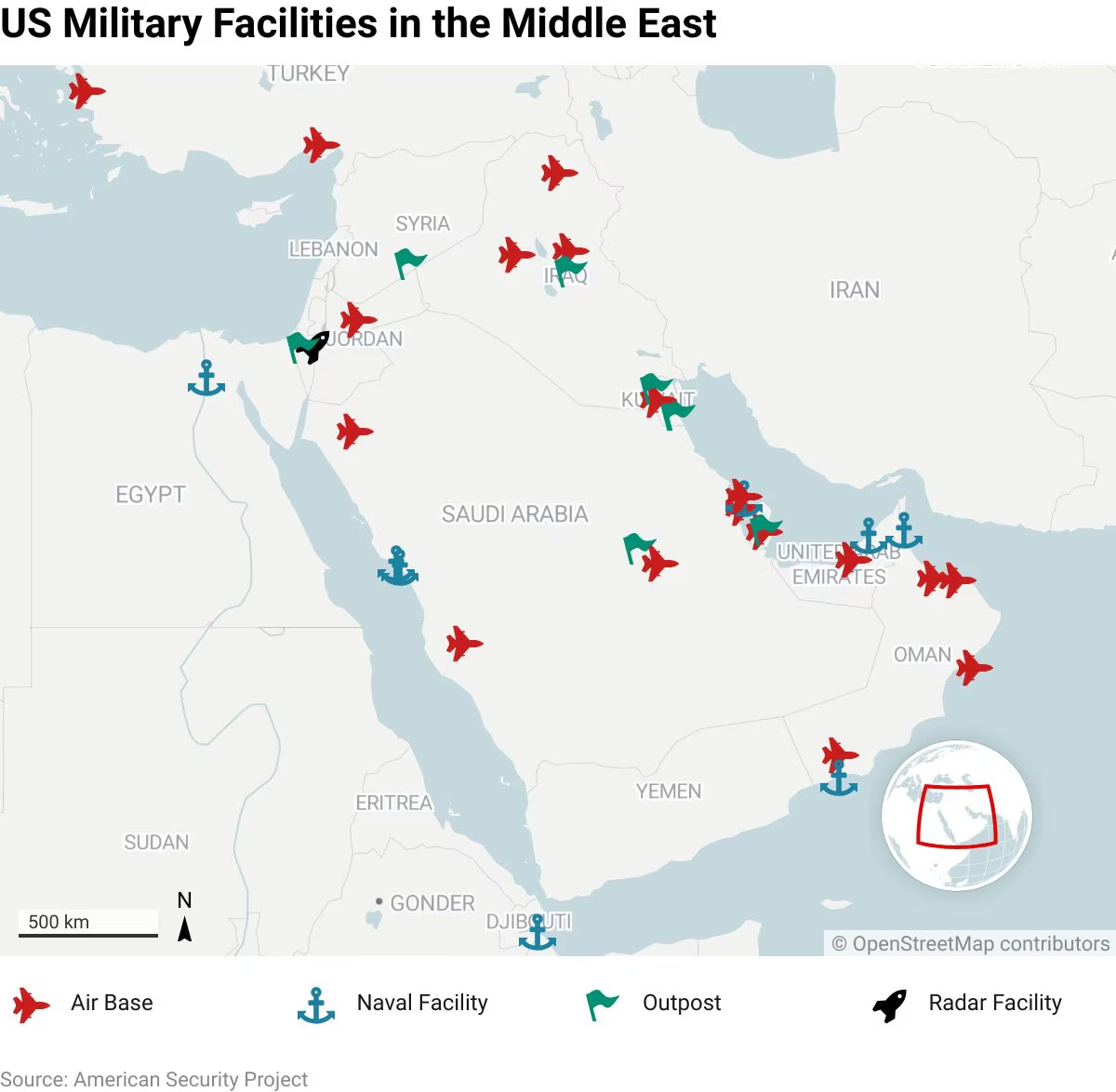
As regards the Middle East, in addition to Jordan, the United States has important bases located in countries such as Qatar, Bahrain, the United Arab Emirates and Kuwait, to which are added the large bases in Djibouti and Turkey, which belong to other regional commands but often contribute significantly to American operations in the Middle East.
From the point of view of military strength, however, according to estimates, around 50,000 American soldiers are deployed in the region as well as numerous military vehicles, including two aircraft carriers and over a dozen missile destroyers.
For decades these bases have had a specific function: in addition to serving as strategic outposts for Washington (especially in these last weeks of escalation), the bases were seen by the governments of the Gulf countries as guarantees of the US commitment to the security of the region and, therefore, as deterrents against possible attacks by Iran, Iraq or other regional powers.
As the Council on Foreign Relations points out, however, during the latest war between the United States, Israel and Iran, US military bases have in fact become the first targets of Tehran’s army, finding themselves within range of Iranian missiles. For this reason, the US army is considering moving some installations underground, so as to better defend themselves in the event of missile or drone attacks.
Jordan and the Muwaffaq al Salti air base
Jordan hosts the Muwaffaq al Salti air base, located in Azraq, about one hundred kilometers northeast of the capital Amman: the installation hosts the 332nd Air Expeditionary Wing of the US Air Forces Central, engaged in missions across the Levant. During this latest conflict, the United States is starting to make more use of bases in Jordan, located at a greater distance from Iran than outposts located in countries such as Qatar or Kuwait: consequently, Iranian army attacks against the base, where 2 American soldiers lost their lives a few weeks ago, have also increased.
Regarding the attacks on September 8, the Jordanian army said that its air defense systems intercepted 18 of the 20 ballistic missiles launched towards its territory; the remaining two fell in uninhabited areas and no casualties were reported.
The most important base in the Middle East is in Qatar
Qatar hosts the most important base of all. Al Udeid is the largest American base in the Middle East and covers an area of approximately 31 km2 in the desert outside Doha, about 170 miles (273 km) from Iran. Its importance doesn’t just have to do with size: It is the forward headquarters of CENTCOM and the home of the Combined Air Operations Center, which controls all American air activity in the entire Middle East.
CENTCOM’s command radius is extremely broad: the Command directs military operations over a territory ranging from Egypt in the west to Kazakhstan in the east. Al Udeid is also the base that suffered the most symbolic Iranian retaliation: after the American attack on Iranian nuclear sites on 21 June 2025, Iran responded by launching an attack on Al Udeid. On the cost front, Qatar spent between $1 billion and $2 billion to build Al Udeid in 1996 and has spent over $6 billion more since then to maintain it.
Bahrain as the hub of the naval fleet
Bahrain is the naval linchpin of the entire US military architecture in the region. It hosts the largest number of permanently assigned American personnel and is home to the U.S. Navy’s Fifth Fleet, whose range covers the Gulf, Red Sea, Arabian Sea and parts of the Indian Ocean.
The headquarters of the Fifth Fleet and the US Naval Forces Central Command are also located here, with the naval base located approximately 128 miles from Iran, approximately 205 km.
Saudi Arabia and coordination with the government
The American presence in Saudi Arabia is more limited and is based above all on coordination with the Saudi government: according to the latest published estimates (however relating to 2024) the country hosted 2,321 American soldiers, engaged in air and missile defense capabilities. Part of these is located in the Prince Sultan air base, about 60 kilometers south of Riyadh, which supports assets such as Patriot missile batteries and THAAD systems, the high-altitude area defense in the terminal phase.
Strategically, western Saudi Arabia is among the options being considered for moving forces further away from Iran, but it does not have Israel’s air defense systems. The country, moreover, has already been the target of attacks, especially with regards to strategic energy infrastructures: yesterday 8 September, the Houthi movement, supported by Iran, attacked oil plants and civil infrastructures in Saudi Arabia with drones and missiles, injuring 73 people.
The two faces of the US presence in the United Arab Emirates
In the United Arab Emirates, the American presence has two faces. On the one hand there is the Al Dhafra air base, south of Abu Dhabi, shared with the Emirates air force and considered a critical hub for the US air force, used for missions against the Islamic State and for reconnaissance flights in the region.
On the other is the port of Jebel Ali in Dubai, which while not a formal military base is the largest US Navy port of call in the Middle East and regularly hosts aircraft carriers and other ships. It is precisely this dual nature that explains why the presence of the United States in the United Arab Emirates is in some cases described as an “access” and in others as a real military outpost.
The installations in Kuwait
Kuwait hosts an American presence spread across multiple installations. There is Camp Arifjan, the forward headquarters of the US Army Central, the Ali Al Salem air base (about 40 km from the Iraqi border and nicknamed “The Rock” for its isolated and harsh environment) and Camp Buehring, created during the 2003 Iraq war as a transit point for army units heading to Iraq and Syria.
Proximity to Iran is the critical point: Camp Arifjan is just 62 miles from Iran (about 99 km) and is therefore the most exposed of the main bases due to its proximity to Iranian territory.
Iraq and the Ain Al Asad base
In Iraq, the United States maintains a presence at the Ain Al Asad air base, in the western province of Anbar, in support of the Iraqi security forces and the NATO mission. The base is known for a sad precedent: it was the target of Iranian missiles in 2020, in retaliation after the American killing of Iranian general Qasem Soleimani.
Further north, in the semi-autonomous Kurdistan Region, Erbil Air Base serves as a hub for U.S. and coalition forces engaged in training, intelligence sharing and logistics coordination.
Israel and its strategic importance
Israel appears among the countries with American structures, but its weight is above all at a strategic level. Distance is the trump card: the journey from an Iranian missile to Israel is about 1,100 miles (over 1,770 km), which leaves much more time to get personnel to safety than at Gulf bases. Not surprisingly, dozens of American planes have been relocated to Ben Gurion Airport and Ramon Air Base in Israel. Former CENTCOM commander Frank McKenzie stressed the need to focus on bases in Israel, both because of the distance from Iran and because it would impose fewer restrictions on access, basing and overflight rights.