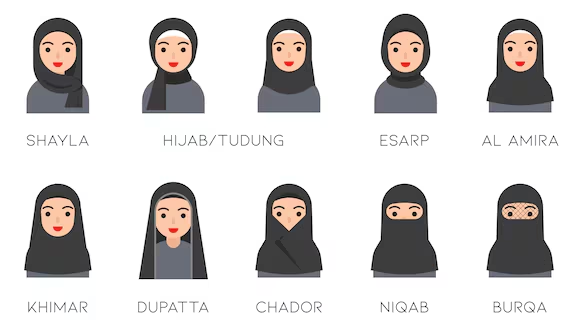
By Arab we generally mean those who speak the Arabic language. This is a vast and heterogeneous group of populations, spread across a territory between the Middle East and North Africa. Arabs are very different from each other, but they share some characteristics. The origins are located in the Arabian Peninsula in the centuries before Christ. The term “arab” is attested from the 9th century BC. C., the alphabet from the 4th century AD. C. However, only with the rise of Islam, in the 7th century, did the Arabs take on a more defined physiognomy and began the expansion that led them to dominate a vast territory. Today in the world it is estimated that there are around 500 million Arabs. However, they do not constitute a political entity, but are divided into approximately twenty states.
Who are the Arabs
By Arabs we mean an ethnic-linguistic group, made up of approximately 500 million people, who speak the Arabic language and share some historical and cultural characteristics. Arabs constitute the majority of the population in a large territory, which includes the Arabian Peninsula (the people’s land of origin), the Near East, the Persian Gulf and Northern Africa. Overall, there are just under twenty countries inhabited by an Arab majority:
- Algeria
- Saudi Arabia
- Bahrain
- Egypt
- United Arab Emirates
- Jordan
- Iraq
- Kuwait
- Lebanon
- Libya
- Morocco
- Oman
- Palestine (not a state with full political recognition)
- Qatar
- Syria
- Sudan (although the majority of citizens identify as Arab, the population is made up of various ethnicities)
- Tunisia
- Yemen
Four other African countries are also part of the Arab League, namely Comoros, Djibouti, Mauritania and Somalia, in which Arabs are not in the majority.
Arabic-speaking people have also emigrated to other countries, including Italy, where they constitute minorities. Overall, it is estimated that there are around 500,000,000 Arabs today (however, there are also different estimates).
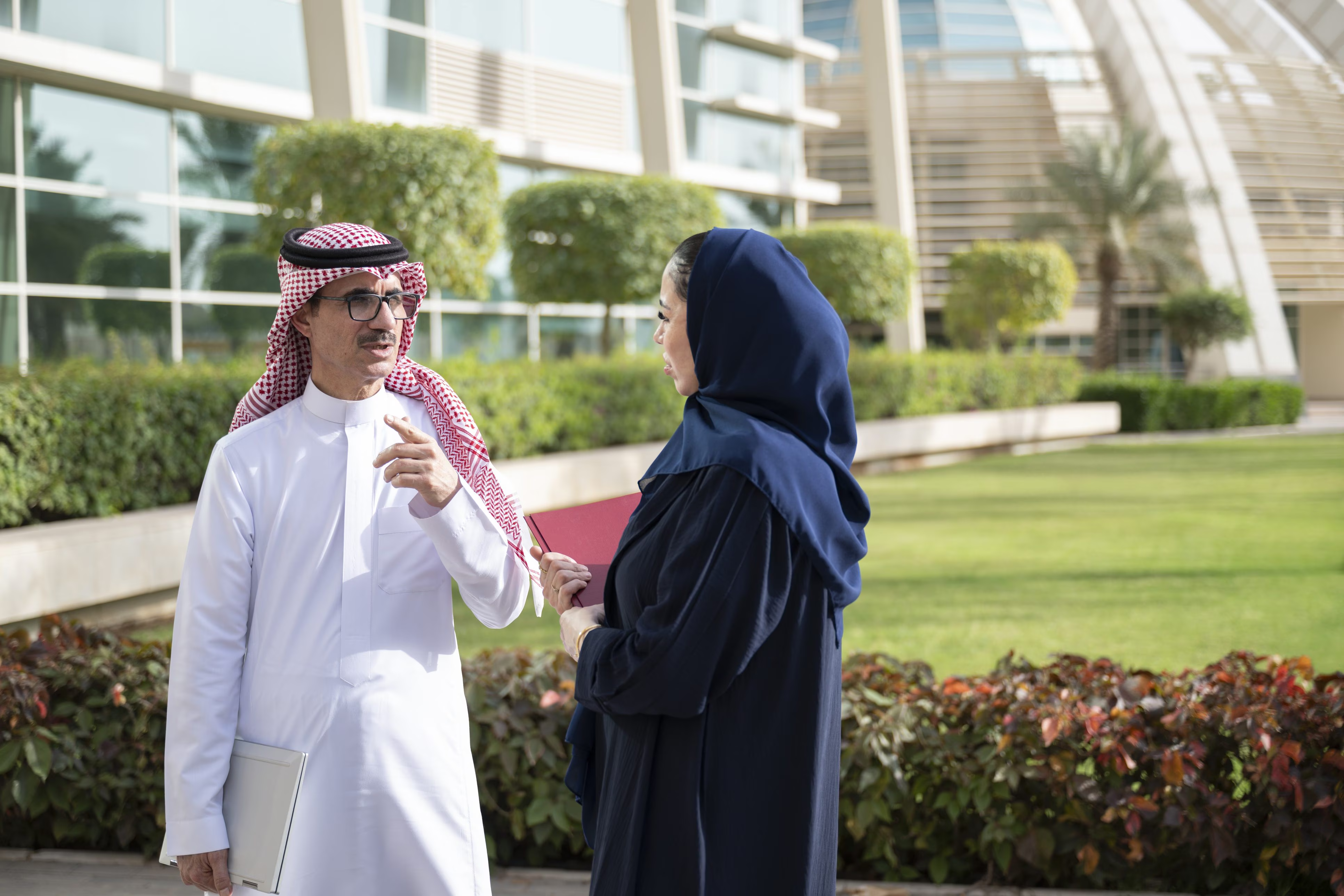
The Arabs are not a unitary whole, but very heterogeneous peoples, who share some characteristics, but have peculiar traits, different depending on the territories where they reside, in terms of history, traditions and culture. In other words, we should not imagine the Arabs as if they were all dressed in traditional clothes and the white keffiyeh on their heads; on the contrary, they were very heterogeneous peoples and cultures, even in terms of clothing.
The language also changes, as there are numerous variations of Arabic, distinguished by vocabulary, pronunciation and grammar. A Moroccan and an Iraqi, for example, would have difficulty understanding each other when speaking exclusively in their respective local varieties. However, there is a common supra-regional language: Modern Standard Arabic, used in writing, in newspapers, in official documents, on television news and in formal contexts.
It should be noted that not all the peoples of the Middle East are Arab: the Turks are not, the Iranians are not and many others.
Arabs also call themselves “Dad People” because of the letter “dad”, peculiar to their language.
The origins of the Arabs
The Arab peoples developed in the Arabian Peninsula. Their origins precede the birth of Islam by many centuries. More specifically, the term “arab” already appears in Assyrian sources from the 9th century BC, referring to nomadic or tribal populations.
In the following centuries, numerous peoples and kingdoms established themselves on the Peninsula. One of the most important was that of the Nabataeans, famous for their capital Petra, in the south of present-day Jordan. The kingdom of Sheba, located in present-day Yemen and known for its commercial power, was also very important.
The Arabic language developed among the peoples who inhabited the Peninsula, starting from Aramaic. The first certain evidence of the use of the alphabet is an inscription, however found further north, in Syria, and dating back to 328 AD. C.
From a religious point of view, the tribes of the Peninsula professed local polytheistic cults or variants of Christianity and Judaism.
Today the pre-Islamic period is known as jahiliyyathat is, ignorance (understood as ignorance of the true faith).
Arabs and Islam: why they should not be confused with Muslims
What gave unity to the Arab people was Islam, which established itself in the Arabian Peninsula, more precisely in the localities of Mecca and Medina, starting from the year 622 AD. C. Islam meant that the various tribes of the Peninsula became one people. Furthermore, the Muslims began a powerful expansion, first conquering the entire peninsula and then, after the death of Muhammad (632), a vast territory, reaching west as far as the Maghreb and the Iberian Peninsula, and east as far as Central Asia.
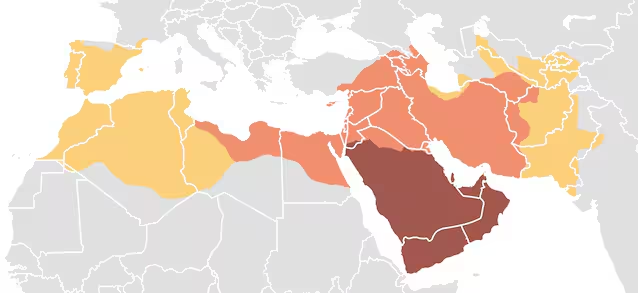
The inhabitants of the conquered territories did not immediately become Arabs (or even immediately Muslims), but over time the new generations adopted the language and culture of the conquerors. In other words, they gradually became arabized. For this reason, today the Arab peoples are the majority in a vast territory between the Maghreb and the Persian Gulf.
However, although Islam has had a capital importance in Arab history, Arabs should not be confused with Muslims: Islam is a religion, Arabs are an ethnicity. It is no coincidence that, although Islam is the largely prevalent religion, there are also Arabs who profess other religions, such as Christianity (in total, Arab Christians number around 15 million). Furthermore, Islam is widespread among many other peoples and it is estimated that only 20-25% of Muslims are Arabs.
Because the Arabs are divided into many different states
The Arab peoples are divided into many states essentially because they are different from each other. Over the centuries, it is no coincidence that they have never constituted a political unity (except in the very early times of Islam), but have always been fragmented. Furthermore, they were often subjected to the domination of other peoples. The longest domination was that of the Turks, who between the 15th and 16th centuries, through the Ottoman Empire, subjugated almost the entire Arab world and controlled it until the First World War.
From a cultural point of view, the Arabs had great importance, contributing to the progress of the whole world both with their discoveries and because they transmitted many elements of Greek culture, which had been lost in the West.
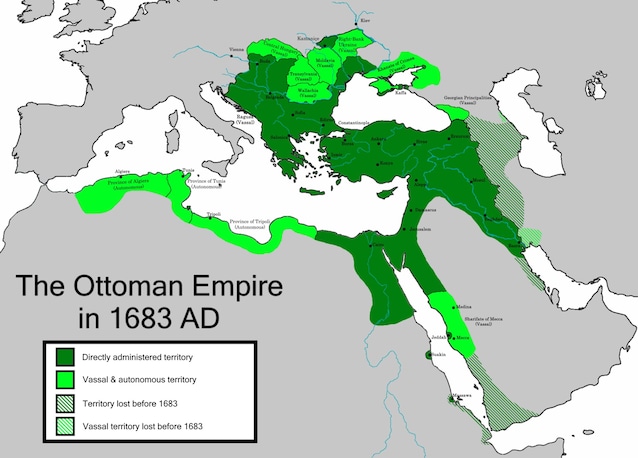
Between the end of the nineteenth century and the beginning of the twentieth century, with the so-called “Arab renaissance”, the Arab peoples began to become aware of their identity. After the First World War they freed themselves from Ottoman domination, but they did not immediately obtain independence and in fact had to face heavy interference from Western countries. Over the years, numerous independent Arab states have emerged.
After the Second World War, a supranational organization was also founded, the Arab League (officially the League of Arab States), which is based in Cairo and aims to promote cooperation and coordination between member states. It was originally made up of six countries, today it has 22.
However, despite the existence of the League, each Arab state maintains its own sovereignty and follows its own line in domestic and foreign policy. There are countless conflicts (or even wars) between different Arab countries or within them. Attempts to impose a pan-Arab ideology, that is, to achieve if not political unity, then at least the cooperation of all Arab peoples, have not been successful.
Furthermore, an Arab people, the Palestinians, are still fighting for the recognition of their right to self-determination. Even on this aspect, the Arab states are unable to be united and to support Palestine’s demands for independence in a united manner.