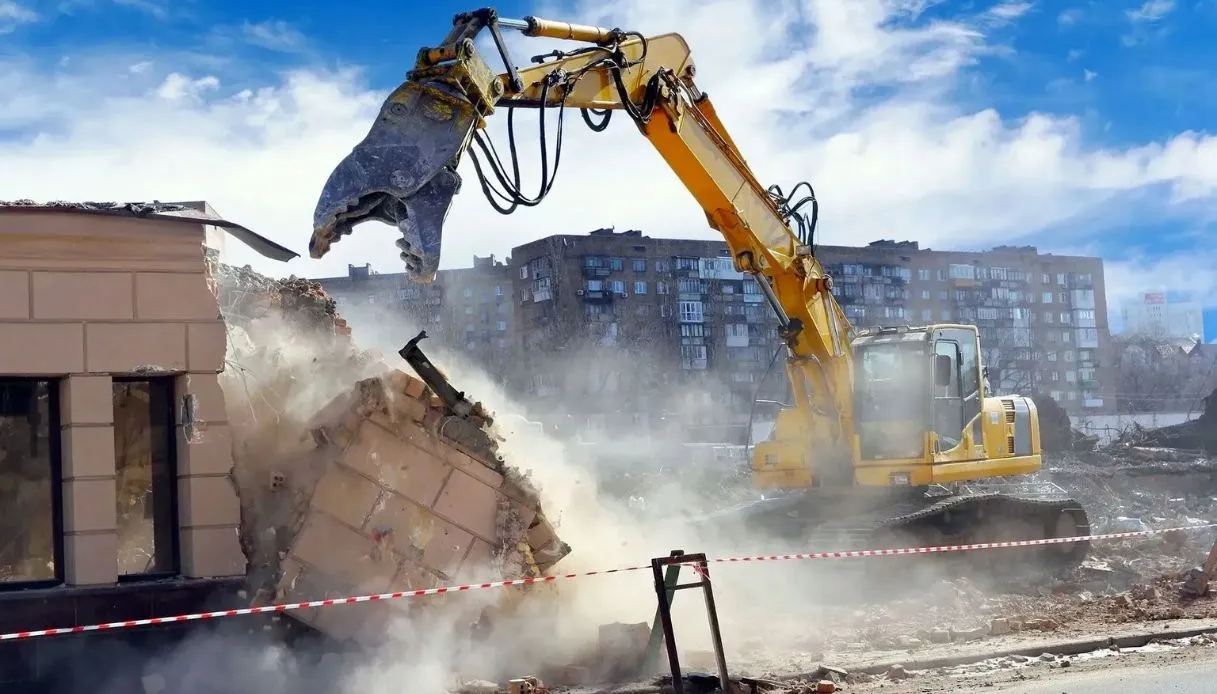
The construction and infrastructure sector is going through a phase of profound transformation driven by the need to modernize the existing building stock, redevelop historic urban areas and respond to the rigorous environmental requirements dictated by the circular economy.
The execution of civil, industrial and road demolitions has overcome the archaic concept of simple mechanical demolition to become a real engineering discipline with high technological and analytical content.
Operation in the Lucanian capital, Potenza, and in the urban centers of the region is particularly challenging, characterized by a complex orographic conformation, high-density building fabrics, narrow streets and frequent proximity to historic structures or sensitive infrastructures.
Preventive technical planning and structural diagnosis of the construction site
Operating in complex urban contexts, in the presence of limited maneuvering space or close to inhabited buildings, requires a paradigm shift in which engineering analysis anticipates and guides every single mechanical action on the construction site.
The safety legislation, coordinated by Legislative Decree 81/2008 in the context of temporary or mobile construction sites, peremptorily establishes that demolition operations cannot be improvised, but require a preventive assessment of the stability conditions of the structures to be demolished and those adjacent to them.
Before starting any intervention, the specialized company must carry out a rigorous preliminary diagnosis of the work.
This diagnosis allows us to understand the static behavior of the building during the lightening phases, identify the presence of any pre-stressed or degraded structural elements and precisely define the operational dismantling sequence.
In parallel with the protection of static stability, planning must satisfy the requirements of the Minimum Environmental Criteria (CAM Building). CAM requires the adoption of selective demolition, also known as controlled decomposition or deconstruction, a process that involves the sequential dismantling of building components before demolishing the structural parts.
Through the preventive removal of windows, systems, glass, insulating elements and finishes, contamination of cement and brick materials is avoided, laying the foundations for highly efficient recovery.
By analyzing the operational effectiveness in detail, the comparison clearly highlights the difference between an archaic approach and special controlled demolition:
- Operational planning: while traditional undifferentiated demolition is limited to a direct intervention without sequential modeling of the phases, special and selective demolition is based on a preventive structural diagnosis and on the accurate engineering of the entire demolition sequence.
- Mitigation of environmental risks: where conventional methodologies involve a high uncontrolled dispersion of dust and acoustic-vibrational stresses, the controlled approach guarantees the constant reduction of dust through nebulization systems and the use of low-vibration hydraulic equipment.
- Separation of materials: unlike classic demolitions, which generate heterogeneous and promiscuous rubble with a high risk of chemical-physical contamination, selective demolition implements precise differentiation at the source of bricks, concrete, metals and plant components.
- Destination of residues: if the undifferentiated approach mainly leads to the debris being sent for final disposal in landfill with high economic costs, special demolition allows the recovery of material beyond the threshold of 70% by weight envisaged by the CAM.
- Compliance and legal protection: while improvised procedures expose the client and the company to administrative sanctions, blockades of the construction site and criminal liability, specialized management ensures total documentary traceability and full compliance with the provisions of Legislative Decree 81/2008 and Legislative Decree 152/2006.
Regulations on construction waste, traceability and advantages of the single point of contact
The management of the results deriving from demolition and excavation activities is regulated by Part IV of Legislative Decree 152/2006, which attributes precise environmental and criminal responsibilities to the producer of the waste and the executing company. A frequent mistake in managing construction sites is to consider the management of waste materials as a secondary activity, fragmenting the assignment between different uncoordinated subjects for the demolition, loading, transport and disposal phases.
To ensure compliance with these constraints and avoid the risk of disputes by the supervisory bodies, the most effective operational solution consists in relying on a single interlocutor capable of governing the entire value chain.
A single specialized partner takes care of the initial chemical-physical characterization of the materials, organizes the temporary storage on site in compliance with current regulations, manages the authorized transport with the correct compilation of the Waste Identification Forms (FIR) and guarantees the sending of the aggregates to qualified recovery plants. This integrated approach relieves works management, designers and clients from operational uncertainties, preventing unplanned interruptions of works and guaranteeing total documentary transparency.
Perspectives for the construction supply chain and the role of qualified operators
The execution of special demolitions in the complex urban contexts of Basilicata requires multidisciplinary skills ranging from structural engineering to environmental legislation, up to in-depth knowledge of the dynamics of the circular economy.
The adoption of a rigorous methodological approach, based on preventive diagnosis, selective demolition and the use of advanced technologies for the abatement of dust and vibrations, constitutes the only guarantee for operating safely and in compliance with contractual times.
From this perspective, the choice to rely on organized structures strongly rooted in the Lucanian territory, such as SO.CO. Ecological, it allows you to transform a critical and risky phase of the construction site into a controlled process that generates economic and environmental value.
Integrating the dismantling phase, the documentary traceability of waste and the production of certified recycled aggregates into a single operational flow today represents the essential standard for all professionals, businesses and public bodies who intend to lead the infrastructural relaunch of the territory in the name of safety and sustainability.