According to what was stated by sources at the CIA, the main intelligence agency of the United States of America, Russia is preparing attacks by means of drones, released from container ships, against targets located in the territories of some European countries, among which France, Spain and Italy are explicitly mentioned. The Spanish newspaper detonated the media bomb El Mundo and, given the contents, it contributed to spreading panic almost everywhere in the world of information.
Almost immediately came the words of denial from the Minister of Defense Guido Crosetto, who spoke of a lack of feedback from the Italian side and at the same time called for a containment of the proliferation of news that could contribute to aggravating the already high tensions. Being news of great importance, it is necessary to carefully evaluate its potential truthfulness and the scenarios it could open up.
The plans revealed by the CIA according to El Mundo
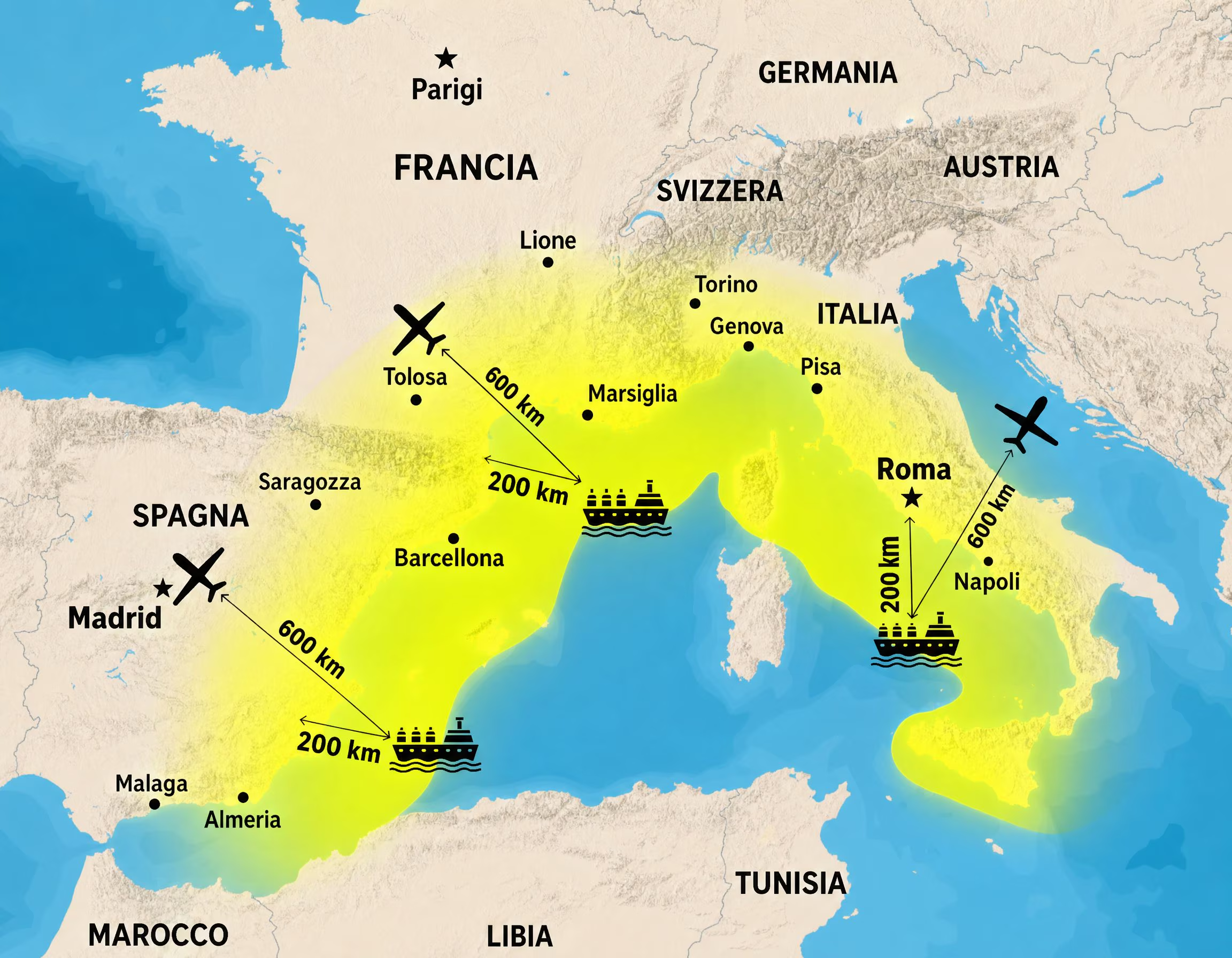
The journalistic scoop was exploded by the Spanish newspaper “El Mundo”: citing Lithuanian sources, who in turn would relay news apparently of American origin, to be precise directly from the CIA, it states that the Armed Forces of the Russian Federation are planning to strike targets located in the territories of France, Spain and Italy. These are member countries of both the European Union and NATO, committed to varying degrees to supporting the war efforts of Ukraine, which has been engaged in a large-scale conventional defensive war against Russia since 24 February 2022. Such attacks, the newspaper reveals, would be carried out using drones released from specially equipped container ships.
That said, there are two hypothetical scenarios that are worth wondering about, at least so as not to be caught unprepared should they materialize.
The first scenario is the beginning of an all-out war
The first scenario we must face is that of the so-called “total war”. That is, hypothesize that any attacks that Moscow is about to carry out against European countries by means of drones are the prelude to a large-scale and grand style offensive against Europe.
At the moment we can already classify this gloomy scenario to the realm of “political fantasy”: in order to think of attacking Europe, the Russians would have to complete huge preparations which would certainly not go unnoticed, especially in this moment of creeping international crisis.
In particular, as already underlined in past articles characterized by a similar tenor, the movements of the Russian Navy must be kept under close surveillance, which in a context of open war with the West should carry out a whole series of missions of primary importance in Moscow’s war plans. It was precisely the massive Russian naval deployment in the Black Sea and Eastern Mediterranean area between the end of 2021 and the beginning of 2022 that raised the definitive alarm regarding Moscow’s intentions to start war.
It is essential to underline the fact that nothing similar is currently happening in today’s context. The maneuvers of the Russian Navy, with the notable exception of the Black Sea Fleet and the Caspian Flotilla, directly involved in the war effort on the Ukrainian front, are to be ascribed to ordinary administration. In light of this critically important fact, we can confidently say that Russia is not about to launch an all-out war against Europe.
The second scenario leads to a new stage of hybrid warfare
Another scenario to take into consideration is that relating to “hybrid war”, that complex of operations with nebulous outlines which can be classified as “acts of war”, but which are specifically designed to maintain conflict within “an acceptable level of tension and/or violence”.
The objective, in this eventuality, is therefore to send a message of a political nature, but ensuring that the situation does not degenerate into a scenario of open war. In this case, drones would be the perfect weapon, given their proliferation on a planetary level.
This scenario, while tempting, presents problems: if on the one hand it is true that a whole series of highly profitable strategic objectives are located right along the Spanish, French and Italian coasts and drones, perhaps of medium-large size, would be the ideal weapons to hit them, the aforementioned container ships would hardly escape capture by the authorities of the countries involved and, once subjected to an in-depth inspection, they would reveal the thread that ties the vessels to the state that used them for the operation covered. This fact also removes plausibility from the “hybrid war” scenario.
The escalation of tension continues
Regardless of the plausibility or otherwise of the situations described above, it is necessary to underline that since the incipit of the Russo-Ukrainian War, the geostrategic tension between Russia and Europe (and the West in general) is visibly increasing: many voices have been raised to raise the alarm about the fact that, if this tug of war were to get out of control at some point, the chances of a total war breaking out between Russia and Europe would increase considerably, with unpredictable outcomes.