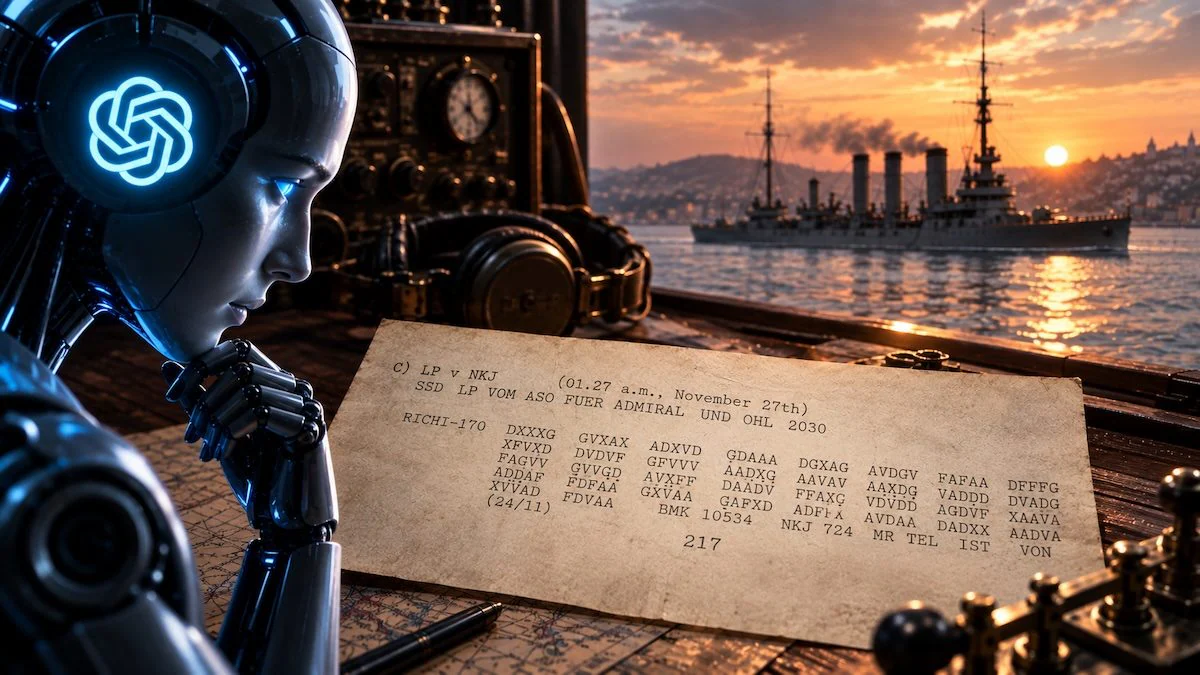
GPT-6 Astra, OpenAI’s new flagship model, may have finally made readable a German military radio message that had resisted deciphering attempts. The communication belongs to a group of transmissions intercepted in the last phase of the First World War and in the weeks immediately following the armistice, some of which remained without a certain solution for decades.
The possible reconstruction of the message is proposed by an author who goes by the name Prinz, who on 17 September 2026 published the result obtained using AI. The content concerns some naval movements in the Black Sea and several details are reflected in the logbook of HMS Canterbury, making the case particularly interesting.
What the German message from 1918 reconstructed by GPT-6 Astra says
The radiogram is made up of 170 symbols and was transmitted on 27 November 1918, just over two weeks after the armistice of 11 November. The message is part of the German radio traffic documented by the American James Rives Childs and also appears in a collection of communications encrypted with the ADFGVX system that remained unsolved, with material provided by the cryptanalyst George Lasry.
According to what was published by Prinz, the OpenAI model would have obtained a German sentence reporting the arrival of an English cruiser in Sevastopol on the “?4” of the month and of an allied team on the 26th. The first date does not emerge completely from the text: the character that should indicate the initial digit does not return a coherent number, therefore the model did not directly read “24 November”.
This is where historical verification comes into play. The logbook of HMS Canterbury, a light cruiser of the Royal Navy, records that on 24 November 1918 the ship moored in Sevastopol harbor at 10.20am. Two days later, on November 26, the same document reports the arrival of an “Allied Squadron”, i.e. an Allied naval team, at 11:30. The two pieces of information therefore correspond very well to the meaning of the reconstructed text.
This coincidence makes the solution plausible, but it is not enough in itself to demonstrate that each step of the decipherment is correct. Prinz’s work is not a peer-reviewed scientific study and is not currently supported by publicly available independent cryptographic verification.
How the ADFGVX cipher works and how AI managed to crack it
To understand what GPT-6 Astra would have done, you must first see, in a simple way, how ADFGVX worked. The system was introduced by the German army in 1918 and takes its name from the only six letters used in the ciphertext: A, D, F, G, V and X. The ADFGVX version was an evolution of the previous ADFGX. The addition of the V allowed us to move to a 6×6 grid and also include the digits. The choice was not random. The respective Morse code signals were different enough from each other to reduce the risk of errors during radio transmissions. It was a manual technique but rather sophisticated for the time, because it combined two different steps of cryptography, namely a substitution and a transposition.
In the first step letters and numbers occupied the boxes of this grid. Each character of the original content was transformed into a pair of two ADFGVX symbols, one to indicate the row and one for the column. At that point the sequence obtained was further shuffled by arranging it into columns and changing the order based on a keyword. To return to the readable form it was therefore necessary to identify both the layout of the grid and the way in which the columns had been reordered. The combination of the two steps made the message more difficult to reconstruct than a simple replacement, because not only the symbols used changed, but also their position in the sequence.
For this radiogram, Prinz reports that the model applied the German word TRUPPENVERSCHIEBUNG, which translates roughly as “troop movement.” This is a 19-letter key that was not invented by the model or derived from scratch by analyzing the ciphertext alone. It was already documented in historical sources on the ADFGVX system.
The peculiarity is another. In the documentation cited by Prinz that word is associated with communications starting from 9 December 1918, while the radiogram is dated 27 November, twelve days earlier. Applying it anyway, the model would reconstruct the order of the columns and then convert the ADFGVX pairs until the German sentence was obtained. It is unclear why a key attributed to a later period works with that text. It may have been employed earlier than reported, the historical timeline may be incomplete, or there may be another explanation.
The interesting fact, therefore, is not that GPT-6 Astra has demonstrated that it can break modern cryptography. ADFGVX is a manual system of the time, already widely studied, and many other messages encrypted with this method have been deciphered. For this reason it is not comparable to the algorithms used today to protect communications, transactions or sensitive data. In this episode the model seems to have had above all the role of connecting scattered information, putting together a still unsolved radiogram, an already known key, the rules of the cipher and naval documents with which to check the result.
All this then suggests a possible use of artificial intelligence also in historical and cryptographic research, where it could help formulate and test hypotheses by combining large quantities of information without replacing the verification of sources.