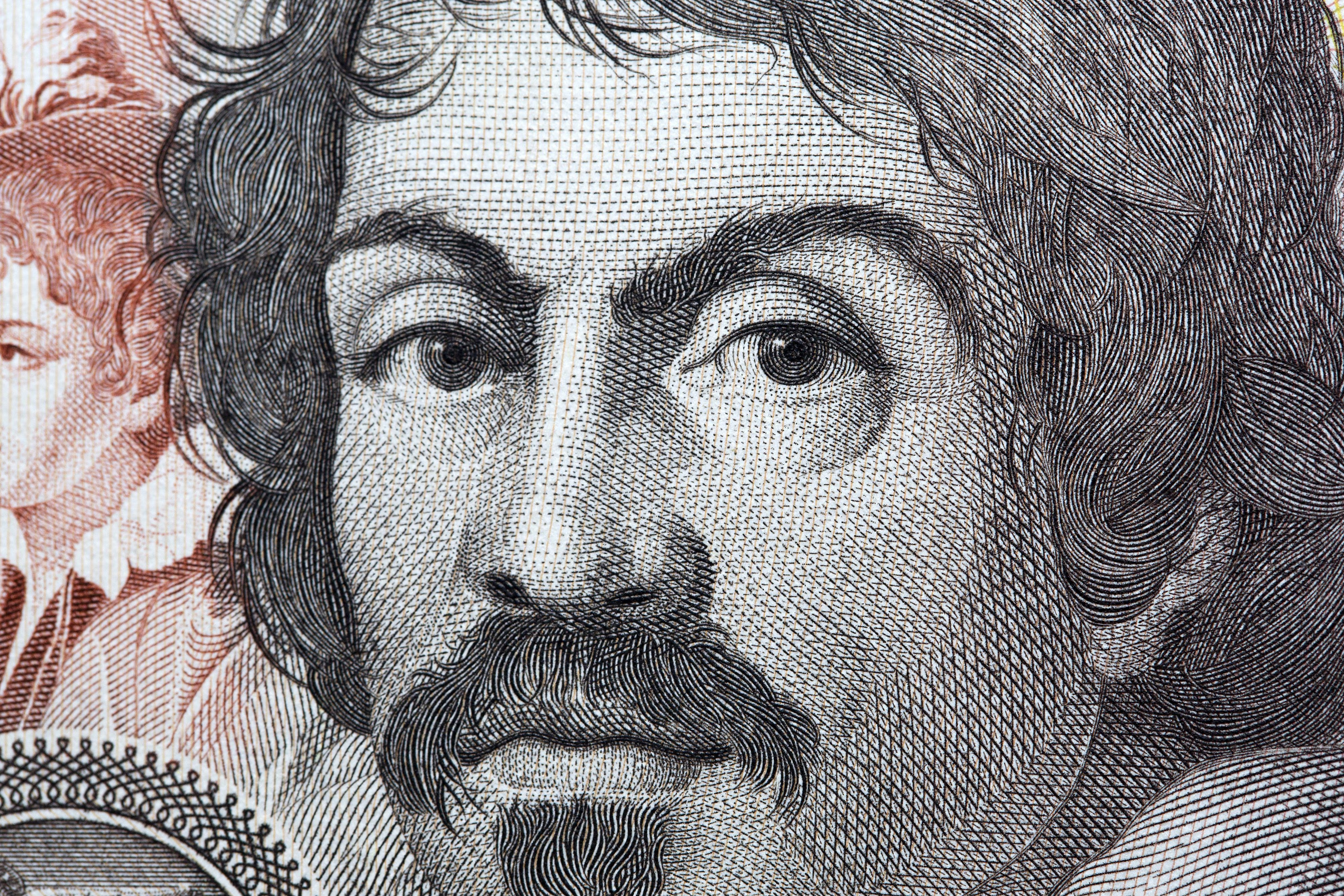
Michelangelo Merisi, known as Caravaggio, born on 29 September 1571, is one of the most important painters in the history of Italian art, although today he is much better known by the name of the city in which he spent much of his early childhood. Having become famous during his lifetime and overshadowed for centuries after his death in 1610, he was only fully rehabilitated from the twentieth century onwards (thanks to scholars such as Roberto Longhi and Anna Banti), a period during which many parts of his life finally emerged from legend. Let’s see the most important ones.
1. The Italian painter was born in the midst of the plague epidemic of the sixteenth century
Caravaggio was born in Milan in 1571 in the midst of a plague epidemic (not to be confused with Manzoni’s, which followed a few decades later). In 1577, to escape the contagion, the Merisi took refuge in their hometown, Caravaggio, forty kilometers further east, but even there they did not escape the disease: death struck their father and grandfather on the same day. Then, four years later, her mother also died of the same disease.
2. Caravaggio and the influence of the Counter-Reformation
When the Catholic Church reacted to the Protestant Reformation with the Counter-Reformation in the late 16th and early 17th centuries, it formally or otherwise turned to painters, sculptors, and architects to confirm the dominance and power of Catholicism (and to win back the first converts to Protestantism). This climate greatly influenced the artistic production of the period, which had to be vivid and close to ordinary people: characteristics that we also find in Caravaggio’s paintings, in his highly dramatic compositions and in the scenes that spoke to faithful of all social classes and especially to the marginalized.
3. The Church didn’t like him
Despite his contribution to the Counter-Reformation, the Church did not particularly love him due to his “lack of decorum”, especially in portraying sacred characters and situations. His ambiguity and the widespread darkness of his works did not adapt well to the style of classicist painting, which was increasingly widespread throughout Europe, nor to the dialectic of the Enlightenment. This did not stop him from being admired and appreciated.
4. Nonconformity and bisexuality
There are also more personal reasons why the Church didn’t like Caravaggio. His companies, for example: it is known that he often frequented prostitutes, who he also asked to be models for his madonnas, and that he was bisexual.
5. The special technique he used for light
Caravaggio, as we already explained in this article, is famous for the theatrical use of chiaroscuro, which illuminates the subjects emerging from the darkness: according to recent studies it seems that the artist used an optical camera with lenses, mirrors and even photosensitive substances to project the models onto the canvas, anticipating photographic techniques.
6. The murder and exile of the “cursed genius”
This is perhaps the best-known part of Caravaggio’s life: the artist had a short temper and a propensity to pick fights. There are many violations recorded, some minor (such as walking around with a sword without a license) and serious (including slashing prostitutes and guards), up to and including murder. Art historians have long debated the details and context of the assassination of Ranuccio Tomassoni, who however certainly died by his own hand on the sidelines of a tennis match. As punishment, Caravaggio received a death sentence: he fled first to Naples, where he hid in the homes of noble families, and then to Malta, an independent state that welcomed him safely. During his exile he never stopped working, moving to Sicily to paint some of his most beloved works, such as the Beheading of Saint John the Baptist.
7. He tried to buy papal forgiveness with his works
During his four years of exile, he constantly tried to obtain pardon from the Pope to revoke the death sentence: he sent many paintings (including the famous David with the head of Goliath and Salome with the head of John the Baptist) to influential friends and family who enjoyed papal support, in the hope that they could mediate to obtain pardon. Unfortunately he died before obtaining results.
8. He gave birth to an artistic movement that takes his name
What Caravaggio achieved with his works caused a great stir and admiration among his contemporaries, giving rise to Caravaggism, an international movement within Baroque painting. Caravaggio’s main Italian follower was Bartolomeo Manfredi, whose scenes of gambling and fortune-telling were widely imitated. Caravaggio’s art was also very popular among foreign painters in Rome, such as the Dutch Hendrick ter Brugghen and Gerrit van Honthorst, the French Valentin de Boulogne and Nicholas Tournier, and the Spaniards Juan Bautista Maino and Jusepe de Ribera and Zurbarán. Unfortunately, given the Church’s aversion to his style, Pope Urban VIII and the Jesuits vetoed Caravaggism, which thus died in the bud.
9. He may have been poisoned by his paintings
In 2010, human bones were found in Porto Ercole which most likely belonged to Caravaggio. The bones had toxic levels of lead, almost certainly from the paint. It is established that Merisi painted with his hands, and therefore was a subject particularly at risk of the so-called “saturnism”, i.e. lead poisoning (the same syndrome that killed Van Gogh and Goya). However, there is a second hypothesis regarding his death, which occurred at just 39 years of age, namely that he may have been killed by syphilis.

10. One of his paintings was at the center of a famous art theft (perhaps by the mafia)
The Nativity with Saints Lawrence and Francis of Assisi by Caravaggio was included by the FBI in the list of the ten most important stolen masterpieces in the world. The work was kept in the Oratory of San Lorenzo in Palermo: on the night between 17 and 18 October 1969 it was stolen and has never been recovered since. There are several lines of investigation open, including a mafia-related one, but we have not yet come close to the truth. The market value of the painting, meanwhile, is estimated at at least 20 million dollars.