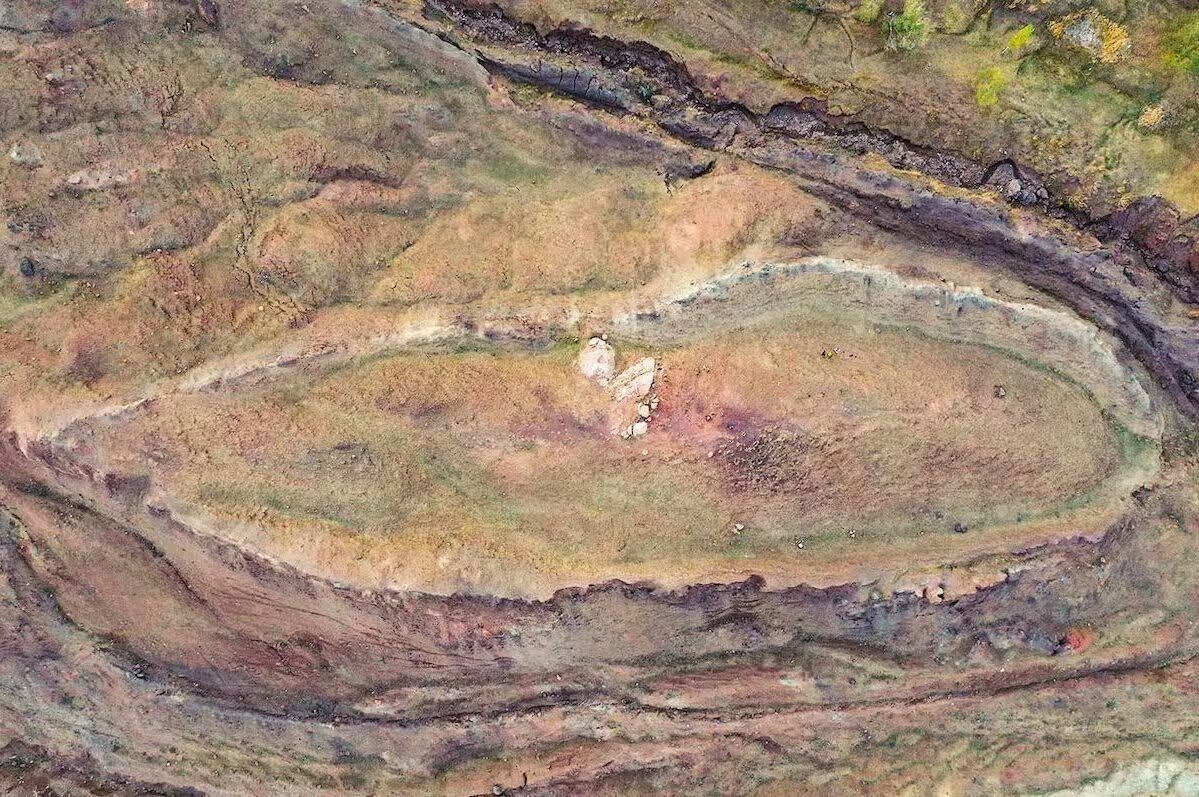
The Noah’s Ark Scans research group is trying to demonstrate that the Durupınar formation, a relief in eastern Turkey about 157 meters long, holds what remains of Noah’s Ark, the boat described in Genesis, made of wood which according to scholars would have petrified. We are 29 km from Mount Ararat, at around 2 thousand meters above sea level. For the first time, a camera descended into one of the site’s core holes and the group released the footage, which can be seen below. The filming was done by Gopher, a small robot, mounted on wheels and equipped with a video camera. Core drilling operations began in September, as part of a project that has received the green light from the Turkish authorities and is directed by the Cumhuriyet University of Sivas.
The news has started to travel around the world, but to understand why a drilling in a hill in Anatolia causes such a sensation we need to take a step back. According to the Book of Genesis (the first book of the Bible and the Torah), God unleashed a flood to erase a humanity that had become violent and corrupt and entrusted Noah with the task of building a colossal ship in which to shelter his family and the animals of the Earth.
The detail that sparked the research is precisely in Genesis, when as the waters receded “the ark came to rest on the mountains of Ararat”. Already in the Middle Ages, in fact, scholars wondered if that name referred to Urartu, the ancient name of the Armenian area, a short distance from the current eastern Turkish border.
The discovery of Noah’s Ark in 1959 and the denial by geologists
In reality, expeditions in the region have followed one another since the Middle Ages, but the real turning point came in 1959. According to the reconstruction published on the Noah’s Ark Scans website, it was a captain of the Turkish army, Ilhan Durupinar, who noticed in some aerial reconnaissance photographs an oval crest that resembled the bow of an enormous hull. The following year a joint Turkish-American expedition reached the site, but with the instruments of the time could not establish much about what lay beneath the surface.
In 1977 the researcher Ron Wyatt began field investigations destined to last about twenty years and it was in this season that the Noah’s Ark hypothesis took hold. In 1996, however, a study signed by geologist Lorence Collins (together with explorer David Fasold) dismissed the alleged ark as a common geological structure. The authors attributed the singular shape of the relief to completely ordinary processes, minerals of volcanic origin consumed by erosion, mud rising to the surface and landslides.
Fasold and Collins’ study describes the ship-shaped shape as a double-dipping syncline, a fold of sedimentary layers that erosion has sculpted into a ship-like profile. The geologist Collins arrives at this conclusion first by examining the supposedly recovered iron stirrup, a sample of the Kazan rock and one of the anchor stones. The bracket turned out to be an aggregate of limonite grains immersed in clay, calcite, quartz and anthophyllite. In fact, as the study explains, a forged iron would have been compact and the melting would have separated those minerals as slag. This is confirmed by the chemical analyzes under the scanning electric microscope, conducted in five points of the find, with the composition changing from one point to another, while a molten metal would be almost homogeneous.
Excavations and core sampling have never yielded fossil wood, reeds or carbon of organic origin. According to the study, the anchor stone, subjected to chemical analysis, is an andesite similar to volcanic rocks from the Ararat area, while the alleged gofer bark is a metamorphosed peridotite. Then there are the aerial and ground photographs which show how two hundred meters away, beyond the landslide, the layers around a resistant bank present the same forms of erosion and the same vegetation as the presumed shape of the ship.
What the cores found at the Durupınar site in Türkiye and what happens now
Since 2014, Noah’s Ark Scans has conducted non-invasive surveys on the site with ground penetrating radar, electrical resistivity tomography and LiDAR. The team reports linear structures and right angles in the subsurface and, in 2024, soil samples with nearly three times as much organic matter inside the formation as outside. These results were disseminated by the promoters themselves, who on their website claim that this high organic content is consistent with the presence of decomposed biological material such as wood.
In 2026, a campaign authorized by the Turkish authorities and directed by Cenker Atila of the Department of Archeology of Sivas Cumhuriyet University in collaboration with Noah’s Ark Scans was started.
According to Andrew Jones, founder of Noah’s Ark Scans, “So far we have recovered layers of rich organic material that we believe may be the decomposed remains of the upper level of the Ark.” Furthermore, the founder of the research team explained that “No bedrock or compact limestone has so far been identified in the holes drilled within the formation. These results call into question claims that it is simply a natural form made of limestone or bedrock.”
“We are now collecting physical samples for laboratory analysis and more field work is planned for next year. This first season of our international team has opened a whole new chapter in the Noah’s Ark investigation,” Jones said.
Jones himself urges caution. When asked by Newsweek, he specified that “we have not identified any material as ancient wood nor have we established its age”, because no results have yet arrived from the laboratories and that the decomposed remains of the Ark are “the hypothesis we are verifying, not a discovery”. As for timing, the samples are destined for an independent laboratory and some universities. The analyzes will concern the organic matter content, mineralogy and microscopic observation, with further tests to be decided based on the initial results. The first results are expected during the winter and a more detailed scientific report is expected for spring 2027. The word now passes to the laboratories. The analyzes on the samples will tell whether that organic material is wood worked by man or the normal deposit of an Anatolian hill.