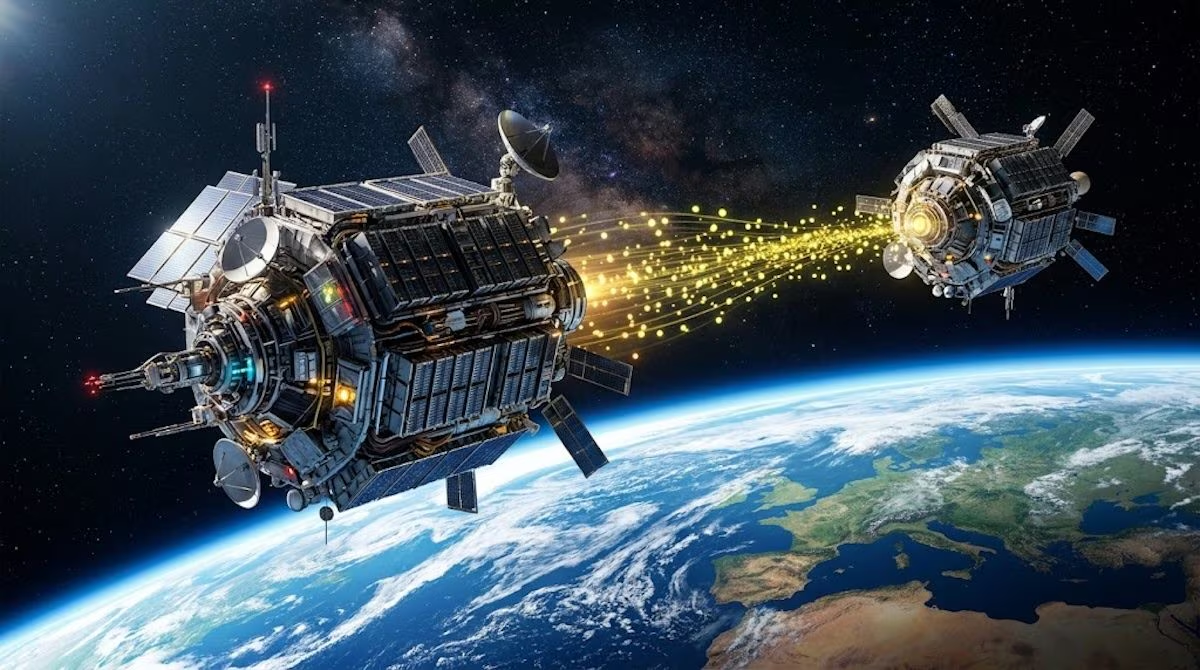
Google is about to test the feasibility of its Project Suncatcher in space (in Italian it could be literally translated as “Sun-catching Project”): a name that says it all. The aim of this project is essentially to one day be able to host in space «a scalable infrastructure for machine learning», to quote Google directly. In achieving this long-term goal, Google is preparing to launch a demonstration satellite into orbit today to evaluate how its proprietary TPU chips perform in space.
The satellite that will transport them will be very far from being a true orbital data center, but it represents the first concrete step of Project Suncatcher. The initial mission will take place aboard the upcoming Transporter-18 rideshare mission with SpaceX and was developed in collaboration with Planet.
The genesis of the project and the first tests
The idea was born in 2023, when Blaise Agüera y Arcas, among those responsible for the development of artificial intelligence at Google, wondered about the growing amount of energy required by data centers. Hence a question arose: why not directly exploit the Sun’s energy in space and build computing infrastructures in orbit in the future?
The experimental satellite, developed together with Planet Labs, will carry four TPUs into space (Tensor Processing Unit), the microchips that Google uses to accelerate the calculations necessary for artificial intelligence systems. Their overall capacity will be comparable to that of a single server, i.e. one of the computers which, multiplied by thousands of units, normally constitute a data center.
The first objective, therefore, will not be to make a colossal AI infrastructure work in space, but to proceed in small steps and first verify whether these TPUs can actually work in orbit, in conditions very different from those on Earth. During the launch, which lasts about ten minutes, the satellite must in fact withstand very intense vibrations, as well as accelerations that can reach 10 times the force of gravity. Individual components can be subjected to even greater stresses, up to 50-100 times the force of gravity.
The first tests carried out by the Google team in environments that simulate these complex conditions have given the first positive results. In this regard Google explained:
The team conducted vibration tests by intensely shaking the satellite on all three axes to simulate the frequencies of a space launch. Tests like this rarely go as expected, so we were pleasantly surprised that the hardware withstood the force.
But overcoming the complex launch conditions is just one of the many challenges that Google’s hardware is called upon to withstand. Another problem comes from radiation. We know well how on Earth the atmosphere acts as a shield and helps protect us from high-energy particles coming from space. In orbit, however, electronics are more exposed to cosmic rays and solar events. To understand how the TPUs would react, Google engineers subjected them to a particle bombardment at the Crocker Nuclear Laboratory at the University of California, Davis.
Among the effects observed were so-called bit-flips, i.e. temporary changes in the state of a bit. The bit is the smallest unit of measurement of digital information and can only have two values: 0 (off) or 1 (on). Explained in simple terms, when the bit-flip phenomenon occurs these values can “go high” and 0s can become 1s or vice versa. The tests conducted by Google simulated a quantity of radiation higher than that which the processors should receive during a five-year mission and apparently the TPUs resisted well and the errors attributable to the bit-flipping phenomenon remained within a rather acceptable tolerability range.
Another challenge is heat. Processors consume energy and some of this is inevitably transformed into heat. On Earth, data centers can use air and water to move it away from servers. In space, however, there is no atmosphere and therefore it is not possible to rely on convection, that is, the transfer of heat through a moving fluid.
The heat must therefore be dispersed through radiation, emitting energy in the form of infrared radiation and radiators are needed to do this. For this reason, Google is also experimenting with systems based on the combination of heat pipes and radiators, testing them in vacuum thermal chambers that simulate space conditions.
In the current prototype, the TPUs can work for about 15 minutes before needing to be turned off to cool. During the mission they can therefore be used for relatively simple processing.
Solar energy: a powerful ally to exploit
An advantage in bringing computing systems into orbit comes from the possibility of exploiting solar energy more efficiently than is possible on Earth. Without Earth’s atmosphere to filter some of the solar radiation, photovoltaic panels can receive much more light and, according to Google, can produce up to eight times more solar energy than Earth. The long-term goal would therefore be to exploit this advantage by connecting many satellites equipped with AI processors together.
To make them work as a single infrastructure, however, extremely fast connections will be needed. The satellites will have to communicate with each other using laser beams and continuously know their own position and that of nearby satellites. The difficulty is considerable: the lasers will have to guarantee a very high bandwidth and over relatively short distances to maintain a precision comparable, to give an idea, to that necessary to hit a coin from kilometers away while both the target and the starting point are moving.
Google plans to test this part of the project in 2027, when two more satellites are expected to be put into orbit. The Mountain View technology giant also announced that it is already working on another 80 satellites which, in fact, could constitute the first nucleus of what could become an orbital computing infrastructure. At least that’s Google’s intentions.