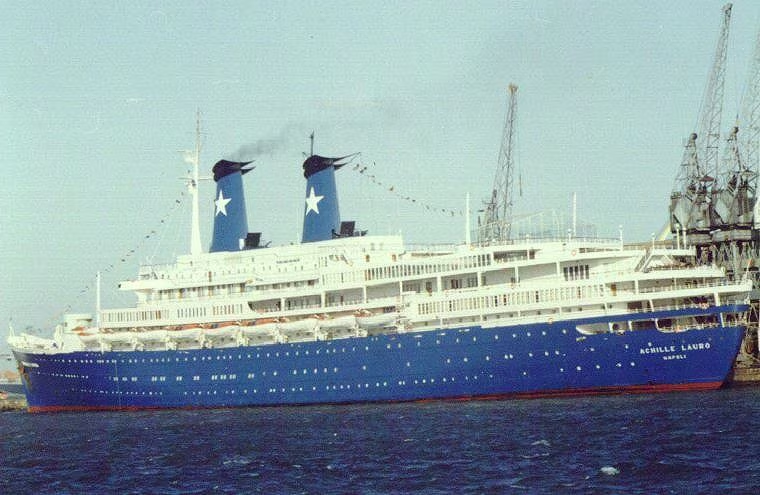
The Achille Lauro was a passenger ship active between 1947 and 1994, known for its terrorist hijacking in 1985. Built in Holland and put into service for a Dutch company, the ocean liner was acquired in 1965 by Achille Lauro, the famous Neapolitan shipowner and politician. It then became part of the Lauro Fleet as a cruise ship. In 1985, while sailing off the coast of Egypt, it was hijacked by a Palestinian commando unit intending to protest the occupation of Palestine. The hijacking was resolved diplomatically, but it gave rise to the Sigonella crisis between Italy and the United States.
After the hijacking, the Achille Lauro continued to sail until 1994, when it sank in the Indian Ocean due to a fire that broke out on board.
What the famous cruise ship was like and the history of its sale to Lauro
The Achille Lauro was a passenger transport ship. 196 meters long and 25 meters wide, it had a tonnage of almost 24,000 tons. It was powered by 8 engines, which could develop a speed of 22 knots, equal to just over 40 kilometers per hour (some sources report slightly different figures on the technical data). The crew consisted of approximately 300 people, while the maximum number of passengers was 152 in first class and 1155 in tourist class. There were 9 decks, of which 6 were accessible to passengers. From a technical point of view, the ship was cutting-edge and was also equipped with a desalination plant which allowed drinking water to be obtained from the sea.
The Achille Lauro has Dutch origins. The hull was laid down in 1938 at the Vlissingen shipyard for the Koninklijke Rotterdamsche Lloyd (KRL) company. The outbreak of the Second World War delayed the completion of construction, which was completed only in 1947. The ship, which had the name Willem Ruys, entered service on 2 December of that year on the route between Europe and Australia. It operated as a passenger ship because at the time air transport was still underdeveloped and long-distance travel took place mainly by sea.
In 1963, due to the growth of air transport, it changed its intended use and was used for cruises in the Mediterranean. Two years later KRL sold the vessel to Achille Lauro, the wealthy shipowner and former mayor of Naples.
Renovated by the Palermo shipyards, the vessel returned to service as a cruise ship in 1966, taking on the name of its new owner, Achille Lauro. She served regularly for many years, despite being hit by fires and once colliding with another vessel.
The terrorist hijacking of the Achille Lauro: what happened in 1985
The ship was hijacked on 7 October 1985 by a commando of the Popular Front for the Liberation of Palestine: four men, armed with Kalashnikov machine guns, ordered the commander to direct the ship towards the port of Tartus, in Syria, instead of towards the Israeli port of Ashdod, where it was headed. The purpose of the hijacking was to obtain the release of fifty Palestinian prisoners held in Israeli prisons and, more generally, to bring the occupation that their country was suffering to the attention of public opinion.
After the hijacking, frenetic negotiations began, involving the Italian government, led by Bettino Craxi, the Egyptian government and the Palestinian political authorities. The Italian armed forces also prepared an operation to regain control of the ship by force and had a unit of 60 raiders transferred to Cyprus, to the Akrotiri base. However, the armed assault was not necessary: the negotiations were successful and the kidnappers agreed to free the ship in exchange for immunity and safe conduct to an Arab country. The Achille Lauro therefore landed in Egypt. Everything seemed to have ended well when it emerged that a man, Leon Klinghoffer, a US citizen of Jewish origin, had been killed during the kidnapping.
The US administration, led by Ronald Reagan, who already did not like the Italian government dealing with the kidnappers, decided to react: on 11 October, after a Boeing 737 had taken off from Egypt to bring the kidnappers and mediators to Tunis, the American fighters forced the aircraft to land at the NATO base in Sigonella, in Sicily. Thus began a diplomatic crisis, because the Italian government refused to hand over the kidnappers to the United States. When American Delta Force soldiers surrounded the plane, Italian carabinieri surrounded them in turn. The Italian government managed to assert its reasons and did not hand over the kidnappers, who were tried by an Italian court and served long prison sentences in Italy.

The fire in the engine room and the sinking of the ship
After the hijacking, the Achille Lauro returned to service. In the following years he followed the vicissitudes of the Lauro Fleet, which in 1987 came under the control of other entrepreneurs, taking the name of Starlauro, and in 1991 was acquired by another company, the Mediterranean Shipping Company.
The Achille Lauro continued to sail under its name, despite changes in ownership, until 1994. On 30 November of that year, while sailing off the coast of Somalia, as part of a voyage from Genoa to South Africa, a fire broke out on board. Despite the intervention of various rescue ships, the fire spread to the point of forcing the passengers and crew to abandon the ship, which sank.
Three people lost their lives in the fire, while another was missing. Among the survivors there was a young man destined to become a well-known television personality: Alessandro Borghese, a member of the kitchen staff.
The wreck of the Achille Lauro today lies at around 5000 meters deep.