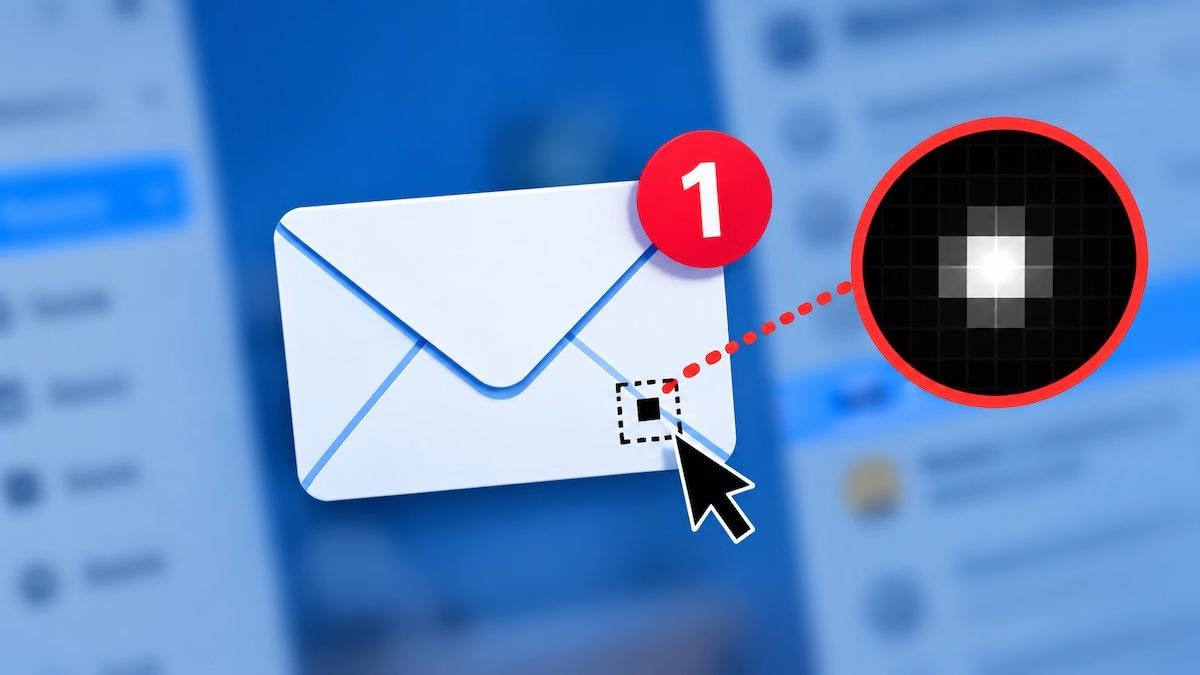
Anyone who sends a newsletter can know if it has been opened even when the recipient has not clicked on any link. What makes this possible, in many cases, is the tracking pixel (or tracking pixel), a tiny, almost invisible image inserted into the message. Its loading can provide the sender with information about interaction with the email without the recipient taking any particular action.
The topic is back in the news because by 29 October 2026 companies, platforms and services that use these tools will have to comply with the Guidelines of the Guarantor for the protection of personal data. The indications clarify when consent is required, what information must be provided to users and in which cases tracking can instead be used without prior authorization.
How tracking pixels in emails work and what information they can reveal
Usually this image is not embedded directly in the email, but is hosted on a remote server. A reference to this resource is inserted in the HTML code that makes up the message. When the mail program loads remote contents, a request is automatically sent to that server.
It is precisely that request that acts as a “signal”. The system can record the loading of the pixel and thus infer that the message has been opened. Tracers can also be associated with specific identifiers, so as to link the event to a single user or a particular communication.
Depending on how the system is configured, the pixel can reveal more information than just the aperture. The request to the server allows you to record the date and time of the upload and, if it is made again, to detect how many times the message has been opened. It can also provide information on the type of device used and, in some cases, the operating system. When the recipient’s IP address is available, it is also possible to estimate their approximate geographic location, without however identifying their exact location. This doesn’t mean that the pixel “reads” what’s happening on the screen or knows the contents of your inbox.
The principle has been used in email marketing platforms for a long time. Services like Mailchimp insert a small invisible image into HTML campaigns and record an open when it is downloaded. Whoever sends a newsletter can thus calculate metrics such as the opening rate and obtain an indication, at least approximately, of how many people have viewed the communication.
The system, however, is not infallible. If the mail app blocks remote images or the email is shown as text only, the asset is not retrieved and data may not be logged. The opposite can also happen. Some functions designed to protect privacy or other automated activities can make the data less reliable, resulting in openings that do not necessarily correspond to an actual reading.
An example is Apple’s Mail Privacy Protection. When enabled, it hides the user’s IP address and prevents senders from knowing reliably whether the email has been opened. The data should therefore be interpreted as a technical indicator, not as absolute proof that the content has been read.
Why tracking pixels can create privacy issues
The delicate point is not so much the size of the pixel, but the fact that its functioning can be invisible to the recipient. A person can normally open a newsletter without knowing that, at the same time, the image retrieval is generating a request capable of providing information about his activity.
The data collected can be used to measure the effectiveness of a campaign in aggregate form, improve message delivery or combat spam. If, however, the openings are associated with the individual user, they offer clues to their reading habits, for example the times at which messages are opened or the frequency with which they are viewed. This information can be used to adjust mailings, understand which communications arouse the most interest or build commercial profiles. It is especially when monitoring becomes individual that the issue of data protection takes on greater importance.
The Guarantor considers these tools particularly delicate also because the transfer of information can occur without explicit action by the user. Unlike a button that you consciously choose to click, no voluntary action is required here. For this reason, whoever receives the email must be clearly informed of the presence of the pixels and the purposes for which they are used.
The operation resembles that of other online tracking tools in some aspects, but should not be confused with cookies. The latter are small files stored by the browser while browsing the web, while the tracking pixel in emails uses the loading of a remote image. While they work differently, both may be subject to tracking and data protection rules.
What changes from October 29th with the rules of the Privacy Guarantor
The Guarantor’s Guidelines intervene precisely on these aspects. After the six-month period granted to operators to adapt, the new indications become fully operational and concern not only commercial newsletters, but more generally public and private entities that use tracking pixels in email communications.
The starting rule is that whoever receives the message must know that the tracking exists. The information must explain in an understandable manner that these tools are used in emails and for what purposes. When consent is necessary, it must be acquired before using the pixel and must be free, informed, specific and unambiguous.
This applies, for example, when openings are measured at an individual level to analyze the behavior of the individual recipient and improve a promotional campaign, adapt mailings to their interests or build commercial profiles. In the case of promotional communications, the Guarantor admits that the authorization for tracking may be included in the more general consent to receive messages, provided that the request is formulated in a transparent and without force.
However, not all tracking pixels require consent. There are some exceptions. One concerns aggregate statistics, when it is not possible to measure the behavior of the individual and the technical data are anonymized. Other exemptions may concern specific security needs or institutional and service communications in which it is relevant to verify actual awareness, such as some notifications relating to security incidents or contractual changes.
Finally, there is the issue of revocation. Anyone who has accepted tracking must be able to change their mind easily and, according to the Authority’s indications, also selectively. In practice, it should be possible to continue receiving emails without tracking pixels, without being forced to unsubscribe from the service entirely.
The Guidelines therefore do not absolutely prohibit the use of tracking pixels, but define the conditions of their use. The recipient must be able to know if he or she is being monitored and, in applicable cases, choose whether to accept it or revoke consent.