The results of the fact-finding survey organized to evaluate the possible impacts of permanent summer time were presented today, 15 October: the
The Commission, however, has not expressed its opinion on the possibility of making summer time permanent or, on the contrary, solar time permanent. The choice, therefore, remains open: according to the Commission, the topic requires “a distinct evaluation of the respective energy, health, social and production effects, as well as their territorial distribution”. In this sense, the recommendations indicate the need to promote the resumption of negotiations in European bodies to abolish the seasonal change.
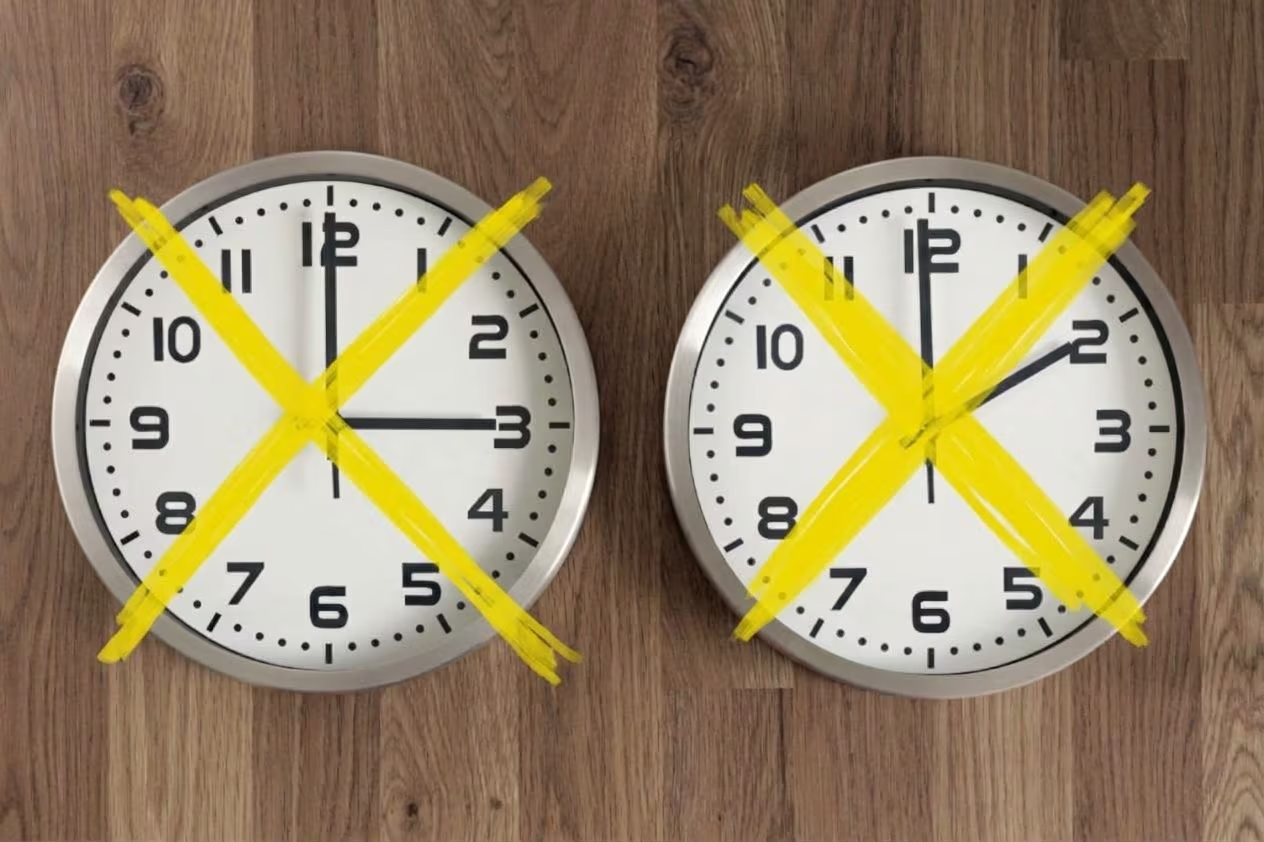
The press conference takes place approximately ten days before the next time change: on the night between 24 and 25 October, in fact, solar time will start regularly, with the hands moving back an hour, with 03:00 becoming 02:00.
The content of the fact-finding investigation
On 1 October 2026, the X Chamber Commission (Production Activities, Commerce and Tourism) unanimously approved the final document of the fact-finding investigation on the impact of permanent summer time in Italy, divided into seven chapters, which analyzes the effects of the time change from an energy, economic, health and social perspective.
On the energy consumption front, Terna data indicates that the current regime (with seven months of summer time) produces savings of approximately 302 GWh per year. The extension of summer time to the winter months would add another 160 GWh, for a total of approximately 462 GWh, equal to approximately 0.15% of the national electricity requirement. In economic terms, we are talking about approximately 120 million euros for 2026, of which 80 million refer to the April-October period already in force. However, the document highlights that this benefit has progressively reduced over the last twenty years, especially due to the spread of LED bulbs and low-energy lighting systems.
As regards the productive sectors, commerce and tourism would welcome permanent summer time: more light in the evening hours would mean more people out and about, more perceived safety, more consumption and better deseasonalization of tourist flows. However, the winter mountain tourism sector reports important critical issues: with permanent summer time, in some areas of Northern Italy dawn would arrive after 9:00, reducing the operational window of ski resorts. Similar concerns come from the agricultural and construction sectors, where the delay in dawn would put workers in conditions of poor visibility in the early hours of the day.
The most debated chapter is healthcare. Experts in the medical-scientific sector agree on one point: the double seasonal change of time should be overcome, because the spring and autumn transitions produce measurable negative effects (increase in heart attacks, road accidents and workplace accidents in the days following the change). But on which regime to adopt as a replacement, positions clearly diverge. The sleep medicine community (AIMS, AASM, British Sleep Society) indicates permanent solar time as the most prudent option for health, because it is more consistent with natural circadian rhythms.
Other experts, including Professor Giovanni Esposito (University of Naples Federico II) and the EMA (European Medical Association), believe that permanent summer time could be a valid choice, provided it is accompanied by careful monitoring of the effects on vigilance, circadian adaptation and safety in sectors with greater operational intensity, such as healthcare, transport, logistics and public services.
The conclusions of the X Commission of the Chamber of Deputies
At this point, in its conclusions the X Commission of the Chamber of Deputies proposed:
- The start of an experimental phase of summer time, temporally defined and supported by a multidisciplinary monitoring system on energy consumption, road safety, predatory crimes, health, productivity and sectoral and territorial impacts. Any experimentation should cover at least a complete seasonal cycle, while duration, indicators, evaluation criteria and frequency of publication of results should be defined before starting, ensuring the publicity of the data;
To follow:
- The adoption of a permanent summer time regime which would make it possible to consolidate, albeit to a limited extent, the energy and economic benefit, to favor the trade and tourism sectors through the extension of afternoon and evening light and to produce positive effects in terms of urban safety. The evaluation of this option, however, must be accompanied by the identification of measures proportionate to the territorial and seasonal critical issues, with particular regard to the flexibility of school timetables, public services and work.
- The adoption of a permanent solar time regime, indicated above all by a part of the medical-scientific community as an option more consistent with the alignment of circadian rhythms and with natural light cycles, but which, according to the assessments of other subjects interviewed, would lead to a reduction or loss of part of the energetic and economic benefit connected to the greater availability of evening light, as well as a lesser valorisation of afternoon light for tourism-commercial purposes;
- Promote the resumption of negotiations in European bodies to abolish the double seasonal exchange rate. In this sense, the launch of a coordination initiative at European level led by Italy is proposed, also in light of the absence of a shared position at EU level, in order to avoid the fragmentation of timetable regimes between Member States and the related repercussions on transport, logistics and the internal market.