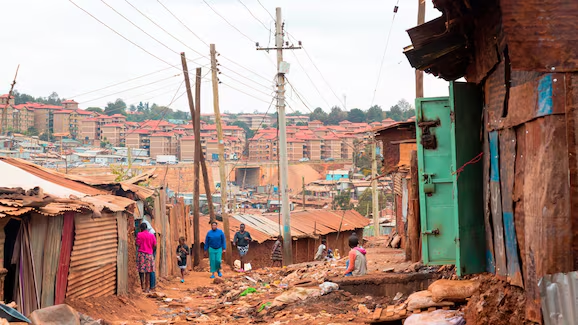
According to the UN SOFI 2026 report, 645 million people in the world suffered from hunger in 2025. Overall, the percentage of people suffering from hunger has decreased (7.8% compared to 8.1% the previous year), but progress remains uneven: Africa remains the most affected continent and there are strong disparities between states. Also of concern are the possible effects of El Niño on food security in the coming months and years. To draw attention to the right to food and the inequalities that still characterize access to food resources, World Food Day is celebrated every year on 16 October. The anniversary coincides with the anniversary of the foundation of FAO, the Food and Agriculture Organization of the United Nations, established on 16 October 1945.
Data from the 2026 UN report on world hunger
The 2026 edition of the report The state of food security and nutrition in the world (SOFI), published by five United Nations agencies, indicates that the global hunger situation is slowly improving. For the third consecutive year, the number of people suffering from hunger is decreasing: almost 14 million people less than in 2024 and around 43 million less than in 2022. The trend is also positive when considering the percentages: the share of the world population suffering from hunger went from 8.6% in 2022 to 8.1% in 2024, up to 7.8% in 2025.
The improvement, therefore, is progressive, but relatively slow compared to the scale of the problem as the current pace is not sufficient to achieve Sustainable Development Goal 2, called Zero Hunger, by 2030. According to FAO projections, in 2030 there could still be between 510 and 520 million people suffering from hunger.
Furthermore, decreased hunger does not automatically mean more people have access to adequate nutrition. The report distinguishes between malnutrition and food insecurity. To estimate the number of people suffering from chronic hunger, FAO uses the prevalence of undernourishment indicator, which counts those who do not have regular access to a sufficient amount of calories to lead an active and healthy life. Moderate or severe food insecurity estimates how many people consistently have difficulty obtaining sufficient, quality food.
If in 2025 around 645 million people in the world suffered from hunger, overall around 2.1 billion (a quarter of the world population) lived in conditions of moderate or severe food insecurity. This indicator also improved from the 27.1% recorded in 2024, but remains higher than pre-COVID-19 levels.
Regional disparities: conflicts and climate worsen the situation in Africa
The decrease in hunger at a global level hides profound differences between the different regions of the planet. In 2025, according to the FAO, around 309 million people suffered from hunger in Africa, compared to 292 million in Asia. The African continent therefore surpasses the Asian continent in terms of the absolute number of undernourished people, despite its total population being significantly lower. The percentage of the population affected also shows a significant difference: in Africa the prevalence of hunger went from 20.3% in 2024 to 20.0% in 2025. The figure shows a slight improvement, but means that around one in five people on the continent continues to suffer from hunger.
The share of the population living in conditions of moderate or severe food insecurity reaches 56.6% in Africa. This is followed by Latin America and the Caribbean, with 22.9%, Asia, with 20.3%, and North America and Europe, with 8.7%.
The differences depend on a combination of economic, political, environmental and social factors. Protracted conflicts, market instability, poverty and poor agricultural infrastructure can hamper the production and distribution of food.
Added to these elements are the effects of climate change and extreme weather events. In particular, regarding this aspect, the risk linked to El Niño is increasing, a natural climatic phenomenon associated with the anomalous warming of the surface waters of the tropical Pacific, which can alter rainfall and temperatures in different regions of the world, increasing the risk of drought in some areas and intense rainfall in others.
According to estimates from the United Nations World Food Programme, a possible particularly intense episode of El Niño could contribute to pushing around 50 million more people into conditions of hunger and in 2027, up to 274 million people spread across 45 countries could find themselves in conditions of severe food insecurity. The phenomenon could therefore aggravate already ongoing food crises, particularly in countries that have limited resources to deal with climate shocks of this magnitude.