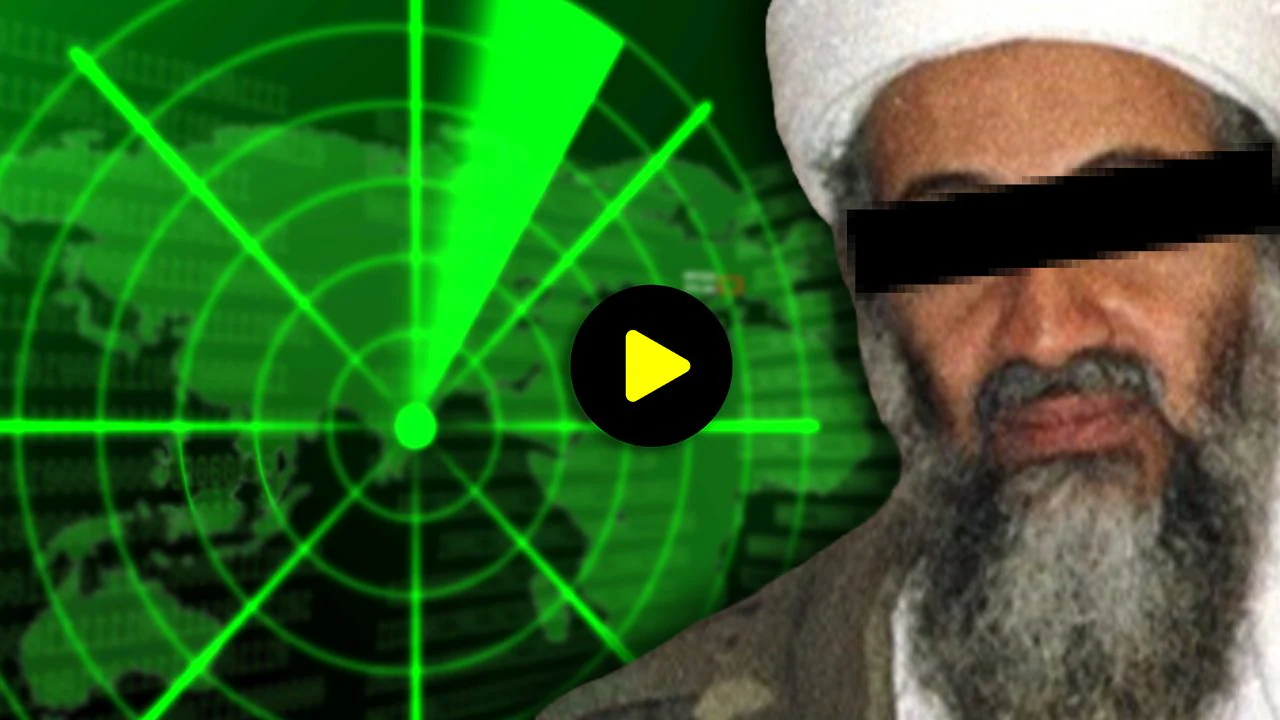
After the September 11 attack, the United States began a ten-year manhunt to find him: Osama bin Laden. But why did it take them so long? And how did they eliminate him in his hiding place? Today we retrace the entire Operation Neptune Spear, shedding light on one of the most discussed military operations in recent history.
The escape after September 11, 2001
After 9/11, US intelligence concentrated a lot of its resources on identifying Osama’s hiding place… and in fact within a few weeks they identified him: he was hiding inside some caves in Tora Bora, Afghanistan. The US government, however, chose not to send large contingents of troops to the site and entrusted the manhunt mainly to local Afghan militias.
This choice – within the United States – was highly criticized. In fact, that December a battle took place in Tora Bora whose main objective was precisely to encircle and capture bin Laden… too bad that the US presence proved to be too small and, in the end, the Al-Qaida leader managed to escape. From here began a dark period for US intelligence. They managed to make some interceptions, but not much. Paradoxically the only information they had were the videos that Osama himself published. And where did he publish them from? Oh, here’s the beauty of it. The various US government agencies, with so little data available, began to hypothesize where he could be found: specifically, the CIA and DIA became convinced that Osama was hiding in Waziristan, a mountainous Pakistani region a few kilometers beyond the Afghan border
But nothing could be more wrong. Let’s go back to Tora Bora. During the battle Osama managed to escape and, as partially understood by the CIA and DIA, decided to take refuge in Pakistan. Why Pakistan? Well, because it was a short distance from Tora Bora and crossing the border wasn’t particularly complicated. But compared to what was hypothesized, he did not go to live in a mountainous area, in Waziristan, but took refuge in the city. Indeed, almost out of disgrace, he moved to Abbottabad, to a house a short distance from the Pakistani military academy. In other words, he hid in plain sight.
Obviously, even if it is true that he lived in the city, his hideout – of which the USA still knew nothing at the time – was anything but improvised.
The shelter in Abbottabad, Pakistan
The structure had a semi-triangular shape with main sides measuring 117 by 85.6 by 61 meters. The perimeter was enclosed within a wall between 3 meters and 5 meters high, on top of which there was barbed wire. The only access to the complex was on the northern side: it was a heavy metal gate that overlooked a walled corridor, at the end of which there was a new metal gate overlooking the guardhouse.
Once you passed this second gate you reached the heart of the complex, a small three-storey building, the bin Laden residence. Inside there were living rooms, bedrooms, kitchens and bathrooms. Nothing strange in short… if it weren’t for the presence of heavy metal doors at the beginning of each flight of stairs: their purpose was to hinder the advance of a possible intruder. In fact, no one outside the organization could access the top floor, the one where Bin Laden’s study was located. Here were the PCs, hard drives and all the information regarding al-Qaida. We are talking about hundreds of gigabytes of materials which – only later – will be recovered by US agents and published on a special portal.
The importance of those documents for Osama was such that it pushed the designers of the house to create a protective wall on the balcony, 2.1 meters high, for that floor. But not only that: the isolation had to be almost total. For this reason the windows of the entire building were opaque, and for the same reason the rubbish was burned directly in the garden, so as not to have to push the garbage collector to approach the property to collect the bags. The same was true for food: the structure was almost self-sufficient, with a small vegetable garden in the garden and some animals, such as goats and chickens.
Furthermore, the intelligence also realized that that refuge had no internet and no telephone.
But… if he was so isolated, how did Osama communicate with the rest of the organization? Well, he used couriers. And as we will see, one of them will be the key used by the CIA to locate the hideout.
Couriers to communicate with al-Qaida
Starting from his move to Abbottabad, bin Laden used exclusively couriers to communicate with other al-Qaida members, i.e. extremely trusted people who were given the task of delivering messages. These were usually saved on hard disks or USB sticks and transported even hundreds of kilometers away, so as not to attract prying eyes to the hideout.
When Osama’s courier met with the recipient’s, the two exchanged memory cards, allowing the message to arrive without being intercepted. However, the system had an intrinsic vulnerability: if it had been possible to trace the courier, it would have been possible to find Osama’s hideout. And so it was. In 2007, for the first time, the US secret services discovered the name of bin Laden’s trusted courier, managing to identify his position only in 2009, confirming the Pakistan hypothesis. This man was Abu Ahmed al-Kuwaiti.
In any case, thanks to this information, on 1 August 2010 the secret services managed to locate the Abbottabad residence and, from that moment, a massive monitoring campaign of the hideout began through the use of the RQ-170 Sentinel. Despite the potential of this medium, the CIA never managed to get a photo of Osama inside the building and his presence was hypothesized solely based on logical deductions and clues.
On September 1, the CIA begins to discuss with Obama about a possible military intervention in the complex and between March 14 and 28 of the following year a meeting with national security leaders is held. The goal? Devise the plan to kill bin Laden.
Operation Neptune Spear
May 1, 2011, approximately 11.00 pm.
Two stealth MH-60 Black Hawks take off from Jalalabad base, Afghanistan. Two MH-47 Chinooks remain on standby as a Rapid Reaction Force, i.e. mobile military units ready to intervene quickly. At 00:30 on May 2, after about an hour and a half of flight, the Black Hawks entered Pakistani airspace flying at very low altitude and following the valleys to evade radar. At around 1:00 they arrive near the hideout.
The first Black Hawk (Chalk 1), however, has a problem, falling into its own turbulence. The pilot tries to make an emergency landing in the western garden. However, the plane crashes into a wall, the rotor breaks and the vehicle catches fire. None of the soldiers on board are particularly injured, but the cover is blown. In the meantime, the second Black Hawk (Chalk 2), no longer able to land in the garden, deposits the soldiers outside the external perimeter.
Before entering the compound, the SEALs already had a decisive tactical advantage: someone – even if the official documents never openly stated who – had disconnected the electricity supply of the entire neighborhood. That area of Abbottabad was completely dark. For the SEALs with night vision goggles, it was like fighting in broad daylight. For those inside the compound, however, it was like being blind.
Team 2 chose the fastest possible method to enter the hideout: they used C-4 explosive charges to blow up the metal gates of the external perimeter one after the other, thus opening a passage to the inside. Also because since the helicopter had crashed the cover had been blown: from this moment on the success of the mission depended solely on their speed.
Once inside the perimeter, the two teams converged towards the two buildings of the complex: the annex and the main building, proceeding according to the clear from bottom to top tactic – that is, systematically advancing floor by floor, eliminating any threat.
Annex – approximately 01:00 am
The first firefight occurred at the annex. Abu Ahmed al-Kuwaiti – Osama’s courier, the man who had unknowingly led the CIA there – opened fire on the commandos from behind a door. He was killed instantly. His wife, who was caught in the middle of the fight, was accidentally hit and also died.
Main building – Ground floor
The SEALs quickly moved towards the main building. Here too, no gate or door opened spontaneously: the commandos blew up both the front entrance door and a brick wall at the back with explosive charges, creating a second access route to avoid ambushes. On the ground floor they found Abrar al-Kuwaiti, the courier’s brother. They saw him preparing to shoot and eliminated him.
Main building – Stairs between first and second floors
As the team advanced down the stairs, Khalid bin Laden — one of Osama’s sons — lunged at them. He was shot down on the spot.
Main building – Third floor
As the SEALs advanced floor by floor, Osama stood in the dark in his third-floor study for about 15 minutes, silent, as the sounds of fighting rose from below. Then he made the fatal mistake: he opened the metal gate that blocked access to his room to peek outside and understand what was happening. When he retreated inside, he didn’t lock it behind him. The SEALs followed him directly into the room. Also inside were an AK-47 and a Makarov pistol – never used. A woman tried to come between him and the soldiers. A commando forcefully moved them. A SEAL shot Osama in the chest. He was still alive. A second shot, however, hit him above the left eye, putting an end to a manhunt that lasted a decade.
At the end of the raid, the first thing to do was collect all the available IT materials: hard disks, USB sticks, documents – those that would later become the Abbottabad Collection.
Returning to the raid, in a short time the Pakistani authorities also arrived on site and, until then, were unaware of what was happening there. They ultimately arrested between 16 and 17 people, including women and children. At this point Osama’s dead body was loaded onto the helicopter which remained intact, while the damaged vehicle was blown up by the US military themselves to prevent its recovery by the Pakistani army. Total duration of the operation in the compound: approximately 38 minutes.
Doubts regarding the operation
The first doubts in this regard concern precisely the murder of Osama. To date, for example, there are two SEALs who claim to have fired the fatal shot: Rob O’Neill and Matt Bissonnette, and even today we don’t know for sure which of the two is telling the truth. Even the order in which the shots were fired is not 100% certain, whether first to the chest and then to the eye, or first to the eye and then to the chest. After killing Osama, as we said, his body was loaded onto a helicopter. But he didn’t end up in a morgue, as one would expect, but was sent to the aircraft carrier USS Carl Vinson in the northern Arabian Sea.
The government’s idea, in fact, was to bury Osama on the seabed. This, according to their declarations, would have prevented his faithful from recovering his body to venerate him. In fact, bin Laden’s body was ballasted and lowered into the water less than 24 hours after his killing, and since then no one has had any trace of him. The main doubts concern precisely this choice. The lack of public photographic evidence of the body (which Obama chose not to release so as not to create an iconographic trophy or incite violence) and the rapidity of the burial at sea have fueled numerous conspiracy theories, despite the DNA test performed by the CIA having confirmed the identity of the corpse with an accuracy of over 99.9%.
In short, from all this we have understood how the story of Osama bin Laden and his capture is extremely complicated and full of gray areas that, perhaps, will never come to light.