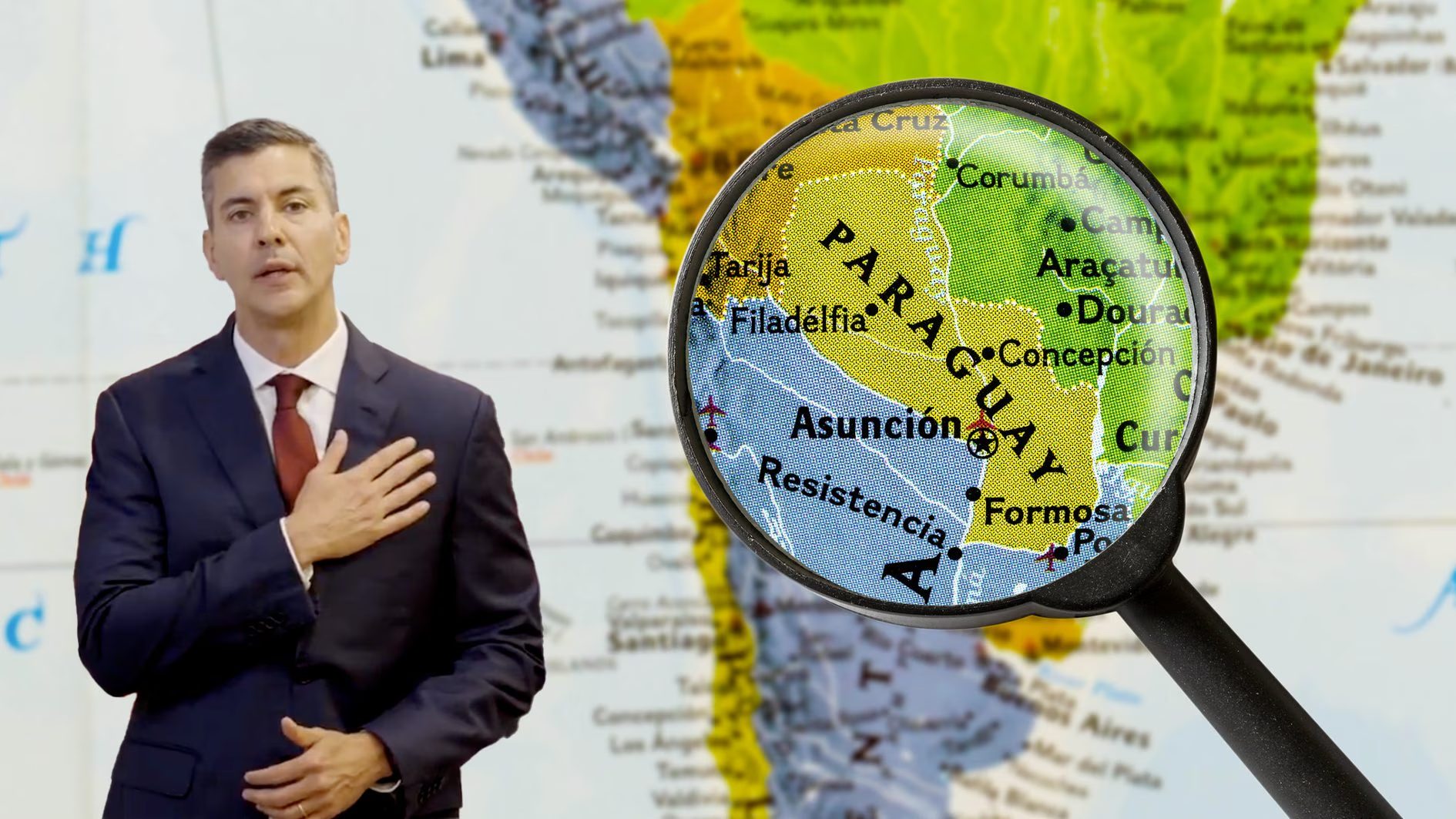
Paraguay is experiencing a serious banking crisis, which has triggered a subsequent institutional crisis: Ueno Bank, one of the most widespread banking institutions in Paraguay and used by more than half of the adult population, received a resolution procedure from the Central Bank, after its solvency ratio (an indicator of a bank’s capital strength, which measures the availability of capital compared to the risks assumed) had fallen below half the minimum required.
The intervention left around 3 million customers without access to accounts, in a country of around 6.5 million inhabitants, freezing apps, cards and branches. The financial crisis became political in the space of two days: President Santiago Peña, linked in the past to the group that owns the bank, announced his resignation on Thursday 5 November while the Chamber of Deputies carried out impeachment proceedings supported even by his own party.
Strong protests broke out in the country, with the population taking to the streets to demand the return of their savings.
Faced with this news, it is natural to ask: could a situation like this also happen in Europe? In the Euro Area countries, the most important banks are subject to the supervision of the European Central Bank and savings are covered by a guarantee of up to 100,000 euros per account holder, financed by the banks themselves.
What happened in Paraguay: the banking scandal and the resignation of the President
Until a few months ago, Ueno Bank was described as one of the success stories of the Paraguayan financial system. According to the BBC’s reconstruction, its origins date back to 1976 as Financiera El Comercio, with the institution which, after the authorization of the Central Bank, transformed into a bank at the end of 2023. In 2024 the expansion continued with the absorption of Vision Bankwhich brought in over a million customers. As of September 2026, Ueno reported more than 3 million customers (in a country of approximately 6.5 million inhabitants) and over 3 million transactions per day.
The collapse began after the Central Bank of Paraguay initiated resolution proceedings against Ueno Bank after finding that the solvency ratio had fallen below the legal threshold. The procedure transfers control to the authorities for verifying assets, but in the meantime it has suddenly blocked customer accounts, sparking queues and protests on the streets of the country.
What made the financial crisis also a political crisis was the proximity between the bank, the regulator and the political power. There BBC World recalls how President Santiago Peña appeared as a shareholder of Ueno Holding and that at the beginning of 2025 he declared that he had sold his share, denying any link with the bank. Even more delicate is the role of Carlos Carvallo Spalding (now resigned): before taking over the leadership of the Central Bank in August 2023 he had been president of Financiera Ueno, i.e. the entity from which the bank was born which he would then have to supervise. And it was he, a few months after taking office, who approved its transformation into a credit institution.
In essence, as highlighted by some economists interviewed by BBCan institution belonging to a single conglomerate had reached a clientele equivalent to over half of the country’s adult population, also concentrating large deposits from public and social security bodies, while the Central Bank had already warned, months earlier, of excessive loans to companies linked to the owners.
The problem, therefore, is also one of trust: when the person who presides over the Central Bank has previously managed the bank he is supposed to control and the head of state has been a business partner of its owners, there is a risk of serious conflicts of interest.
On a political level, after Parliament announced its intention to initiate a procedure impeachment against him, Santiago Peña submitted his resignation, stating that he was acting for the stability of the country and democratic institutions and apologizing to those who had entrusted their savings to the financial system.
For savers, however, the Central Bank of Paraguay has set up a mechanism for the return of deposits to savers, but it is not immediate and there is no guarantee that the entire amount will be refunded. The Paraguayan Deposit Guarantee Fund, in fact, covers up to 228.3 million guaraníes (around 33,000 euros) per saver. However, those who have deposits above that threshold do not yet know when and how much they will be able to recover.
Can a similar event happen in Europe? The ECB supervisory system and deposit guarantees
The question at this point is one: can an event of this type also happen in Europe? In this case, it is worth distinguishing between three levels, on each of which European architecture is structurally different from Paraguayan architecture:
- Who protects savers when a bank fails;
- Who supervises the banks;
- How regulators deal with the rapid growth of fintechs.
As regards the first point, as reported by the European Commission, deposit guarantee schemes reimburse account holders of a failed bank up to an amount of 100,000 euros and are based on a precise principle: they are financed entirely by the banks, without recourse to taxpayers’ money. Directive 2014/49/EU requires each Member State to establish at least one guarantee scheme to which all banks must join. The European threshold of 100,000 euros, therefore, is significantly higher than the Paraguayan ceiling of around 33,000 euros and, above all, relies on funds fed by the entire banking sector.
This regulation, among other things, was strengthened in March 2026, after the European Parliament definitively adopted a package on the orderly management of banking crises (which entered into force on 10 May 2026) which, among other things, strengthens and harmonizes the position of depositors in the creditor hierarchy, attributing a particular priority to the sums recovered from guarantee funds after having repaid protected depositors.
From a supervisory point of view, in the euro area the most important banks are subject to the supervision of the European Central Bank, a supranational authority separate from national governments and supervised institutions. It is the clearest contrast with the Ueno case: in Paraguay the Central Bank was led by a former manager of the bank that was placed under special administration, while the European system aims to reduce the risks of political interference and conflicts of interest thanks to supranational supervision, common rules and institutional controls on multiple levels.
In short, from a protection and supervisory structure point of view, if similar episodes were to occur, European citizens would be less exposed than Paraguayans. European rules offer important tools for prevention, crisis management and protection of depositors. However, they do not exclude the failure of a bank or any temporary interruptions in access to accounts.
There is also a final element that distinguishes the European context: the supervisor’s ability to intervene before a problem risks degenerating into a banking crisis. According to an investigation by Financial Times published in June 2026, in the previous summer the ECB had temporarily limited the launch of new products by Revolut’s European banking division, requesting the strengthening of internal control and approval processes. At the center of the ECB’s concerns, in fact, was an organizational model that favored the speed of product launch over the strengthening of controls. In that case it was not a question of a failing institution, but of a rapidly expanding company, which the regulator required to allow growth to proceed hand in hand with risk management: exactly the step which, according to the economists interviewed by CNN and the BBC, did not work in Paraguay, where public funds continued to flow to Ueno despite the alarms already raised previously.