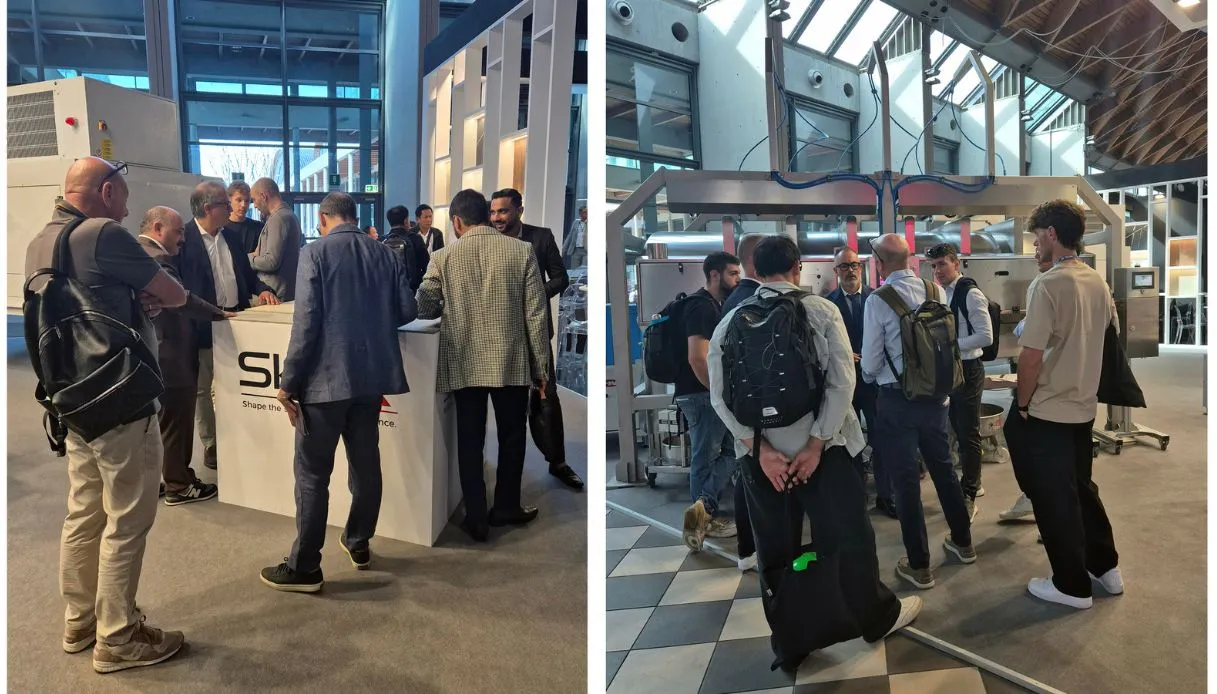
For four days, at the end of September, the Rimini Expo Center once again became the world meeting point for ceramic and surface technologies. The 29th edition of TECNA attracted operators from one hundred countries, with a foreign presence that increased compared to the previous edition.
The fair arrived in a complicated period for Italian machinery manufacturers, who are dealing with scarce orders and customers who are cautious in investments: perhaps also for this reason, among the stands, the attention was focused on technologies that promise greater quality and more control over the processes.
TECNA 2026, an edition with an international scope
The event, held every two years, is organized by Italian Exhibition Group with ACIMAC, the association of Italian ceramic machinery manufacturers, in collaboration with the Ministry of Foreign Affairs and with ICE-Agenzia. Around 300 brands exhibited at the fair, 39% of which came from 19 foreign countries.
Among the Italian companies present was Officine Smac, a true certainty as well as absolute excellence, which since 1969 has been designing and manufacturing automations, systems and machinery for the ceramic and brick industries in Fiorano Modenese. 45% of visitors came from abroad, and the most represented nationalities draw a map of the demand for ceramic technology: India, Vietnam, Bangladesh, Turkey and Tunisia lead the way, followed by Germany, the United Kingdom and Argentina.
The incoming program curated with ICE-Agenzia brought over 285 selected buyers to Rimini, more than double compared to past editions. Another figure shows how much the scope of the exhibition has expanded: 15% of visitors came from surfaces sectors other than ceramics.
It is an opening that also closely concerns technology suppliers, who are called upon to work with different materials and products. Officine Smac, for example, has already applied its know-how to glassware, industrial components, tableware and artistic ceramics. The conference program, with the Decortech Conference, was sold out and also addressed the IT security of interconnected systems. The next appointment is set for 2028.
A slowing sector that focuses on innovation
The positive climate of the fair comes in a difficult situation. According to the MECS-ACIMAC study center, Italian ceramic machinery and equipment manufacturers closed 2025 with a turnover of 1.73 billion euros, 5% less than the previous year, with exports accounting for 69.4% of the total and 7,153 employees. However, Italy remains the world reference in the sector, with approximately half of the global production of these machines.
For 2026 the signs are worse. The economic survey released at the end of October records a drop in turnover of 18.2% in the first nine months of the year, more marked on the foreign market (minus 21%) than on the domestic market (minus 11%). The order book guarantees just 2.8 months of production and the president of ACIMAC, Bruno Bettelli, warned that a similar situation, if prolonged, could put the stability of the sector and employment at risk. On the other hand, after sales holds up, accounting for 29% of the turnover.
SkinX, the texture is born on the line
With decreasing volumes, competitiveness increasingly depends on the ability to offer differentiated products and keep line parameters under control, reducing scrap and waste. This is the path also followed by Officine Smac, which with 35 professionals and a commercial network active in over 60 countries serves more than 2,000 customers. In Rimini, CEO Fulvio Masini presented three innovations built around these two objectives.
On the aesthetic side, the main proposal is called SkinX and is an innovative system for the microstructuring of the tile surface. The processing takes place directly in line on the still raw piece, at the exit of the dryer, before glazing and decoration.
The system allows you to obtain controlled three-dimensional textures, ranging from micro-stripes to bush-hammered finishes up to tailor-made geometric patterns. Since everything takes place in the normal production flow, customization does not require a separate finishing phase.
For manufacturers, the surface thus becomes a way to add value to the piece and stand out on the market, responding to the demand for refined materials that comes from architecture and interior design.
Dry-Check and RheoX, data serving the process
The second line concerns the automatic monitoring of production parameters. Dry-Check measures the humidity of the tiles as they flow on the line, using TDR (Time-Domain Reflectometry) technology, which derives the water content of a material from the way in which an electromagnetic pulse passes through it and is reflected.
The measurement is quick, non-invasive and also detects the internal humidity of the support, as well as the surface humidity. Having the data during processing allows operators to intercept anomalies in time, with benefits on production stability and the quantity of waste. The novelty also attracted the attention of the sector press, starting with Ceramic World Review.
RheoX instead deals with the viscosity of glazes and engobes, the coatings spread on the ceramic support. The system uses the well-known and consolidated Ford cup method, making it automatic, without the need for manual intervention and signals any deviation from the set values. The checks thus become systematic, reliable, repeatable and controlled.
LIFE CAPT-TILE, European research on tiles
Alongside the new products, Officine Smac has reserved a stand space for the European LIFE CAPT-TILE project, in which it participates together with Italian and Polish partners. The initiative aims to develop special brick tiles designed to host vegetation directly on the roof, so as to contribute to the capture of CO2 through green roofs.
The project is linked to the work that the company carries out in the brick and tile sector, one of the growing segments for Italian builders in 2025 (+11.9%, according to ACIMAC). It is also an example of collaboration between businesses, research and European institutions to adapt construction materials to new environmental demands.
From the microstructure of surfaces to the automatic measurement of humidity and viscosity, the thread that binds the technologies seen at TECNA 2026 leads towards more integrated and easier to manage systems. For the specialized mechanics of the Emilian district, in a phase marked by the decline in orders, applied research remains the main lever to defend its positions on international markets.