Not everything you write on WhatsApp is meant to be kept. Some information is only needed at a certain time, while other information is preferable not to be left in the chat history, perhaps for privacy reasons.
To meet these needs, Meta’s messaging app is experimenting on Android and iPhone with the ability to send read-once text messages. The operating principle is similar to that already adopted for some types of multimedia content, with the introduction of a series of measures to prevent those who receive the message from keeping a copy of it through the app.
How one-time text messages work
The novelty consists in the extension of the “View once” function to texts, introduced in 2021 for photos and videos and in 2023 for voice messages. The specialized portal WABetaInfo documented its release, which reported its availability on November 12, 2026 in beta 2.26.45.6 for Android and on November 23 in beta 26.45.10.73 for iOS. It is currently only accessible to some beta testers and a date for distribution in the stable version of the application has not yet been announced.
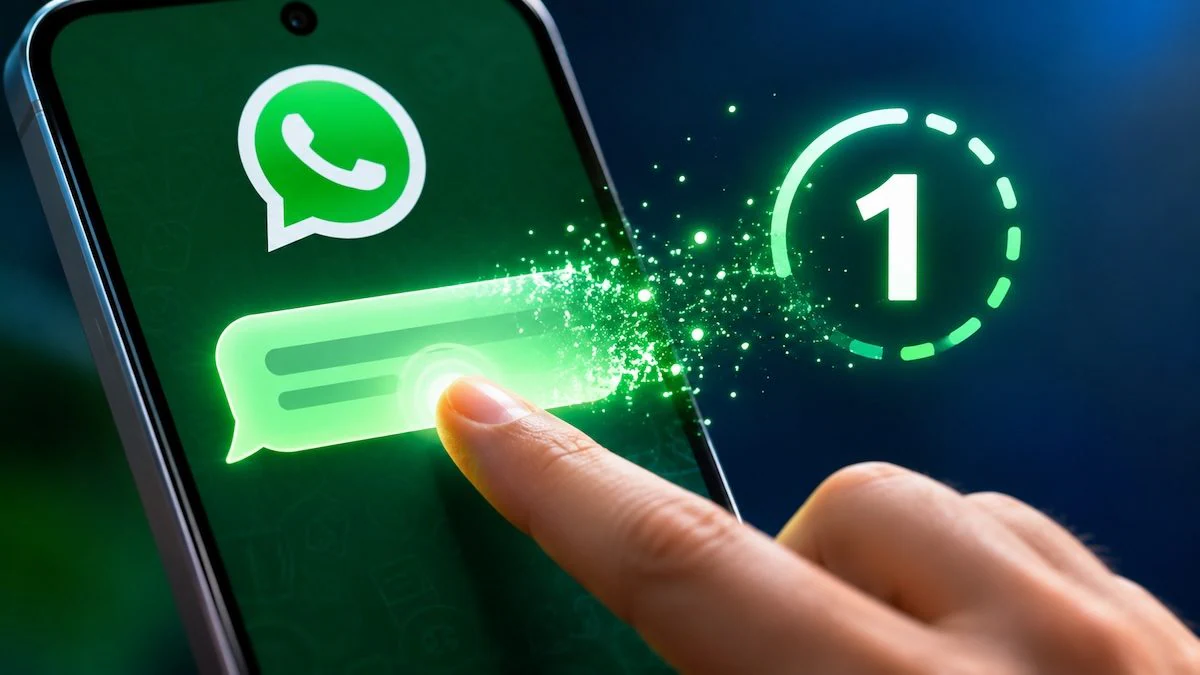
Those who have already shared a photograph with this mode will be familiar with the small circle containing the number 1 which allows you to limit its display to a single opening. In the case of written messages, however, the developers have chosen to use the send button.
Once you have opened the chat and composed the message, just hold down the button instead of touching it briefly. A menu will appear from which you can choose whether to schedule shipping for a later time or make it available for consultation only once. By selecting this last item, the text will be sent immediately, without a further confirmation step. It is therefore advisable to re-read what is written before proceeding. At least for now, it is not possible to combine the two modes.
When the feature is enabled on your account, a short notice appears near the typing field illustrating the action to perform. Installing one of the compatible updates, therefore, does not guarantee that you will be able to use it immediately.
Whoever receives the message, however, will not see the words written by the sender directly in the conversation, but a bubble that can be touched to view them. The recipient will be able to stop and read the text, but once the reading screen is closed it will no longer be possible to consult it, not even for the person who sent it. Only an indication of the opening will remain in the chat.
According to what emerged from the tests on Android, the sender can know if the recipient has viewed the content, provided that read receipts are active, which can be managed via the WhatsApp privacy settings and associated with the well-known blue ticks in individual conversations.
What is the difference with ephemeral messages
Making what is written on WhatsApp disappear is nothing new. In fact, since 2020, the application has made ephemeral messages available to its users. You can enable them in individual conversations or set them as the default mode for new individual chats. Automatic cancellation occurs 24 hours, 7 days or 90 days after sending, regardless of whether the recipient has read what was received. The setting does not affect previously shared content.
During that period of time, however, the information received remains available for consultation as many times as desired. You can also forward them to a conversation where ephemeral messages are not enabled, meaning that the copy you create will continue to be accessible. You can even choose to keep some of them in the original chat, unless the sender objects.
If a friend sends the address of a restaurant to go to in the evening via an ephemeral message with a 24-hour expiry date, it will be possible to consult it before leaving the house and then again once on the road. If you use the “View once” mode, however, the address will no longer be recoverable after closing the reading screen.
Not to be confused with the novelty of November is also the “After reading” option, which WhatsApp has begun to experiment with in recent months. In that case the countdown starts from the moment the recipient views the content, still leaving him an interval of time to consult it again. In the test versions in which it was spotted in the spring, the expected durations were 5 minutes, 1 hour and 12 hours.
Another important difference compared to traditional ephemeral messages is that the new mode applies to the single message, without changing the settings of the entire conversation. It will therefore be possible to alternate ordinary communications with those that can only be opened once. It is also worth evaluating the needs of those on the other side of the screen: information that will have to be used on multiple occasions is poorly suited to this type of sharing.
How safe are single view messages
The confidentiality of conversations on WhatsApp is already protected by end-to-end encryption, the system that makes personal communications illegible to anyone who intercepts them during their transit over the network. Encryption, however, does not prevent the recipient from playing what he received on his smartphone. It is on this aspect that the new modality intervenes.
While reading the message, WhatsApp blocks screenshots and screen recordings. Furthermore, it does not allow you to select words to copy or transfer them to another application, nor does it provide commands for saving and forwarding the text.
These restrictions, however, do not prevent you from keeping a copy of the message using external tools. The recipient could photograph the display with a second smartphone, transcribe what he reads on a sheet of paper or, more simply, memorize it and report it to someone else. Even in the case of single view images, the function does not protect against possible scams and blackmail.
It remains to be clarified how this content will be managed in conversation backups and for how long it will remain accessible in the chat if it is never opened. It is not certain that the same rules already provided for images and voice messages sent with the same option apply.
The new functionality therefore does not guarantee the absolute confidentiality of the information shared. Passwords to access your accounts and verification codes received to authorize banking operations, for example, should not be shared with other people, even using this method, also to avoid falling victim to scams based on social engineering.
WABetaInfo – WhatsApp introduces view-once text messages on iOS WABetaInfo – WhatsApp is rolling out view-once text messages on Android WhatsApp – Voice messages just got more private WhatsApp – About disappearing messages