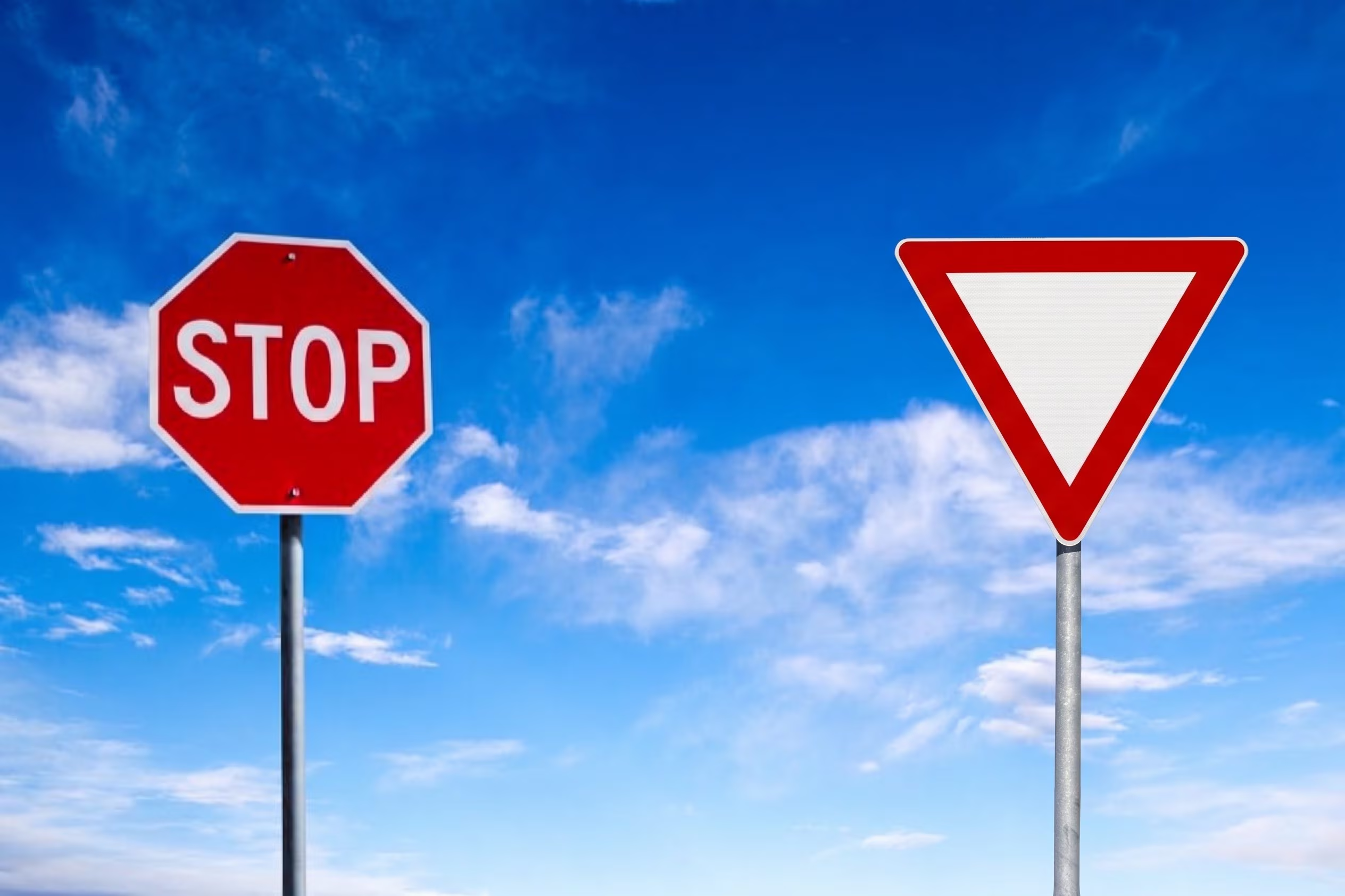
The stop sign and the give way sign are two of the most common road signs: yet, even today some drivers struggle to distinguish the two meanings.
The stop sign – the octagonal sign with a red background – always forces the driver to completely stop the vehicle before entering the intersection, even when there are no other vehicles arriving.
Giving precedence – the triangle with the tip pointing downwards and the red edge – requires you to give way to vehicles arriving on the road you are entering, but does not necessarily force you to stop: if the road is free and safety conditions allow it, you can proceed.
The distinction is clearly established by the Highway Code, in article 145, and by the related Implementing Regulation.
But why do we find stop signs at some intersections and giving way at others? Let’s see what the Italian legislation provides.
What is the difference between stop and give way according to the Highway Code
The key difference concerns the requirement to bring the vehicle to a complete stop. As established by articles 106 and 107 of the Highway Code Implementation Regulation, the two signals impose different behaviors:
- The stop sign, recognizable by its red octagonal shape, always requires you to stop the vehicle (at the appropriate stop strip) before entering the intersection, even when there are no other vehicles arriving. It is therefore not enough to slow down, look left and right and continue: you must stop completely and then start again, only after having verified that it is possible to proceed.
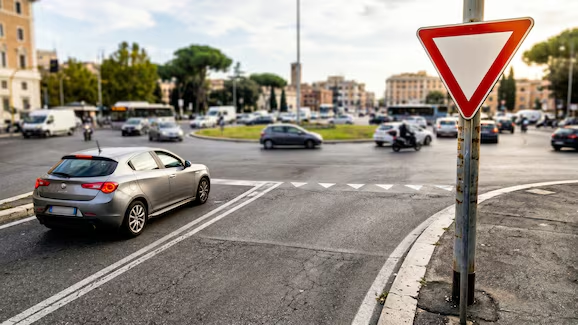
- The give way sign, i.e. the triangle with the tip pointing downwards and the red border, obliges the driver to give way to vehicles circulating on the road he is about to enter or that he must cross, but does not necessarily require him to stop the vehicle. If the road is clear and safety conditions allow it, you can proceed without completely stopping the vehicle. If, however, other vehicles arrive, you must slow down and, when necessary to respect the right of way, stop.
In both cases, however, it remains essential to approach the intersection with caution and, above all, it is mandatory to give priority to vehicles arriving from both directions (therefore both from the right and from the left) on the road you are about to cross or which you want to enter.
The difference between the two signals is also reflected in the horizontal signs: according to article 40 of the Highway Code, the stop is accompanied by a continuous white line integrated by the writing STOP on the asphalt, while giving precedence is accompanied by a discontinuous line, represented by a series of white triangles with the tip pointing towards the driver, as required by article 144 of the Regulation.
The position of the signs is also established by the Implementation Regulation of the Highway Code: the stop sign must be installed at the threshold of the intersection or as close as possible, while the giving of precedence must be located on the threshold itself. For both signals, article 81 establishes a maximum distance of 10 meters in built-up areas and 25 meters outside built-up areas, measured from the limit of the carriageway of the road enjoying the right of way.
Because at some intersections you just need to slow down and at others you have to stop
The choice of signal to install is not random, but also depends on the safety conditions of the intersection. In particular, article 107, paragraph 2, of the Implementing Regulation establishes that the stop sign must be used when it is not possible to guarantee sufficient visibility or in any case in particularly dangerous situations.
This is the case, for example, of an intersection where a building or a wall prevents oncoming vehicles from being seen sufficiently in advance: in such a situation, stopping is essential to face the intersection in greater safety. However, when visibility is adequate and there are no particular dangerous conditions, simply giving priority may be sufficient.
The Ministry of Public Works also expressed its opinion on this point with directive no. 6688 of 24 October 2000, which in paragraph 5.2 highlighted how the stop sign is sometimes installed improperly, even at intersections with guaranteed visibility, in the mistaken belief that this allows for more rigorous traffic regulation.
The stop, however, should not be considered a “more severe” priority, but a signal to be used in the presence of specific conditions that justify its use.
For motorists, however, the rule is simple: in front of the stop sign, the vehicle must stop; when giving precedence, you stop only when necessary to respect the precedence.
Article 107 Highway Code Article 145 Highway Code Article 39 Highway Code Implementation regulation of the Highway Code Directive number 6688 of 24-10-2000