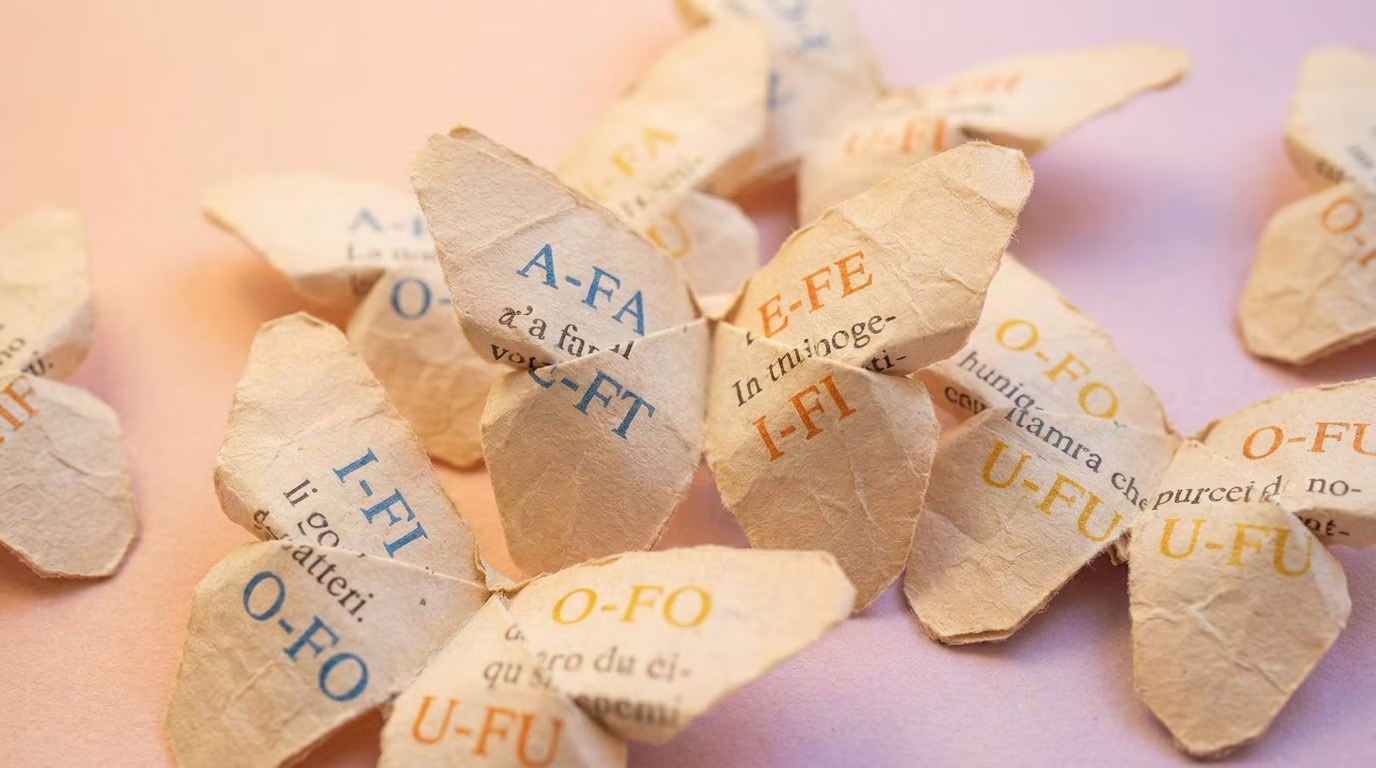
The bow tie alphabet is not a real alphabet as we usually understand, but rather it is a playful codea childhood game born spontaneously and passed down through generations as a secret and fun conversation to play with your friends.
At first glance it might seem like a jumble of meaningless sounds, but you just have to listen to understand that it is a system that follows very specific “phonetic rules” and that makes human language fascinating.
But how does it work? In purely technical terms, the bow tie alphabet is classified as a language gameand is considered an elementary form of substitution cipheran encryption method by which each component is replaced following a regular pattern.
This regular scheme involves a phonetic-syllabic operation: each word is divided into syllables and, after each vowel, the consonant “f” is inserted followed by the reply of the previous vowel.
The basic pattern applies to all five vowels:
TO > AFA (a + f + a)
AND > EFE (e + f + e)
THE > IFI (i + f + i)
OR > OFO (o + f + o)
U > UFU (u + f + u)
To give some practical examples:
HOME → CA – SA → CA + F – SA + FA = CAFASAFA
CIAO → CI + A + O→ CI + FI – A + FA – O + FO = CIFIAFAOFO
CHAIR → IF – DIA → IF + FE – FROM + FI – TO + FA = SEFEDIFIAFA
To make the conversion easier without going crazy, you can use an interactive online translator.
It is essential to highlight the clear distinction between this mechanism and a real one invented language or planned (defined in the specialist field conlangfrom English constructed language). An artificial language, likeEsperanto or the dothraki of “Game of Thrones”, is an autonomous linguistic system created by a creator (a glottotete) and equipped with its own grammar, an original syntax and a new vocabulary, reaching considerable complexity. In fact, planned languages violate the historical priority of speech typical of historical-natural languages, since they are first formulated at a table in written form and only subsequently could they be spoken.
In contrast, the bow tie alphabet does not create a new lexicon or alter grammatical structure, as its sole purpose is camouflage the already existing natural language by applying asound interference.
The primary function of this code is cryptolaliathat is, the creation of a confidential language that allows children to converse without being understood by adults. Furthermore, from a cognitive point of view, it is an exercise much appreciated by pedagogues given its versatility in stimulating mental agility and metalinguistic awarenessor the brain’s ability to analyze and manipulate the shape of words.
And it is not only Italian speakers who have used this linguistic productivity: similar languages exist in many other cultures. As well as another Italian variant known by the name of serpentine alphabet (which uses the consonant “s” instead of “f”), in the Spanish-speaking world there are the jerigonza (also known as habla en efe when it uses the “f” or “p”), in Anglo-Saxon countries the Pig Latin el’Ubbi Dubbi, and in France the Javanais or the langue de feu.
Even speakers (usually children for fun) in these languages will therefore say, for example, “capasapa” for “home” in jerigonza“ousehay” For “house“in Pig Latin or “mavaizavon” to say maisonshowing how different levels of “cryptographic” complexity are achieved.
In conclusion, the bow tie alphabet is a very simplified example of a secret code that reflects a universal expressive ability. Although not an invented language in the strict sense, this game represents an effective verbal agility training ground that helps the little ones understand the profound structure of the language.