It’s a gesture that now seems banal to us: the phone rings, we answer and hear the voice of whoever is on the other end in real time. But what if we could also perceive the smells around it? Unlike light or sound, however, a perfume cannot travel in the form of waves: it requires molecules that reach our nose. To overcome this obstacle, some researchers at Ohio State University have developed Scentronic, a technology capable of recognizing odors via an “electronic nose” and recreating them remotely using artificial intelligence and the internet. In short, a sort of olfactory phone call, which in the future could also open up new possibilities in the medical field, for example by contributing to the development of tools to study and monitor alterations in the sense of smell.
Transmitting smells through the Internet is no walk in the park: new study technology
Human-machine interfaces, also known as HMI (from English Human-Machine Interface) are technologies that allow you to communicate and interact with electronic devices, such as computers, smartphones and virtual reality viewers. Most of these interfaces exploit physical stimuli, such as light or sound.
And the sense of smell? Unlike the other senses, reproducing a smell through an electronic device is more complex.
A smell depends on the presence of specific volatile molecules that must reach the receptors in our nose. Light and sound, on the other hand, propagate through waves, electromagnetic and sound respectively, which transfer energy without involving a net transport of matter.
To expand the possibility of transmitting odors over a distance, a group of researchers from Ohio State University has developed Scentronican HMI that allows you to detect an odor and reproduce it remotely. The technology is described in a study published in the scientific journal Science Advances in October 2026.
So far, researchers have had to face three obstacles in particular: the lack of standardized methods to reproduce olfactory stimuli, the use of often bulky devices and the difficulty of connecting these systems to the internet to transmit odors remotely. Advances in electronics have already begun to overcome the first two limitations.
With Scentronic, however, the researchers attempted to address the third, exploiting the so-called Internet of Things (IoT), in Italian “internet of things”. If with the traditional internet it is we humans who exchange information through devices such as smartphones and computers, with the IoT it is the physical objects themselves that collect information from the surrounding environment and exchange it through the network, often automatically and without the need for direct human intervention.
The goal is to make something similar to a phone call possible, but with smells: a device detects an olfactory stimulus, transmits the information over the internet, and a second device uses it to reproduce a similar smell.
How Scentronic, the digital nose, works
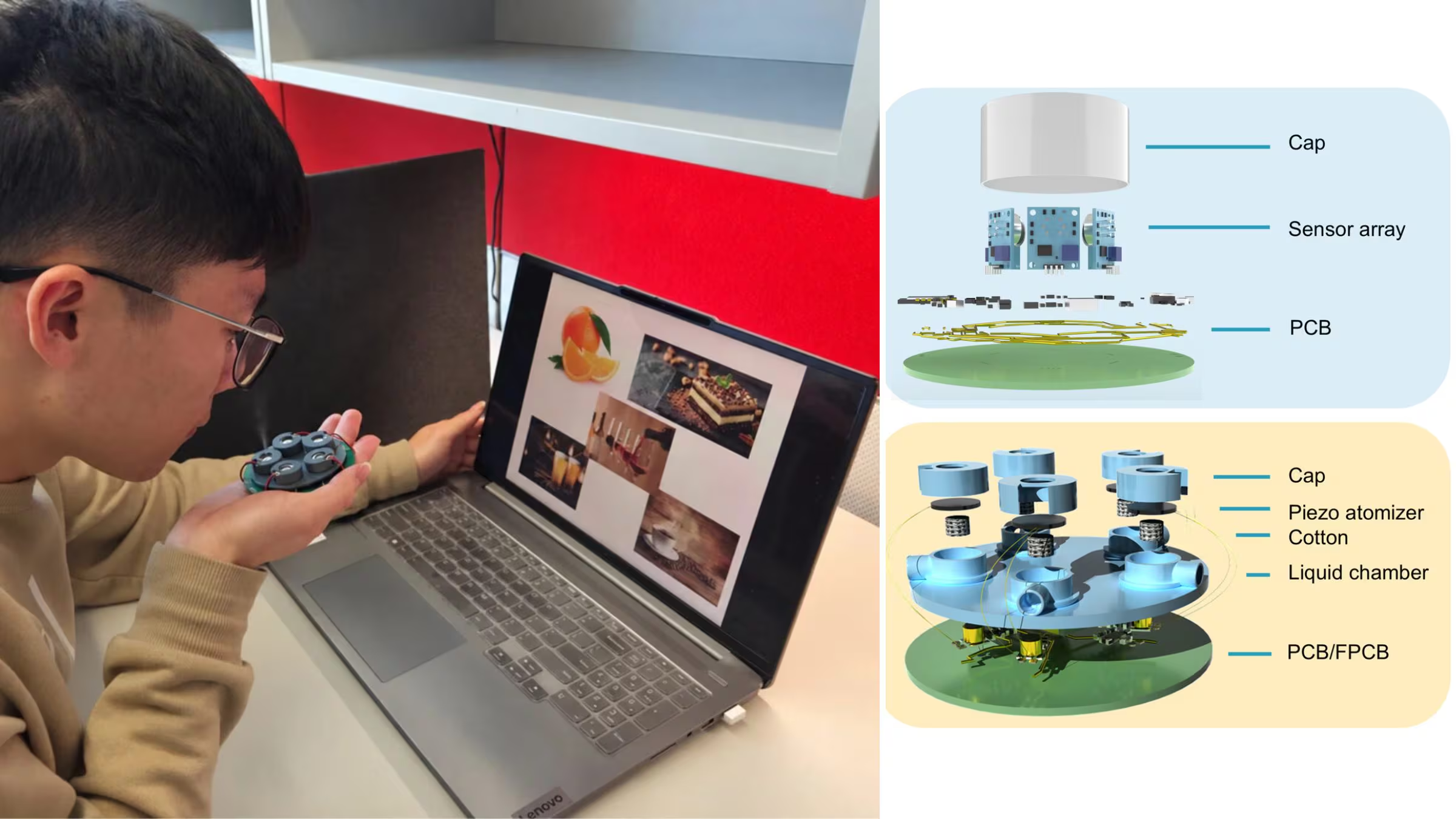
To work, Scentronic first needs a sensor, something that can pick up odors. This “artificial nose” has various metal oxides inside it, materials which change their electrical resistance when they come into contact with certain substances present in the air.
This change is analyzed by an artificial intelligence system which, by comparing the responses of the different sensors, recognizes the odor detected. The information is then transmitted via the internet to a second device, a wearable olfactory interface.
Inside there are small tanks, each containing a different odorous substance and equipped with a component which, by vibrating, allows it to be sprayed into the air in the form of tiny droplets.
Based on the information received, the device establishes which tanks to activate and controls the quantity of substance released, also combining odors from multiple tanks. In this way it can remotely reproduce the odors recognized by the artificial nose, regulating their composition and intensity.
Why this discovery is important
The development of technologies such as Scentronic could open up new possibilities in various sectors, starting from the medical one. Some viral infections, or other conditions such as neurodegenerative diseases and head trauma, can cause alterations of the sense of smell, such as parosmia, where odors are perceived in a distorted way, or its complete loss, called anosmia.
Devices of this type could therefore become useful tools for doctors, allowing them to remotely evaluate and monitor any changes in patients’ olfactory ability.
But we can also go a little further with our imagination. In the future, for example, this technology could make some virtual experiences even more immersive. Let’s think about a documentary: in addition to images and sounds, smells could also contribute to recreating a setting.
Or, going even further, we could imagine installing similar sensors on space probes to analyze volatile molecules present on other celestial bodies. After all, who wouldn’t be curious to smell what the Moon smells like?