If the time machine existed and you could land in a 16th century British kitchen, you could witness something very curious: Turnspit dogs, literally “rotisserie dogs”.
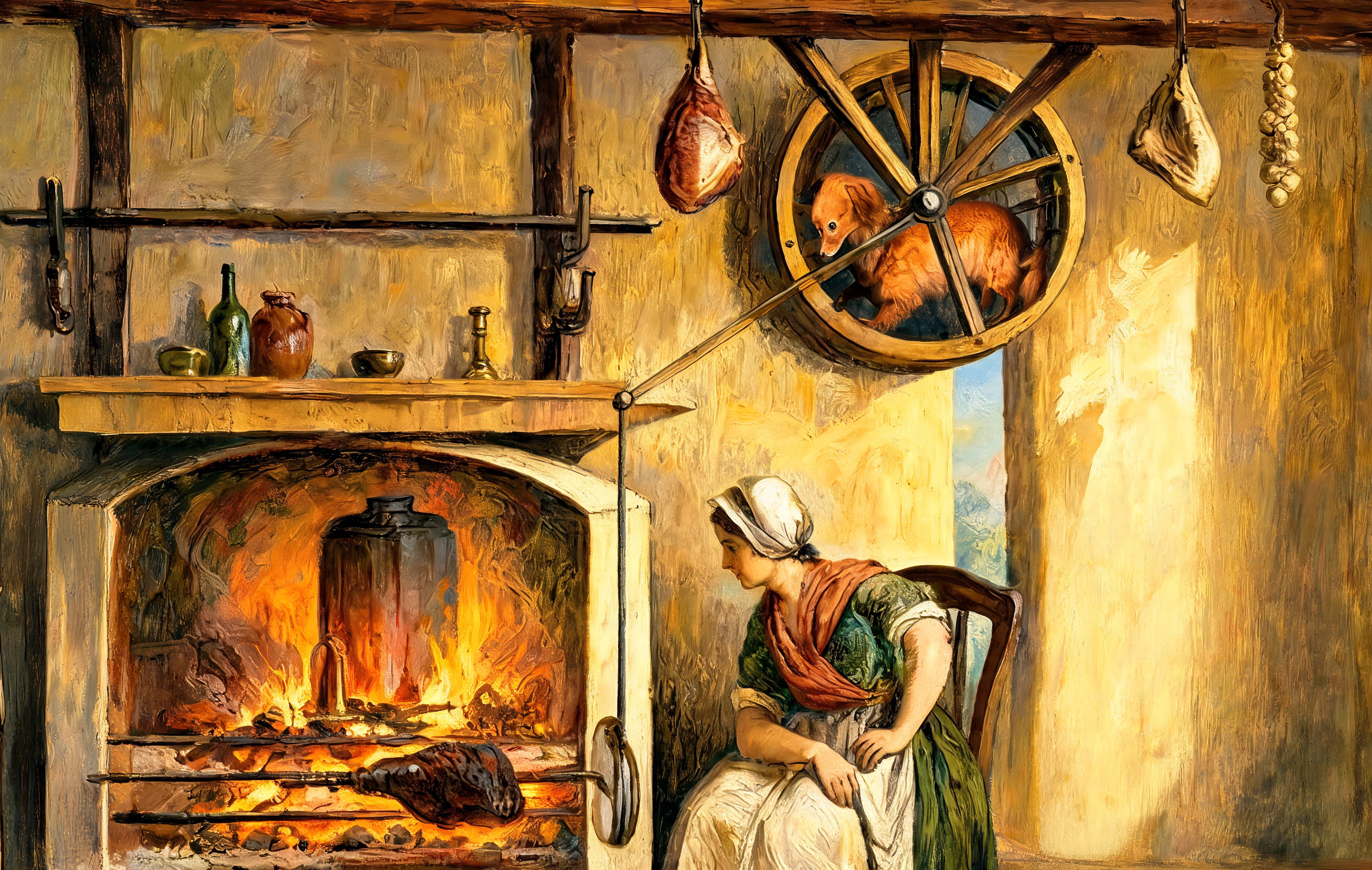
As the name indicates, these animals with elongated bodies and short, crooked legs had the task of continuously rotating the meat over the embers of the fireplace to ensure uniform cooking and prevent it from burning on only one side. To do this, they were placed inside a hollow wooden wheel mounted high on the wall, next to the hearth, but away from the direct fire, so that they would not faint from the excessive heat.
The mechanism worked by transmission: running on the spot, the dog pushed the wheel and made it spin; this was connected via a chain (or a belt) to the axis of the spit in the chimney, thus transmitting the rotary motion to the meat.
Turnspits were not just any dogs: they were the result of careful selection. In fact, these animals must have been small, but robust and tireless. Above all, they had to have a low center of gravity, because this allowed them to maintain balance in the wheel. Their legs were very short, and according to some writings, slightly crooked. The naturalist Linnaeus classified them as “Canis vertigus“, i.e. “giddy dog”.
As you might imagine, a dog could not run for too long, which is why there were usually at least two dogs working on alternating shifts. According to the chronicles, these animals even had a “sense of time”, and knew when to stop their turn and jump out of the wheel.
Unfortunately, the working conditions were not the best: in addition to drinking little, they were thrown hot coals into the wheel to encourage them to run faster.
Again according to some writings, on Sunday – their only day of rest – Turnspit dogs were often brought to church by families and used as foot warmers, given that English churches were very cold.
Henry Bergh, founder ofASPCA (the first large American society for the protection of animals), was so shocked by the working conditions of the Turnspit dogs in Manhattan (these dogs had in fact spread to some areas of the United States during the 18th century), that in April 1866 he managed to obtain the first laws against animal cruelty, which among other things also prohibited the use of dogs in rotisserie wheels.
Gradually, these dogs disappeared. However, it was technology rather than laws that decreed their end: the invention of spring-driven and clockwork mechanical rotisseries, which were cheaper and more reliable, made these dogs useless.
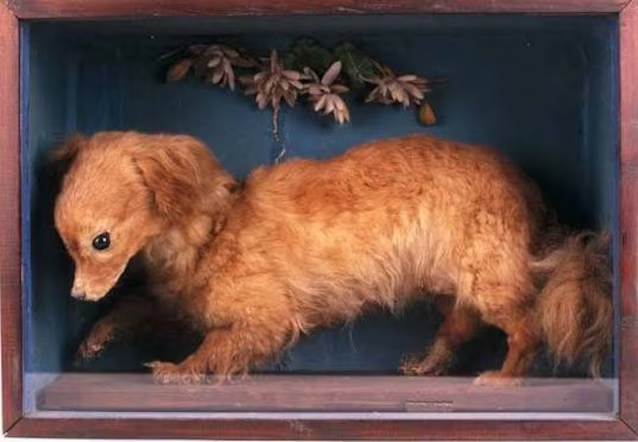
Being seen – precisely because of their “work” – as “plebeian” dogs, clumsy and with a suspicious character, no one wanted them as companion dogs (with the exception of Queen Victoria, who adopted some of them when she was now retired). Nobody let them breed again and, within a few decades, the breed vanished and was declared extinct (their closest relatives today are the Welsh Corgi and the Glen of Imaal Terrier). Today only one specimen remains in the world, stuffed, called Whiskey, which is preserved at the Abergavenny Museum in Wales.

Mental Floss Smithsonian Wood’s Animal Kingdom People’s Collection Wales Smithsonian