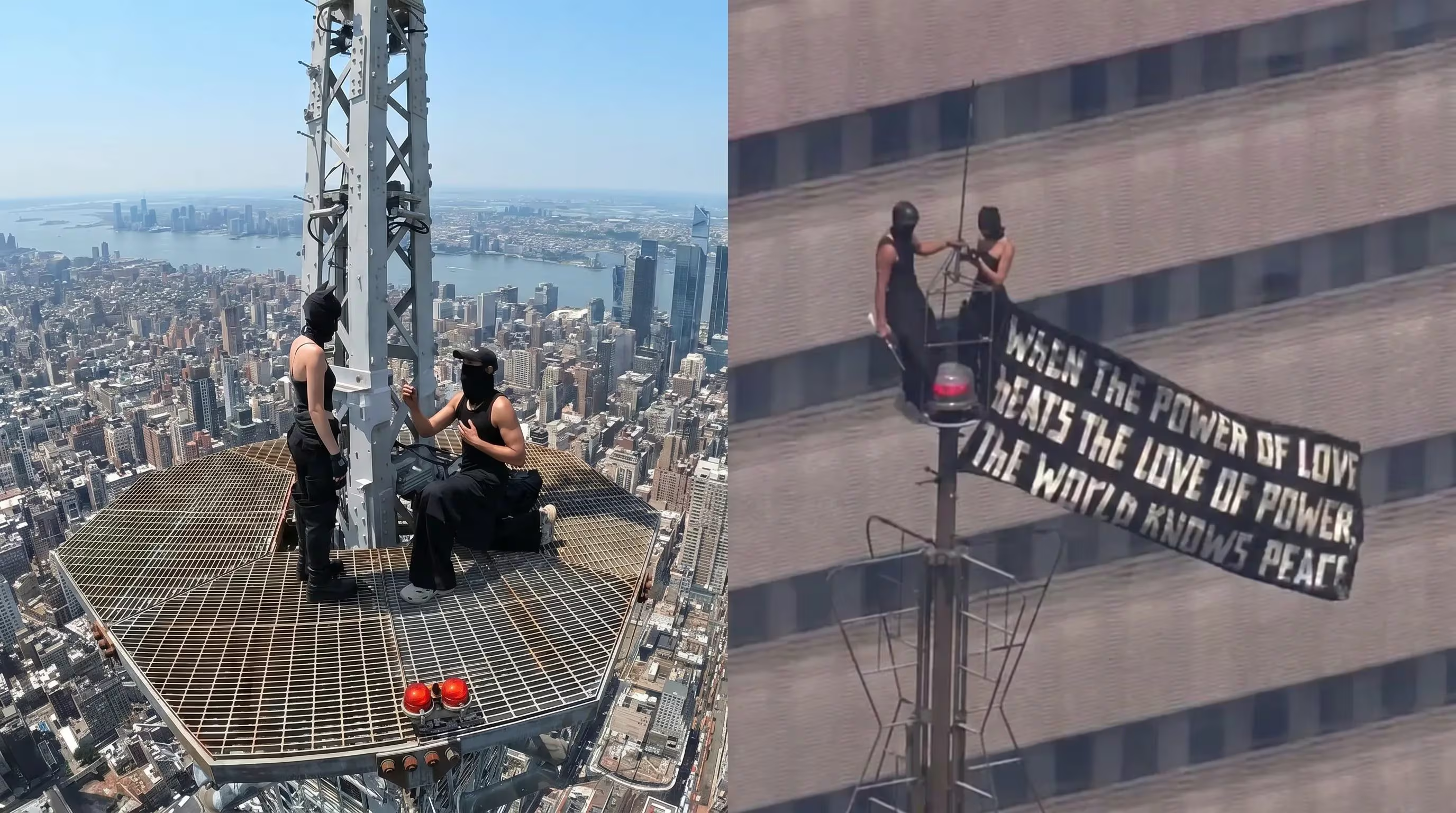
On 1 July 2026, two young people of Russian nationality, Angela Nikolau, 33 years old, and Ivan Beerkus (born Ivan Kuznetsov), 32 years old, climbed with their faces covered to the top of the antenna of the Empire State Building in New York, at a height of 443 metres, and unfurled a banner containing a message of peace (“When the power of love beats the love of power, the world knows peace”, i.e. “When the power of love defeats the love of power, the world will know peace”) and they got “engaged” live before being arrested by the police.
It was not an improvised undertaking: the two are in fact among the best-known names in the world rooftoppingan illegal practice consists of climbing skyscrapers, cranes, chimneys and other very tall structures, often without ropes, harnesses or safety protection, to take photos or videos to share on social media.
What is rooftopping, the illegal practice of climbing buildings
The term “rooftopping” literally indicates the unprotected climbing of roofs, antennas, construction cranes, chimneys and skyscrapers, almost always without authorization. Contrary to what one might think, it is almost never a real climb from the outside of the building: rooftoppers prefer the simplest and safest route, often reaching the roof from the inside via service stairs, elevators or unsupervised passages, and reserve the actual climbing only for the final part, when it is needed to reach antennas or protruding structures as happened on the Empire State Building.
Among the most iconic cases in history are the exploits of the French tightrope walker Alain Robert, known as “Spider-Man”, who in turn climbed the Empire State Building in New York in 1994, the Eiffel Tower in Paris and the Golden Gate Bridge in San Francisco in 1996 and the Willis Tower (then called Sears Tower) in Chicago in 1999. Before him, in 1974, Philippe Petit was arrested after attracting the attention of the world’s media by walking on a cable stretched between the two towers of the World Trade Center in New York.
From buildering to Russian social media: the origins
The roots of the phenomenon lie in an early twentieth century practice called buildingclimbing the facades of buildings, widespread among English university students. Among its first “professional” interpreters is the American Harry Gardiner (1871-1956), called “the human fly” who, starting from 1905, climbed hundreds of buildings in Europe and North America.
Rooftopping as we know it today, however, was born as a derivation ofurbex (urban exploration), the unauthorized exploration of abandoned or normally inaccessible buildings. Real popularity arrived around 2010, when some young people in Russia and China began to film their climbs on skyscrapers, making them increasingly spectacular, with small acrobatics on the edge of the roofs. Among the pioneers of this phase are the Muscovite Kirill Oreshkin, nicknamed the “Russian spider”, who began climbing buildings as a hobby in 2008, and the duo formed by Vitaliy Raskalov and Vadim Makhorov, who became famous in 2014 for having illegally climbed the Shanghai Tower, then under construction.
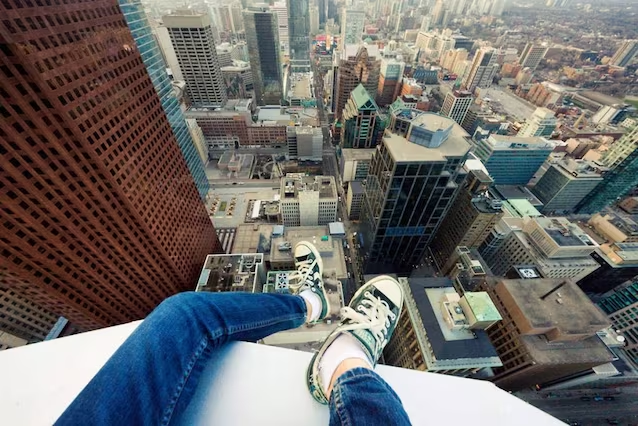
Canadian Tom Ryaboi also played an important role in the birth of the photographic genre, author of a shot in 2011, “I’ll Make You Famous”, among the first rooftopping images to go viral, taken from a building under construction in Toronto.
Rooftopping, building and free climbing: the differences
To be clear, these feats have nothing to do with feats like the authorized one of Alex Honnold, who last January climbed the Taipei 101 skyscraper barehanded, in “free solo”, to beat a personal record, filmed and broadcast live all over the world. It is easy to confuse rooftopping with similar disciplines, but they are practices with their own specificities:
- The building it is the actual climbing of the external facade of a building, from bottom to top;
- The free climbing (free only when practiced without any protection) is a climbing technique that can also be applied to natural walls, and which in the urban context has its most famous interpreter in the Frenchman Alain Robert, nicknamed “French Spider-Man”, known for having climbed dozens of skyscrapers around the world with his bare hands (although on several occasions with a safety harness), or Alex Honnold;
- The rooftoppingon the other hand, aims above all to reach the top of a structure in an unauthorized manner, often using internal routes, and then document the feat with photos and videos to post online.
Nikolau and Beerkus, protagonists of the climb to the Empire State Building and already known to the general public for the Netflix documentary Skywalkers: A Love Story (2024), which recounted their climb of Merdeka 118 in Kuala Lumpur (the second tallest building in the world), move precisely between these disciplines, mixing rooftopping and free climbing elements with a strong performative component designed for social media. And in fact, the whole world is talking about it.
Rooftopping is, first of all, a media phenomenon: it was born on the street, but its real objective is photography or video to share. Popularity has grown hand in hand with Instagram and YouTube: some of the most followed rooftoppers have obtained sponsorships from outdoor clothing brands and hundreds of thousands of followers, transforming what was a subculture into a global phenomenon, capable of generating documentaries and television products.
The risks and legal consequences
Behind the spectacular images taken hundreds of meters above sea level, rooftopping remains an extremely dangerous activity, especially because it almost always lacks any safety device. The best-known case is that of Wu Yongning, a Chinese rooftopper followed by millions of followers, who died in 2017 after falling from the 62nd floor of a skyscraper in Changsha while filming a video. It is not an isolated episode: over the years the number of rooftoppers killed or injured following a fall has progressively grown along with the popularity of the discipline.
In almost all cases, rooftopping is illegal, because it involves unauthorized access to private properties or areas prohibited to the public. In New York, for example, the law punishes it as a crime (misdemeanor class A) the unauthorized climbing of any structure more than 15 meters high, with penalties that can reach up to a year in prison or a thousand dollars in fine, as in the case of Nikolau and Beerkus. Even in Italy the phenomenon is not new: in recent years there have been episodes of young people climbing onto the roof of the Galleria Vittorio Emanuele in Milan, attempts to reach the Madonnina del Duomo and, during a concert, the climbing of the roof of the San Siro stadium by a seventeen-year-old boy.