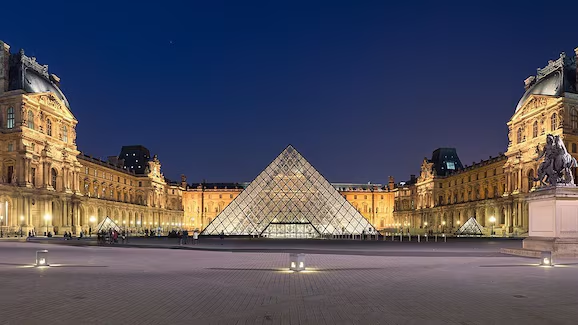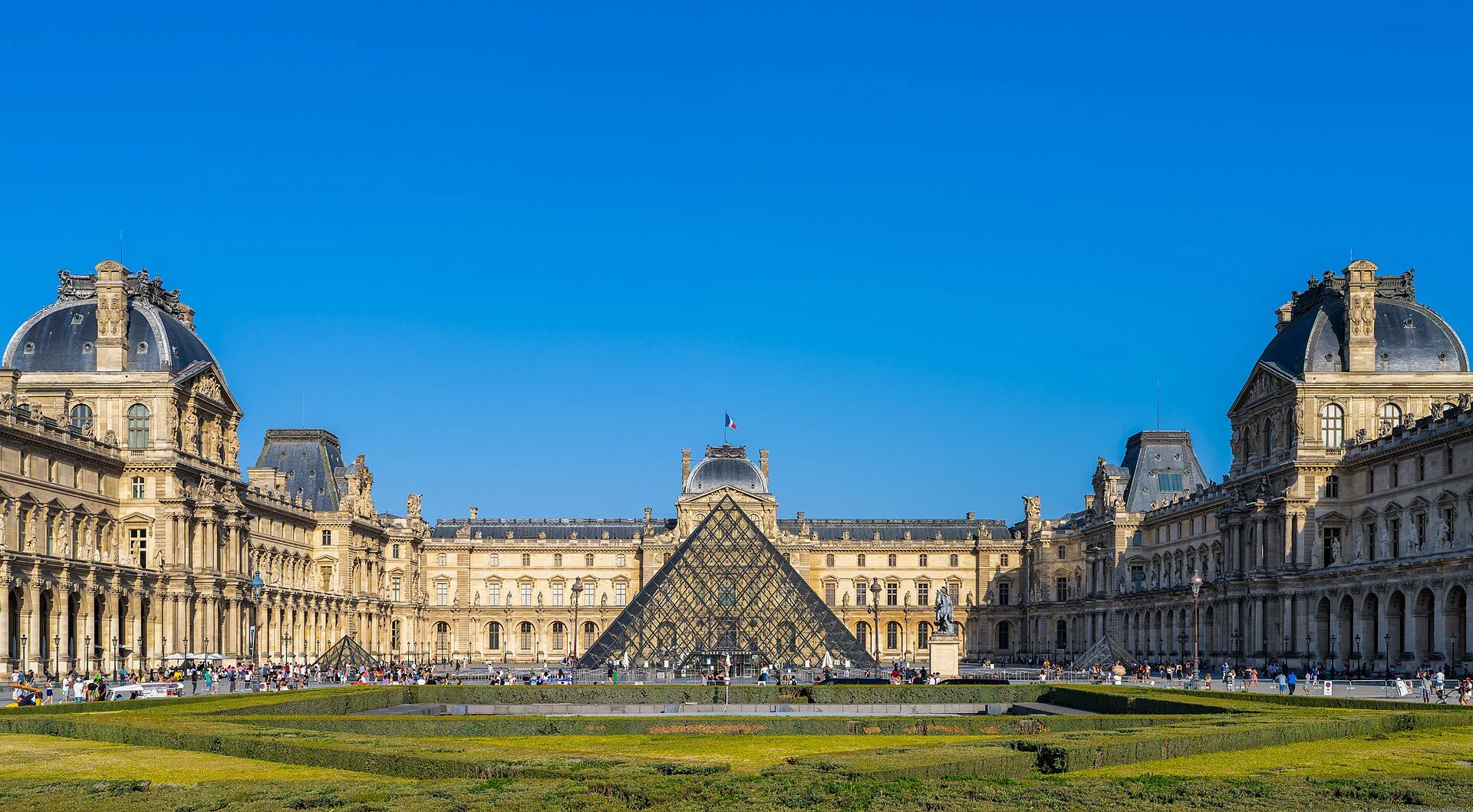
Although new museums are continually opening all over the world, the most seen of all still remains: the Musée du Louvre in Paris. The latest annual survey on museum attendance confirmed that, despite the decline in visitors following the pandemic, the institution welcomed more than 9 million visitors in 2025. Many of these visitors, however, do not know that the Parisian museum, recently the victim of a sensational theft, was not born with this function, but with the role of a fortress.
The origins of the name “Louvre” are disputed: according to the Grand Larousse encyclopédiquethe name derives from an association with a wolf hunting den (via Latin: lupus), but the word may also derive from the French verb louer (to rent), with the addition of the Old French noun-forming suffix.
The history of the Louvre: from military fortress to royal residence
It all began between 1190 and 1202, when King Philip II of France (just before the Third Crusade) had a fortress built that first of all had a defensive function (to be placed alongside the new city walls) in order to consolidate the western side of the capital from future enemy invasions: his concern was mostly aimed at the English soldiers stationed in Normandy. The fortress, 78 m x 72 meters and surrounded by a 10 meter wide moat, also had a second function, closer to the current one: a place to keep its treasures and archives.
In the following years there was a first expansion under Louis IX, while Charles V the Wise (in the second half of the 14th century) the fortress was enlarged and transformed into a royal residence: the architect Raymond du Temple was commissioned to build the apartments as well as the first royal library in Paris.
The building as a prison and arsenal, and then again a home
As the years passed, the Louvre often changed its shape and use: with Louis XI it became a prison and with Louis XII an arsenal. Under Francis I the building returned to being used as a residence, with several modernizations based on the model of Italian Renaissance palaces. The French architect Pierre Lescot began the restoration of the building in 1546: the internal courtyard dates back to this period, i.e. the first half of the sixteenth century.
New modernizations and enlargements arrived with the reign of Henry II and his wife Catherine de’ Medici first, and of Henry IV of Bourbon and his wife Marie de’ Medici later, a period during which the Louvre began to host the works of art of the royal family.
Two Italians collaborated on the Louvre projects: the architect Sebastiano Serlio but above all the famous artist Gian Lorenzo Bernini, who at the end of 1665 arrived in Paris at the court of Louis XIV, the Sun King, after having won the competition for a monumental project that harmonized the new parts and the old structure. Perhaps due to the distraction of work in Versailles, or because Bernini did not feel well in France, the collaboration did not come to fruition.
The age of Napoleon and beyond: the modern Louvre
It is precisely with the Sun King, Louis XV, that the Louvre becomes a museum in the modern sense. The Count of Angiviller, Charles-Claude de Flahaut de La Billarderie, became a vehicle for the ideas that spread with the Enlightenment according to which the royal art collections should be reunited and made available for national progress, the arts and sciences. This idea only came to fruition with the advent of the French Revolution: the Constituent Assembly decided that the palace should display the country’s cultural heritage (hundreds of works confiscated from royalty, the church and nobles) and inaugurated it on 10 August 1793.
The one who wanted to make the Louvre a “universal museum” was none other than Napoleon Bonaparte, who collected works here from all over France but also from all over Europe: the leader was in fact famous for the “requisitions” of cultural goods, which he mostly “legalized” by inserting the transfer of works of art in the clauses of the armistices or peace agreements (at the conclusion of the military campaigns started in 1796). The museum expanded to 19 rooms and became a temple to its greatness, which is why the emperor, in 1810, wanted to celebrate his wedding with Maria Luisa of Austria there.
The director Vivant-Denon, Napoleon’s companion in the Egyptian campaign and appointed to manage the institution from 1802, brought the Louvre closer to the idea of a museum that we have today: here he wanted to collect artistic testimonies from all over the world and all eras as a teaching tool.
After the fall of Napoleon, the museum was enlarged and new works with Egyptian, Etruscan, Greek, Roman and Assyrian antiquities continued to be acquired: in the mid-nineteenth century there were over forty rooms. With the Third Republic the state museum finally became the “Musée National du Louvre”, and is still enriched today by acquisitions and donations of works of art.