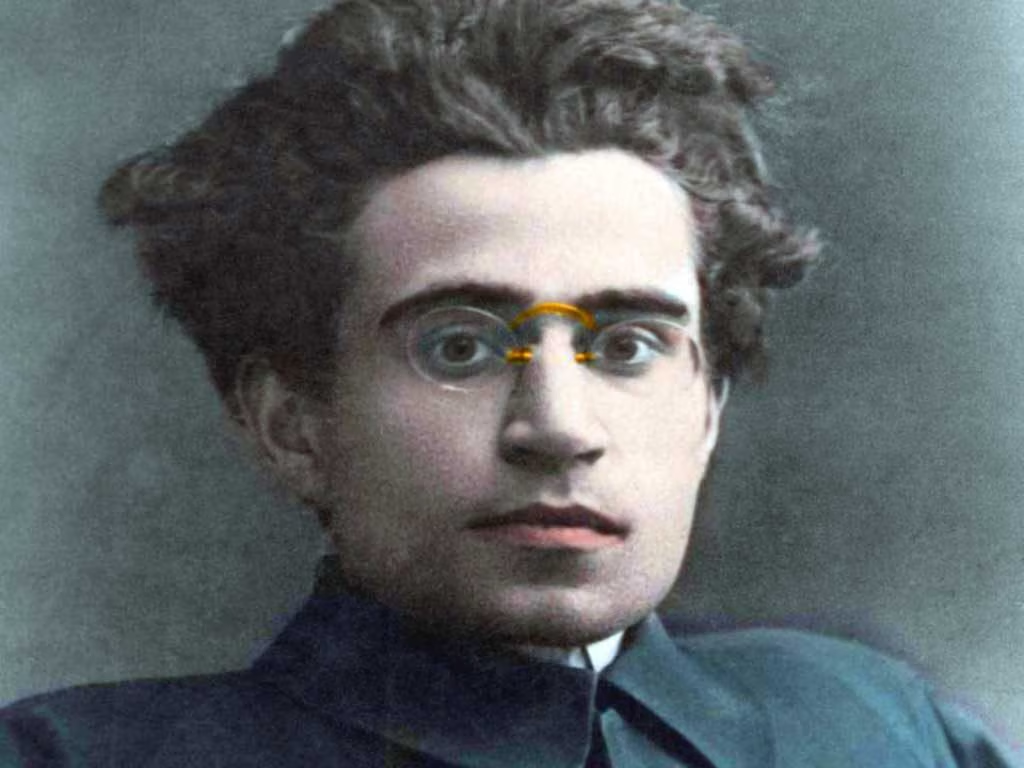
Antonio Gramsci, born in Ales, Sardinia, in 1891 and died in Rome in 1937, was an intellectual and a leader of the Communist Party of Italy. As a young man he studied first in Sardinia and then at the University of Turin. When he was a university student he joined the Socialist Party and, after the First World War, he was one of the founders of the Communist Party of Italy. Between 1922 and 1924 he lived in the Soviet Union and Austria. Elected deputy in 1924, he returned to Italy and continued his political activity until his arrest in 1926 by decision of the fascist dictatorship. He remained detained, first in prison and then in a clinic, until his death. During his detention he maintained a correspondence with his family, collected after the war in Letters from prison, and also wrote the Prison Notebooks, a collection of notes on politics and culture
Gramsci’s childhood and youth in Sardinia
Antonio Gramsci was born in Ales, in the province of Cagliari (now the province of Oristano) in 1891. He belonged to a family of modest means and from an early age he had to face health problems, including the onset of Pott’s disease, which caused kyphosis (i.e. the appearance of the hump). He spent his childhood in the town of Ghilarza and from an early age showed great love for studies, but had to temporarily leave school at 12 to work and help his family, who were also in difficulty because his father, Francesco, had been arrested for crimes committed as a land registry employee. In 1905, however, he was able to enroll in the gymnasium in the town of Santu Lussurgiu and three years later he moved to Cagliari, where his brother Gennaro lived, to attend high school.
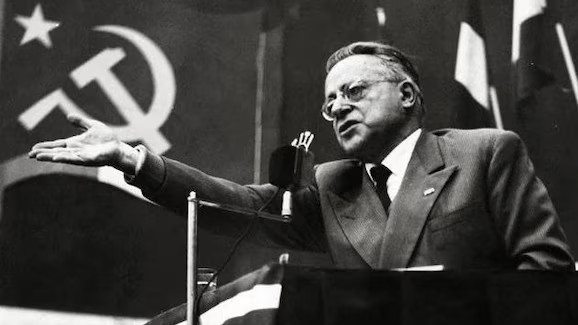
He developed “Sardist” political beliefs, believing that Sardinia had been damaged by the “continentals”, but from a young age he showed interest in the conditions of the humbler classes. He graduated in 1911 and in the same year he participated in the competition for a scholarship to attend the University of Turin, being among the winners. Another of the winners was Palmiro Togliatti.
His stay in Turin and his political maturation
In 1911 Gramsci moved to Turin and enrolled in the faculty of literature. He lived in precarious economic conditions, because the scholarship was barely enough for expenses. He developed socialist political ideas and in 1913 joined the PSI. At the outbreak of the First World War, he showed that he appreciated the interventionist line. During the conflict, he began an assiduous collaboration with the socialist press, writing for the weekly “Il Grido del Popolo” and the Turin edition of “Avanti!”. He became friends with Togliatti and other young socialists, including Umberto Terracini and Angelo Tasca. In 1917, he looked with interest at the Russian Revolution.
His political commitment took him away from his studies, which he never completed. In 1919, together with Togliatti, Tasca and Terracini he founded a new newspaper, “L’Ordine Nuovo”, which supported the workers’ demands and the factory council movement. In 1921 he distanced himself from the Socialist Party and was among the founders of the Communist Party of Italy, of which he immediately became one of the most prominent leaders. However, he had to face fascism, which was increasingly present and violent. The Communist Party took an intransigent position and refused to collaborate with other anti-fascist forces. Gramsci probably did not appreciate sectarianism, but he did not make his dissent explicit.
Gramsci in the Soviet Union and Austria
In 1922 Gramsci moved to Moscow as the representative of the Communist Party of Italy at the Communist International. The Moscow experience was a fundamental turning point in his life. First of all, he had the opportunity to meet the major communist exponents, including Lenin, and to develop precise ideas on the Italian crisis (while he was in Moscow, moreover, in Italy the fascists took power with the march on Rome). Furthermore, due to his health conditions he was hospitalized for a period in a sanatorium, where he met Giulia Schucth, a teacher belonging to a communist family, whom he married in 1923 and with whom he had two children, Delio and Giuliano.
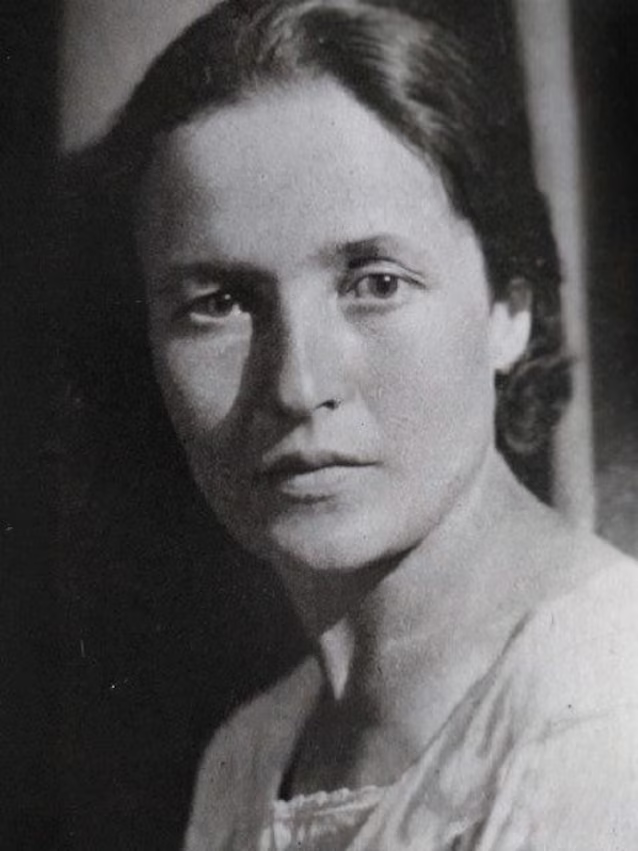
Gramsci remained in Moscow until the end of 1923, when he moved to Vienna as a representative of the Communist International. In 1924, while he was abroad, he ran for the Chamber of Deputies, in the last relatively free elections before the establishment of the dictatorship and was elected.
Deputy and communist leader
Returning to Italy in May 1924, Gramsci took his place in the Chamber. In June, as we know, the fascists killed Giacomo Matteotti, causing the withdrawal of the deputies of the opposition parties from the Chamber. The communists, however, decided to remain in the Chamber to denounce the damage caused by fascism. In the same 1924, the party founded a new newspaper, “L’Unità”: the title was chosen by Gramsci to mean that it was necessary to unite the anti-fascist forces. From the following year, however, the fascists began the process of establishing a real dictatorship, limiting the margins of freedom of the other parties. Gramsci courageously continued his political activity both in the Chamber and in the party newspapers. In January 1926 he was the main protagonist of the Lyon Congress of the Communist Party together with Palmiro Togliatti. In the following months, however, he found himself in conflict with Togliatti regarding the opinion on the fracture that was developing in the Bolshevik Communist Party between the majority, led by Stalin, and the opposition led by Leon Trotsky. Gramsci, although siding with the majority, took a more conciliatory attitude than that of Togliatti. The two leaders could never have clarified: on 8 November 1926 Gramsci was arrested by the police in Rome: Mussolini, taking an attack he had suffered as a pretext, ordered the arrest of the opposition deputies and the dissolution of the opposition parties. The dictatorship began for Italy and the prison doors opened for Gramsci.
Gramsci’s trial and detention
Gramsci was sent into confinement on the island of Ustica, but was later transferred to prison and accused in a trial held in 1928 before the Special Tribunal for the Defense of the State (established by fascism to judge political crimes). Terracini and other managers were accused together with him. After a trial conducted without the guarantees of ordinary courts, he was sentenced to twenty years of imprisonment and assigned to the Turi prison, in the province of Bari. During his detention, he wrote the Prison Notebooks, a work in which, through reflections on the history and culture of Italy, he expressed his ideas on the State, on the fight against fascism, on democracy and on many other themes.
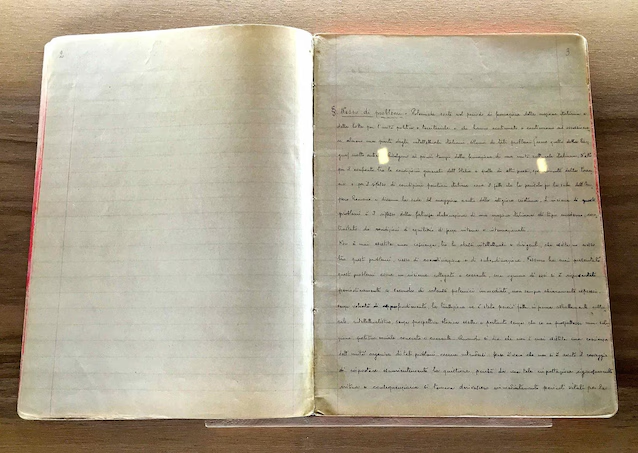
He also maintained an extensive correspondence with Giulia, with other family members and, above all, with his sister-in-law Tatiana, who lived in Italy and was at his side for the entire period of his detention. The letters from prison, published after the fall of fascism, would become one of the best-known literary works of the twentieth century. The imprisonment, however, caused a serious worsening of Gramsci’s health conditions. In December 1933 he was transferred, on parole, to a clinic in Formia. Abroad, he enjoyed enormous prestige and in many countries anti-fascists celebrated him as one of the most prestigious political leaders. Togliatti, despite the differences in 1926, defined him as “head of the working class”. The prisoner’s health conditions, however, progressively worsened. In 1935 he was transferred to a clinic in Rome. On April 25, 1937, when he had just obtained full freedom, he suffered a cerebral hemorrhage. Two days later he died. In the post-war period, his political and cultural legacy, conveyed above all through the Prison Notebooks, had a vast influence on intellectuals and the political world.