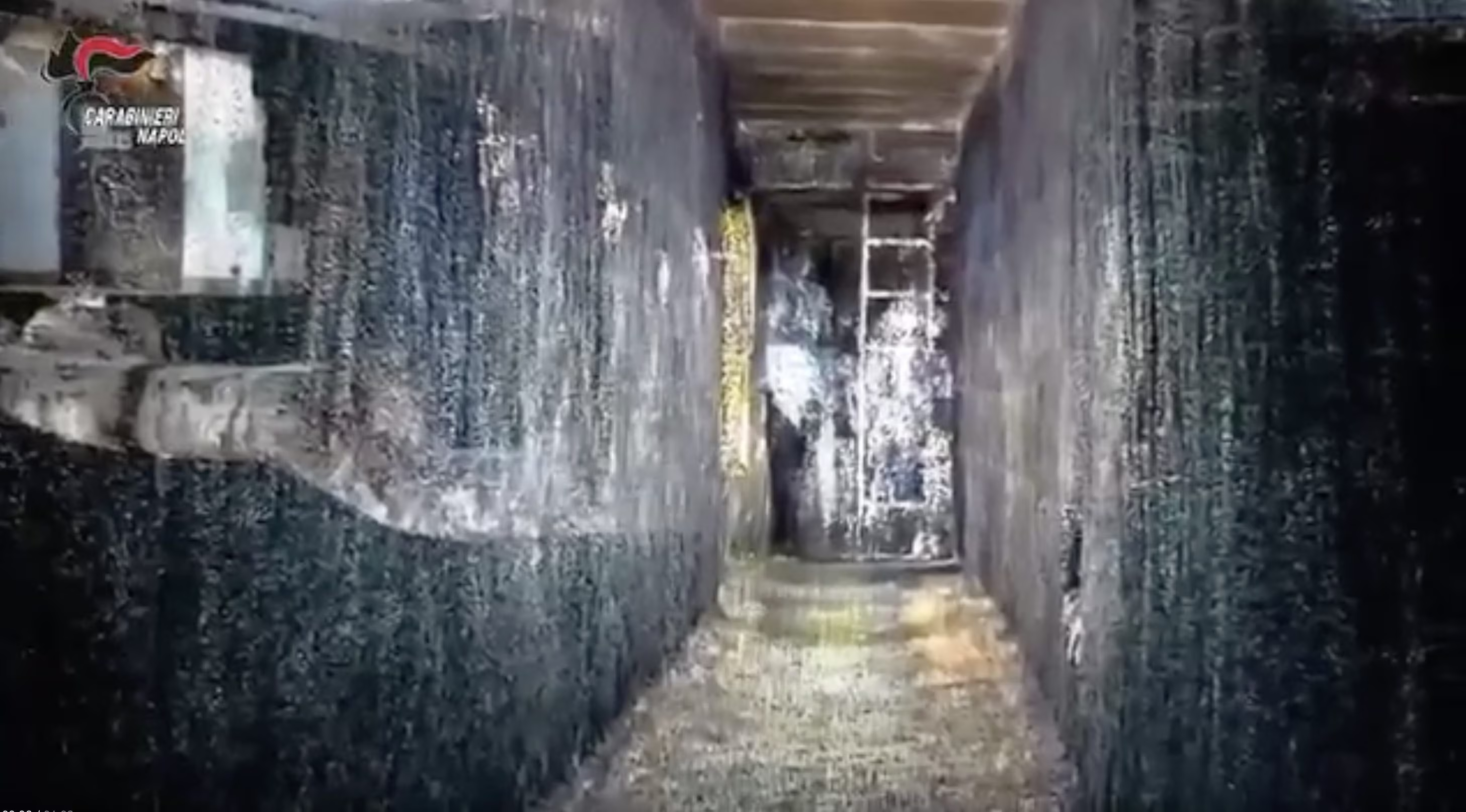
The Carabinieri of Naples have released a 3D reconstruction created by the geologist Gianluca Minin (president of the Galleria Borbonica and one of the leading experts on the Neapolitan subsoil) which shows the network of underground tunnels dug to carry out the robbery of the Credit Agricole bank in Piazza Medaglie d’Oro, in the Arenella district of Naples, which began at 12pm on Thursday 16 April and concluded in the afternoon after the release of 25 hostages. The three-dimensional map, created with a portable laser, shows the 12 meters dug by hand in the tuff between the tunnels of the sewer system and used by robbers to emerge into the bank vault and disappear into the city sewers.
The dynamics of the robbery at Credit Agricole dell’Arenella
At around 12.15pm on April 16, at least three people with their faces covered by balaclavas wearing movie actor masks (including The Rock) broke into the bank branch, where 25 people, including customers and employees, were present. The robbers, armed with pistols, held everyone hostage in a room that looked out onto the street through armored glass, while the API Carabinieri (Aliquote di Pronto Intervento) in riot gear and the Fire Brigade rushed to Piazza Medaglie d’Oro following a 112 call.
After about three hours, around 3:00 pm, the Fire Brigade freed all the hostages by breaking the armored glass window of the bank. At 4.45pm the Carabinieri of the GIS (Special Intervention Group) also intervened, arriving from Livorno by helicopter, who entered the branch with the API. It is at this point that the police discovered a hole in the floor of the vault, approximately 50 centimeters wide, from which the robbers escaped by entering the sewer system after having stolen the contents of approximately 40 safes, the value of which is unknown to the bank.
According to initial reconstructions, while the group of robbers who entered the branch were using the hostages as a diversion, a second group of 5 or 6 robbers would have emerged into the vault (whose anteroom floor was not armored) through a network of small tunnels dug by hand between the passages and would have had plenty of time to steal the safes. The same underground route was also used by the masked group to disappear into the labyrinth of the city sewer system.
3D mapping of the underground tunnels dug up to the bank vault
The day after the robbery Gianluca Minin inspected and mapped the route used by the gang. It is a complex route, 12 meters long and between 70 and 90 centimeters wide, completely devoid of supports or coverings and therefore particularly risky to travel. The route is approximately 4-4.5 meters deep and reaches the vault thanks to a vertical section approximately 5 meters long.
Everything was dug by hand, without tools, most likely to avoid suspicious noises: preparatory work which therefore required a very long time and above all in-depth knowledge of the city’s subsoil. The sewerage system in that area is in fact extremely complex: during the inspection Minin encountered around ten crossroads in a 12 meter long stretch.
In short, the situation clearly shows that the thieves were not improvised, but highly trained and that they had planned the robbery down to the smallest detail, also running huge risks due to possible collapses of the underground route. The fact that the thieves knew that the floor of the vault was not armored and that some of the safes were not deposited in safes also led the investigators to hypothesize the presence of a baseman, i.e. a “mole” perhaps inside the branch of the credit institution who knew the latter closely and what was happening inside it.
The importance of the subsoil geology of Naples in the robbery
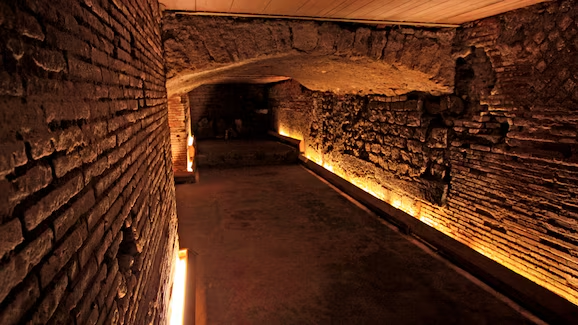
As explained by Minin, the network of tunnels exploited by the robbers is that of the sewer system and not of Underground Naples, but we are still in the same geological context: the subsoil of the Neapolitan capital in fact presents a layer over 100 meters thick made up of tuff emitted during two large volcanic eruptions.
The first was the Campanian ignimbrite eruption, the most violent to occur in the Mediterranean basin in the last 200,000 years with a. It dates back to approximately 39,400 years ago, when the Campi Flegrei emitted something like 150 km3 of magma. The pyroclastic materials produced by the eruption and deposited on the ground can then aggregate and solidify (also with the help of water) into tuff, an igneous rock. It is estimated that this eruption covered much of Campania with a blanket of tuff up to 100 meters thick.
The second was the eruption of the Neapolitan yellow tuff, which occurred 15,000 years ago, also attributed to the Campi Flegrei, second in violence only to that of the Campanian ignimbrite. It is estimated that it emitted up to 40 km3 of magma and deposited a further layer of yellow tuff on top of that of the eruption 39,000 years ago.
Tuff is a soft, porous and easily workable material, which makes Naples a city with a unique subsoil in Europe, with a water and sewage network that intersects, overlaps on multiple levels and connects to the tunnels of Napoli Sotterranea. The characteristics of tuff in fact make it a material – as well as useful for construction – particularly suitable for the construction of tunnels and passages: it is this material, produced by the complex volcanic geology of the area, which allowed the gang of robbers to pull off such a complex heist.