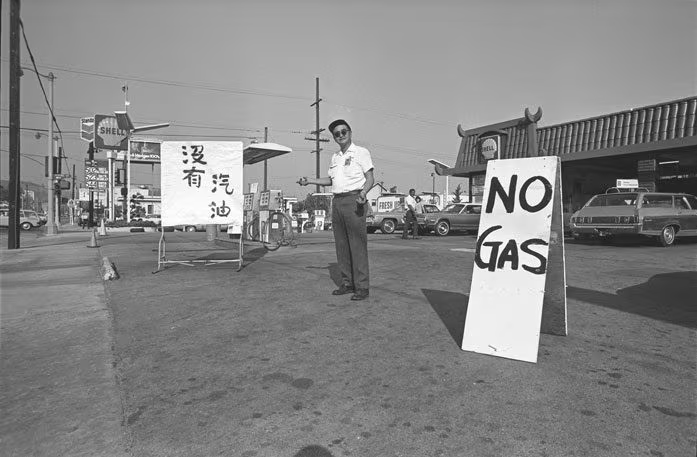
The economic crisis of 1973 was caused by the sudden increase in the price of oil, decided by the Arab countries after the outbreak of the Yom Kippur War, due to Western support for the State of Israel. The crisis put an end to a long period of economic prosperity and led to the introduction of austerity measures, such as the ban on using cars on Sundays. Since then, oil supply has become a constant concern of governments and the public. Another oil shock took place in 1979 after the Islamic Revolution in Iran.
The current rise in crude oil prices has some elements in common with the crises of the 1970s. Today, however, the situation is less serious, also because we have learned, at least in part, to diversify energy sources.
Oil crisis of 1973: causes and consequences
The 1973 crisis erupted following the start of the Yom Kippur War. On 6 October 1973 (when the feast of Kippur, that is, of atonement, according to the Jewish religion, fell) the armies of Egypt and Syria attacked Israel, which had in turn attacked them six years earlier. Since the Jewish state enjoyed the support of Western countries, especially that of the United States, the Arab oil-producing countries decided to react against the West and decided to reduce crude oil exports and double the price.
The effects were immediate. The price of oil quadrupled in just a few months: from 3 dollars a barrel in October 1973 to 11-12 dollars in January 1974. The fact that the war ended on 25 October, after only three weeks, did not mean that prices returned to their previous levels.
The crisis put an end to the period of relative prosperity that had lasted since the end of the Second World War. An economic phenomenon unknown until then began, stagflation, that is, the simultaneous occurrence of production stagnation and inflation. Unemployment increased significantly in many countries. The effects of the crisis were particularly sensitive in Europe, due to its dependence on Arab oil, but they affected the entire planet.
The crisis also had psychological consequences on the collective mentality, helping to make citizens understand the importance of energy supply. Since then, oil has become a subject of discussion in the public scene: it is as if citizens and governments have realized that oil is not an infinite resource.
Since the 1973 crisis, not surprisingly, interest in alternative energy sources, such as nuclear energy, has increased and a more specific attention has developed for renewable sources. The effects of the crisis, however, were not negative throughout the world: the oil-producing countries, in particular the Arab member states of OPEC, not only benefited economically from the shock, but also acquired greater awareness of their geopolitical role and the importance of the resource they possess.
Austerity in Europe and Italy: “Walking Sundays”
To deal with the crisis, many countries had to introduce austerity measures aimed at reducing hydrocarbon consumption: reduction of public lighting, limits on the use of motor transport, etc. Italy was one of the countries in which the measures were most restrictive. On 23 November 1973 the government approved a package of interventions, of which the most important was the ban on the use of private motor vehicles on Sundays. The Italian streets filled with pedestrians, bicycles, even people on horseback.
Furthermore, the signs of bars and shops were ordered to be turned off, the premises were ordered to close early, and the evening news was established to start at 8.00 pm instead of 10.00 pm (the time remained in force after the crisis), all with the aim of encouraging Italians to stay awake for less time and thus reduce energy consumption.
The austerity rules remained in force until the spring of 1974. In April they were eased (from the ban on driving on Sundays to alternate number plates) and in June they were completely repealed. The government, however, also introduced other measures, such as the search for alternative sources of energy and the strengthening of nuclear power plants, which were destined to have long-term consequences.
The oil shock of 1979
In 1979, following the Islamic revolution in Iran (i.e. the ousting of the Shah from power and the establishment of the theocratic regime that still exists today), the world experienced another oil shock. Unlike 1973, the increase in the price of crude oil was not a deliberate choice, but a consequence of the decline in production in Iranian territory. The price per barrel went from 13 to 35-40 dollars. The effects, however, were more limited, thanks to the fact that many countries after the 1973 crisis had begun to diversify their energy sources. Unlike the previous shock, stagflation did not develop, but simple inflation occurred, and no austerity measures were introduced.
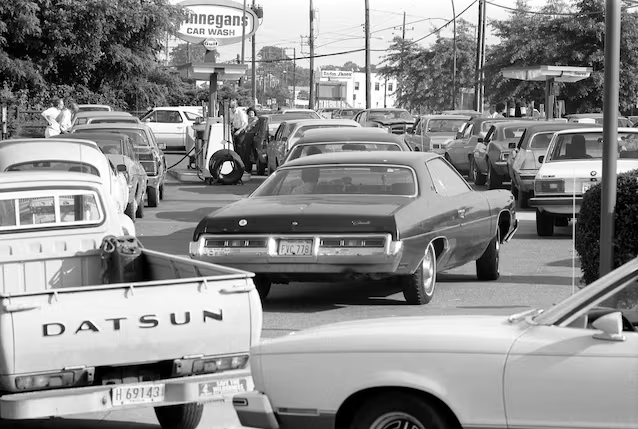
The differences between the current situation and past oil shocks
The crises of 1973 and 1979 apparently have elements in common with the situation created by the blockade of the Strait of Hormuz. Now as then, due to a conflict in the Middle East, an oil-producing country caused a sudden increase in prices per barrel. However, there are very clear differences between the current crisis and past ones.
First of all, today the price increase is, proportionately, much more contained, from around 65 dollars a barrel in February to around 100 in April: a growth of around 30%, while it was 400% in 1973 and 300% in 1979. Today, moreover, the world is more “prepared”, energy sources are diversified and many states possess strategic hydrocarbon reserves. For this reason, the economy is more resistant to rising oil prices, although it is not entirely immune to the damage it causes.
Another difference lies in the fact that in 1973 (but not in 1979) the price increase was directly controlled by the producing countries and not left to market fluctuations, while today the cost of oil is not set by the producers and increases even just due to threats to attack oil tankers passing through Hormuz.
Overall, today’s crisis is less severe than those of the past, particularly that of 1973. At the moment no country has introduced austerity measures like those of the 1970s and, although the future is always unpredictable, it appears unlikely that they will be introduced in the near future.