The second round of negotiations between the United States and Iran is expected to open today, April 21, in Islamabad, Pakistan: in the meantime, the Strait of Hormuz remains effectively closed, with the blockade continuing to weigh on the global economy and energy supplies around the world. Until before the war, approximately 20 million barrels of oil per day (approximately 25% of global seaborne oil trade) and over 112 billion cubic meters of LNG per year (approximately 20% of global liquefied natural gas trade) passed through this maritime hub, approximately 34 km wide, according to data from the International Energy Agency (IEA).
With the truce between the USA and Iran expiring tomorrow, April 22, and the prospects of a peace agreement becoming increasingly distant, we ask ourselves: but are there real alternatives to Hormuz for oil and LNG trade? The answer is very different depending on whether we are talking about crude oil or liquefied natural gas: for the former there are some ways out (even if they are not able to compensate for the quantities of oil that have so far passed through this chokepoint); for the second, however, the situation is even more complicated, since there are no real alternatives to the Strait of Hormuz.
Possible alternatives for crude oil and the maximum capacity of pipelines
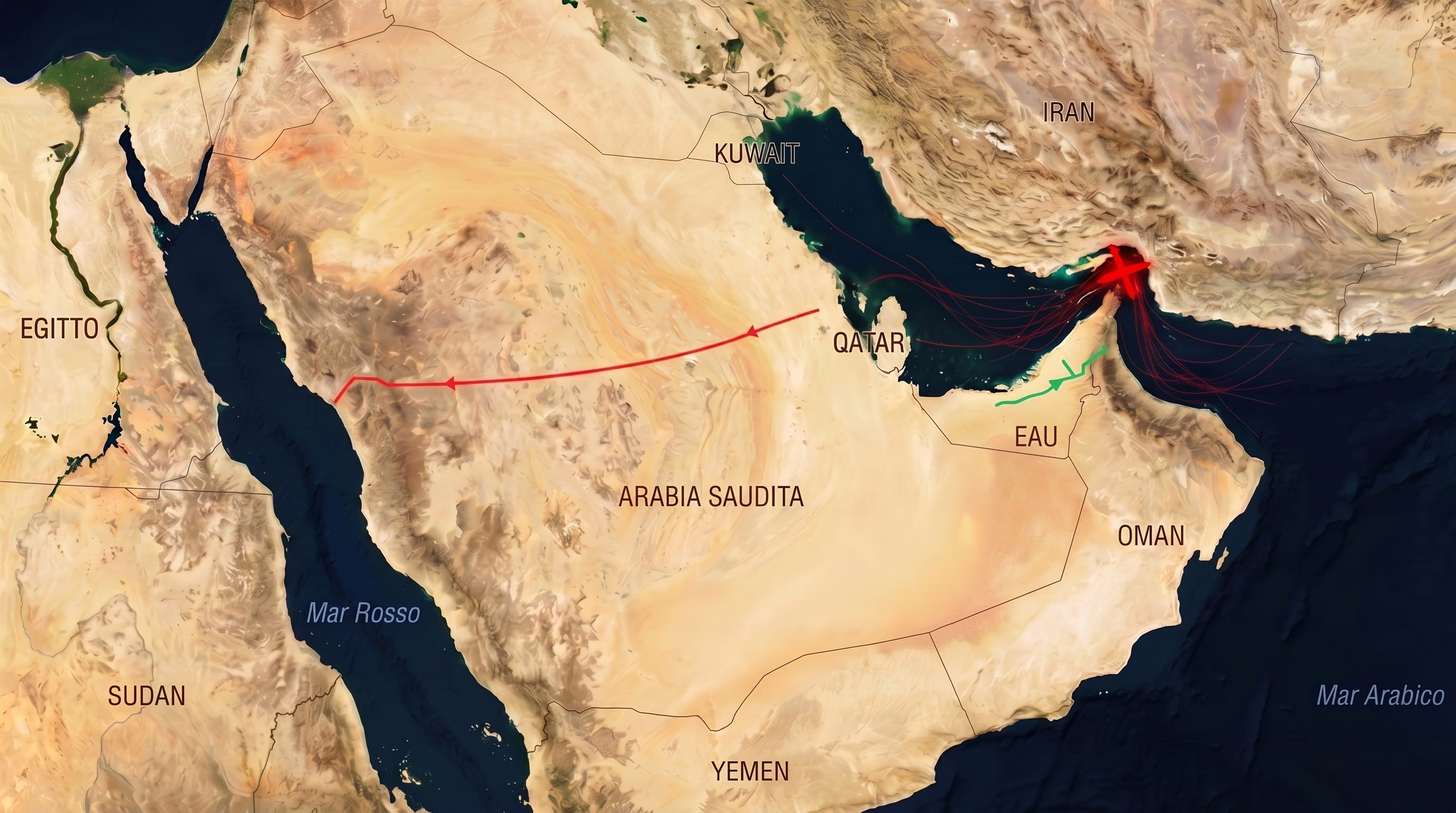
As highlighted by the IEA report on the Strait of Hormuz, only Saudi Arabia and the United Arab Emirates have operational pipelines capable of diverting crude oil flows bypassing this maritime hub. More specifically, the largest system is made up of the East-West Crude Oil Pipeline (also known as Petroline), operated by the Saudi giant Aramco.
This is a network approximately 1,200 km long that crosses Saudi Arabia, connecting Abqaiq to the port of Yanbu on the Red Sea. Since the beginning of the crisis, Saudi Arabia has progressively moved almost all of its exports to this route, whose capacity was increased from 5 to 7 million barrels per day in March 2026, following the crisis in the Middle East.
The second alternative, however, is that of the Abu Dhabi Crude Oil Pipeline (ADCOP), which extends for approximately 400 km from the onshore oil facilities of Habshan, in the emirate of Abu Dhabi, to the port of Fujairah, located in the Gulf of Oman. The maximum capacity of this pipeline is approximately 1.8 million barrels of crude oil per day: according to IEA data, in fact, normal production was approximately 1.1 million barrels per day, with room for an increase in volume of up to 700,000 barrels per day in the event of a closure of the Strait.
Finally, worth mentioning is the Jask oil terminal in Iran, officially inaugurated in 2021 to transport crude oil from the Goreh-Jask pipeline to Jask, on the Gulf of Oman. The pipeline would have a declared capacity of 1 million barrels per day: however, even today the infrastructure is not operational and is not considered a viable option for the export of Iranian crude oil.
The problem is that, even at their maximum capacity, the first two pipelines could only handle a part of the crude oil that previously transited through Hormuz: according to estimates, in fact, there is talk of a maximum of around 8.8 million barrels per day (7 for Saudi Arabia and 1.8 for the United Arab Emirates), less than half compared to the approximately 20 million that normally transited through the Strait.
Most of the oil that crosses the Strait is destined for Asian countries – with China, India and Japan as the main importers: as we have seen, however, the blockade of the Strait is having global repercussions, especially on the prices of energy resources.
The absence of alternatives for liquefied natural gas
For the transport of liquefied natural gas (LNG), however, the situation is more complicated, because there are no alternative routes to export natural gas from Qatar and the United Arab Emirates, except through the Strait of Hormuz.
This is again confirmed by the IEA, which in its report highlights how 93% of Qatar’s LNG exports and 96% of those of the United Arab Emirates transited through Hormuz before the start of the war. The bottom line is that Qatar is the world’s second largest LNG exporter (after the United States), with over 112 billion cubic meters exported in 2025.
It must be said that the Dolphin gas pipeline exists, through which Qatar supplies gas to the United Arab Emirates and Oman: its capacity, however, is extremely limited – just 20.5 billion cubic meters in 2025 – and can in no way replace exports by ship.
Among other things, the oil pipelines of Saudi Arabia and the United Arab Emirates are designed exclusively for the transport of crude oil and cannot be adapted to liquefied gas, which requires completely different infrastructure (such as liquefaction plants or specialized LNG carriers). According to analysts, the only future strategy for countries like Qatar could be to invest in LNG projects abroad to diversify supply sources, but these are still medium-long term plans, which do not resolve the current emergency.
Because so far no real alternatives to the Strait of Hormuz have been developed
At this point, however, a question arises spontaneously: why have no real alternatives to the Strait of Hormuz ever been created in the Middle East, despite history having demonstrated the vulnerability of this maritime hub? The explanations are different and have to do with the geography of the region and the complex diplomatic relations between the Gulf states.
For many countries, in fact, the only way to bypass the Strait of Hormuz would be that of build oil or gas pipelines within neighboring states, cwith high costs both in economic and political terms. Qatar, for example, is the world’s second largest LNG exporter, but by land it borders exclusively Saudi Arabia, with which relations have long been tense. In 2017, in fact, Saudi Arabia, the United Arab Emirates and Egypt accused Qatar of supporting terrorism and Islamist groups in the region and of having compromising relations with Iran. This opened a diplomatic crisis that was resolved only in 2021 thanks to the mediation of the United States, however nullifying any hypothesis for the construction of a gas pipeline.
Added to all this is the fact that the construction of oil or gas pipelines would require a very long time, as well as billions in investments not only for construction, but also for security, given that it would be vulnerable energy infrastructures exposed to possible attacks (as has already happened during this conflict).