New construction, building renovation, urban redevelopment and infrastructural adaptation activities generate large quantities of waste materials on a daily basis.
Traditionally, the management of these wastes was considered a marginal or purely accessory phase of the building work, to be addressed extemporaneously only in the final phases of the construction site. However, the growing complexity of environmental regulations, combined with the need to optimize management times and costs, has radically transformed this paradigm.
Today, the management of construction waste represents a real strategic variable, capable of directly influencing the profitability of companies, the safety of workers, the ecological sustainability and the legal compliance of the entire production chain.
The overall impact of the construction sector on the national waste system is impressive: the latest statistical data show that construction and demolition activities in Italy generate around 83.3 million tonnes of special waste every year, a figure which represents 50.6% of the national total of special waste produced.
Of this significant mass of materials, over 80 million tons are usefully sent to material recovery operations.
The integrated “turnkey” approach
What does it actually mean to adopt an integrated and “turnkey” service for the management and disposal of construction waste? It means entrusting the entire life cycle of waste materials to a single professional partner, relieving the client and site managers of any operational and bureaucratic complexity.
Entrusting the various management phases to different and uncoordinated entities (such as a company for loading, a third-party transporter for handling and an external plant for disposal) creates a dangerous fragmentation of responsibilities, extends construction time and multiplies the risk of formal errors or sanctions. On the contrary, a complete and integrated service rigorously oversees every single step of the entire value chain:
- Initial characterization and identification of the waste: Each intervention starts with an accurate chemical-physical and product analysis of the materials to be removed. This phase is fundamental for correctly classifying the waste using the codes of the European Waste List (EER/CER), promptly distinguishing the non-hazardous inert fractions from the residues that require specific treatments. A preventive and professionally carried out characterization eliminates uncertainties and prevents blocking of work or disputes during the control phase.
- Organization of temporary storage on site: In compliance with the provisions of Legislative Decree 152/2006 and the Minimum Environmental Criteria (CAM Building), the waste produced must be stored on site in an orderly and differentiated manner for category homogeneity. Separating bricks, cement conglomerates, bituminous mixtures, metals, wood and plastics at source prevents mutual contamination of materials and maximizes the amount that can be used for subsequent recycling.
- Loading and authorized transport with a suitable fleet of vehicles: Movement from the construction site takes place via a suitable and adequately equipped fleet of vehicles, registered in the National Register of Environmental Managers. Each journey is accompanied by the correct compilation and management of the Waste Identification Form (FIR), an essential document that certifies the traceability of the flow from the place of production to the destination plant.
- Final delivery and documentary traceability: The cycle ends with the entry of the waste into the authorized treatment plant, where weight checks and official taking over are carried out, issuing the waste producer with the fourth copy of the FIR which fully fulfills the legal obligations.
Maximum efficiency and cost reduction
One of the key factors that determine the operational success and cost-effectiveness of construction waste management is the availability of authorized and directly managed infrastructures in the area.
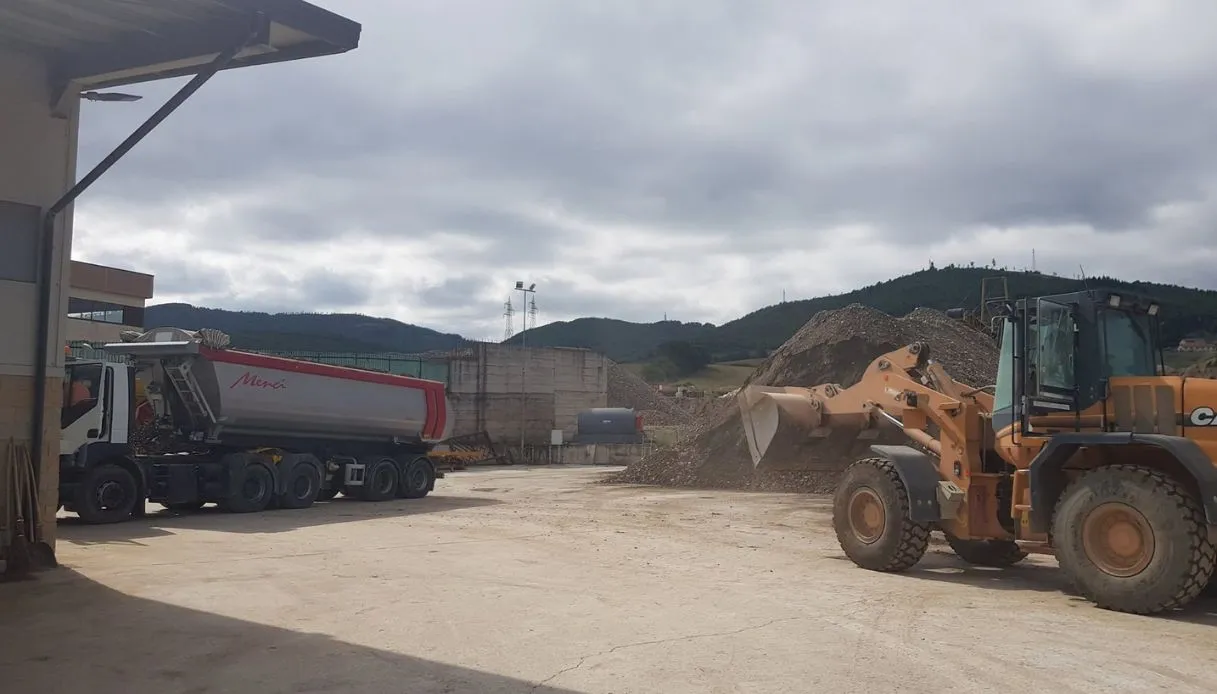
In this context, the reference reality in Basilicata is represented by SO.CO. Ecologica, a company active on the market since 2001 with operational headquarters located in Tito Scalo, in the province of Potenza. The company has its own fully authorized collection center and plant, structured for the management, storage, treatment and recovery of inert waste and materials from excavations and demolitions.
Circular economy and valorisation of rubble
The real turning point in modern construction waste management lies in the ability to convert a business cost and a potential environmental problem into an opportunity for economic development through the principles of the circular economy. The materials coming from demolitions and excavations must not be considered simple waste to be disposed of in landfill, but real deposits of secondary raw materials.
The process of valorisation and recovery of inert materials conducted by SO.CO. Ecologica is articulated through precise advanced technological phases:
- Primary and secondary crushing: Concrete blocks, masonry structures, bricks and asphalt are subjected to mechanical hydraulic crushing treatments which volumetrically reduce the material.
- Magnetic separation and cleaning: During the process, special magnetic iron removers extract the metal fraction (steel rods and armor), while appropriate sorting systems remove any light or foreign fractions.
- Sieving and granulometric classification: The granules obtained are selected through vibrating screens to produce different homogeneous product sizes, ready to be reintroduced into the construction cycle.
SO.CO. Ecologica, the strategic partner for the construction of the future in Basilicata
In a rapidly evolving construction market, where sustainability, regulatory compliance and cost efficiency are the determining factors for business success, SO.CO. Ecologica confirms itself as an essential point of reference for construction waste disposal in the city of Potenza and for the whole of Basilicata.
With over twenty years of experience in the field, an authorized company center in Tito Scalo, a fleet of cutting-edge machinery for interventions in-situ and ex-situ and a supply chain entirely certified by the Giordano Institute, SO.CO. Ecologica offers businesses, craftsmen and construction professionals a truly “turnkey” service.
An operational model capable of combining regulatory rigor, economic efficiency and respect for the environment, transforming construction waste from a construction site problem into a resource for the sustainable development of the territory.