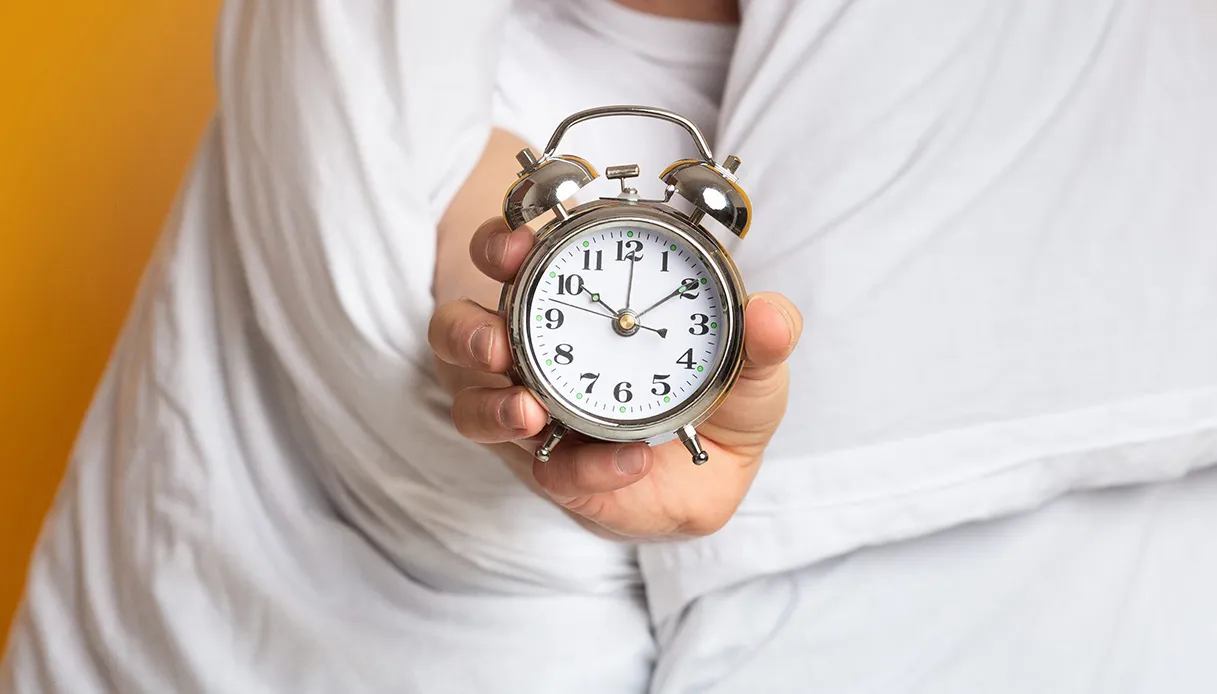
We’re almost there. On the night between Saturday 28th and Sunday 29th March summer time returns and the hands move forward by one hour. Thus, in the first few days after this advance of the hands, we could find ourselves with an hour less sleep, if obviously nothing changes. Let’s be clear: after a few days the sleep-wake rhythm tends to rebalance. But you shouldn’t just think about the time dictated by the clock.
The situation is also changed by the different exposure to light, which somehow creates a sort of mini jet-lag. Because not only do we get up an hour earlier since the alarm always remains at the same time, but we also tend to sleep later because the body has to adapt to the greater evening light. Thus a cocktail is created which, in some cases, can make us more exposed to small annoyances, starting from greater difficulty concentrating and irritability during daytime hours, as if we were exposed to a small temporary lack of sleep.
Symptoms of changing habits
The result of this situation is a change in habits, which like any variation in the rhythms dictated by the body’s clock can affect well-being. In fact, the brain progressively calibrates itself to its rhythms. And the change “stresses” him, albeit in a completely bearable way.
Result? In those who are particularly sensitive (the “extremes” of sleep habits are especially at risk, therefore those who are particularly “owl-like” and go to sleep very late as well as those who, as a lark, wake up in the predawn hours) may experience difficulty falling asleep or early awakenings with the consequent need to catch up on sleep during the day. thus you become (for a few days, let’s be clear) less efficient at work and study and there may be difficulty concentrating and slowed reflexes. You feel nervous. Sometimes an annoying headache can even appear, with the classic tiredness headache.
How we regulate the rhythms
To understand what happens with this “mini jet-lag”, let’s try to retrace some chronobiological data, to understand how our biological clock works. Daylight saving time, in some ways, can act as a “stirrer” for our internal “stabilizers,” which operate irregularly. The “power plants” of biological rhythms, which in many cases undergo external stimuli such as the alternation of light and darkness and on the basis of these “set” the organism, are identified in the hypothalamic-pituitary complex, i.e. two small organs located in the brain and directly or indirectly induce the production of many hormones, from those that regulate the female reproductive cycle to those linked to stress.
But the hypothalamus and pituitary gland must also be subject to small groups of neurons that have been identified as the central “clocks” of the organism. For example, they are the suprachiasmatic nuclei and the paraventricular nuclei. The former would be linked to the ability to receive the signals that come from the so-called external synchronizing elements, such as the alternation of light and darkness or the times dictated by the work rhythm and eating habits. The paraventricular nuclei, on the other hand, have the duty of launching the outgoing signals, and passing the information received to the processing “stations”, represented by the pituitary gland, the epiphysis (another small gland) and another structure of light-coloured, almost blue-coloured nerve cells, called for this reason locus coeruleus.
In practice, always considering as an example the continuous alternation between light and dark every day, here’s what happens. The suprachiasmatic nuclei receive the progressive decrease in external brightness, thanks to the information that reaches the hypothalamus through the retina and the decrease in the production of melatonin, a fundamental hormone for regulating the sleep-wake rhythm which is produced especially at night. At this point this “handful” of neurons – the suprachiasmatic nuclei are composed of approximately 30,000 nerve cells), understanding the situation, sends signals to the paraventricular nuclei, connected with them through a recently identified invisible nerve network. And from there, through the various control “organs” such as the hypothalamus and the pituitary gland which produce hormones that stimulate or slow down the metabolic activity and temperature of the organism and the “pushes” to the action of some organs such as the heart, the entire condition of the organism is modified. To the point that the ideal situations for falling asleep are created.
Daylight saving time, and especially the variations in light exposure it entails, can “agitate” this mechanism. And contribute to altering a regularity that we have acquired as happens with the action of some external synchronizers, such as working hours. It has been proven that in those who work at night or in shift workers, who tend to alternate professional activities during the day and at night, the biological rhythms can change precisely because the signals arriving at the body’s management centers do not agree. In actual jet-lag syndrome, the time zone shifts by six to eight hours or more, in fact the stimuli arriving at the body’s nervous clock also change. So it takes a few days for this to be able to “resynchronize” on the new alternation of light and dark, always “organized” by melatonin. Remember, however, that other elements also contribute to “getting the rhythms high”. For example, the emotional tension which obviously, combined with the hands moving forward by an hour, certainly does not help well-being and maintaining rhythms.
Is permanent daylight saving time a solution?
Having said that it is always necessary to personalize the perceptive dynamics of changing time, several studies have recently emerged which have highlighted how, in terms of physical well-being, constantly maintaining summer time instead of standard time, regardless of small temporary subjective changes, may not be ideal. In this sense it is enough to remember the recent data fromAmerican Time Use Survey which seem to demonstrate that having longer days, moving the clock forward by one hour for the entire 12 months, may not be a good thing. Particularly for sleep time. Being exposed more to light in the evening hours, rather than in the morning, would lead to a “cut” in sleep hours of 115 hours less per year. This was reported a few months ago by the experts of the Italian Society of Endocrinology (SIE), gathered on the occasion of the Italian Meetings of Endocrinology and Metabolism, in Naples.
“Conserving “summer” time would allow us to avoid all those disturbances deriving from alterations in the circadian rhythm due to the summer time/winter time transition, which affect a large segment of the population. The impact could be positive especially on children who would enjoy an extra hour in the open air and thus do more exercise – was the comment of Annamaria Colao, President of SIE and Professor of Endocrinology at the Federico II University of Naples. But, given these benefits, summer time permanent can be poorly “in sync” with the biological clock and therefore prove deleterious, increasing the risk of negative consequences on the metabolism and the cardiovascular system by up to 20%.
In short, brighter evenings would be less similar to the human biological clock which needs darkness in the evening to produce melatonin and for adequate rest. It’s possible that there are even more health benefits to making solar time permanent, which at least on paper seems more in sync with our biological clock.
Strategies to overcome the impasse
Let’s start with a curiosity. According to what an American study appeared in the magazine some time ago Chaos and coordinated by Yitong Huang, eating a larger meal early in the morning in the new time zone could help overcome jet lag. In a small way, even if there is no data on the matter, this survey directs us to the importance of a healthy breakfast also as a possible “help” for well-being in times of time change. Taking the research as a starting point, and remembering that it was proposed for “real” jet lag and not for the time change, if you want to limit the problems linked to adaptation to a new time zone, such as tiredness, difficulty sleeping, headaches and the like, it is better to focus on a healthy and nutritionally sound first meal.
The study made it possible to understand with a mathematical model what could happen to the body, without fixating on a single biological “time stamp”. Jet lag syndrome would therefore be characterized by weaker signals between circadian clocks and decreased sensitivity to light. The result would be a system that is more vulnerable and slower to recover. According to this working hypothesis, a rich breakfast would be a useful way to limit the damage caused by jet lag.
We are obviously talking about scientific information to be weighed, even if it is interesting. While we certainly await evidence, however, we should not think that there are no simple strategies to limit the damage. For example, remember that you don’t have to get up an hour later but it is better to keep the same wake-up time. Likewise, it is better to consume more energy with regular physical activity to find yourself more tired in the evening, without changing the time of dinner and without focusing on particularly laborious foods and alcohol in the hope of sleeping more.
Last fundamental recommendation: summer time, with greater exposure to light, can affect our biological clock. But devices such as smartphones and tablets (these year-round, but now perhaps more pressingly) can emit bright light, which inhibits melatonin production. And this affects sleep, regardless of whether the hands are moved forward!