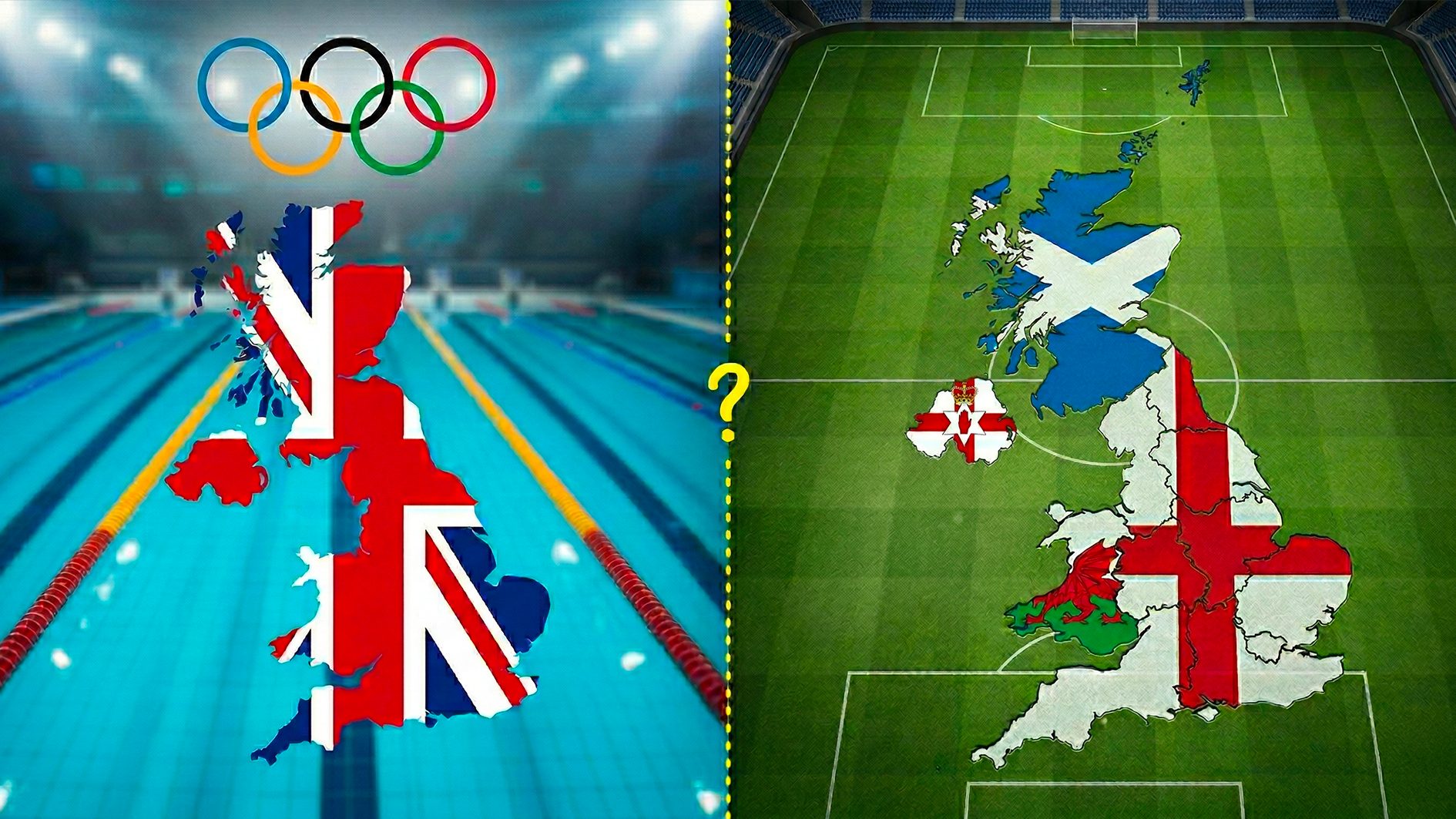
England, Scotland, Wales and Northern Ireland: why do they take to the field as opponents in football, but join forces under the single flag of the United Kingdom at the Olympics? Behind this “strangeness” there is not just sport, but a mix of history, geopolitics and bureaucracy. A mechanism that affects us very closely these days. On Thursday 26 March, in Bergamo, Italy will face Northern Ireland in the very delicate semi-final of the qualifying play-offs for the 2026 World Cup which will be played between the United States, Mexico and Canada. An inside or outside match, fundamental to avoid the sporting drama of a third consecutive exclusion from the most prestigious competition on the planet. Let’s discover how this anomaly works, dictated by the different readings of the IOC and FIFA, which leads “sister” nations to be rivals on the green lawn, and then celebrate historic Olympic medals together, such as the gold medal of Scottish tennis player Andy Murray in London 2012.
The IOC and FIFA rules on the UK
To understand the British anomaly, we must look at the rules of International Olympic Committee (IOC). Born in 1894 in Lausanne, the IOC is the supreme authority of the Olympic Movement and has a golden rule: does not allow the participation of countries or entities that are not officially recognized as independent sovereign states.
The British Olympic Committee is managed by the British Olympic Association (BOA), which acts as the National Olympic Committee for the whole of Great Britain and Northern Ireland. Although the IOC-assigned code is “GBR”, the delegation uses the Team GB branding, making it clear that it represents the entire union and not just the island of Great Britain.
The Home Nations (Scotland, Wales, England and Northern Ireland) are not independent sovereign states, but are part of the British Crown. As a result, they cannot have their own autonomous Olympic Committee. The United Kingdom also oversees over 5,000 islands – including the “Crown Dependencies” (Guernsey, Isle of Man and Jersey) – and overseas territories such as Gibraltar. None of these could ever participate independently under the IOC’s strict regulations.
So why is it different in football? The answer lies in the rules of FIFA (Fédération Internationale de Football Association), the association whose role is to ensure and promote the development of football throughout the world. Founded in 1904, it allowed the four nations of the United Kingdom to maintain theirs independent football federationspioneers of this sport in Europe and born before FIFA itself. The English Football Association, for example, was born in 1863. For this reason, FIFA fully recognizes England, Scotland, Wales and Northern Ireland, allowing them to compete separately in the World Cup and European Championships.
The rugby paradox: sport and British history
This “anomaly” also applies to rugby. In fact, at the Six Nations tournament, Italy regularly faces England, Scotland and Wales as distinct opponents. The reasons for the oval ball are the same: the world governing body (historically known as the IRB – International Rugby Board and today called World Rugby), acting exactly like FIFA, has always recognized the individual British federations as totally independent sporting entities.
However, there is one detail that concerns Ireland. If in football the island is split in half, in rugby the Republic of Ireland and Northern Ireland take the field together in a single national team, erasing all political boundaries. To manage this delicate union, a special anthem, “Ireland’s Call”, was created. Only this is sung away while in the home games in Dublin, the team sings the official Irish anthem first (Amhrán na bhFiann) and, to follow, the anthem that unites the entire island.
But to fully understand where all these differences arise we must summarize the geopolitical history of these islands. The United Kingdomwhose current official name is the United Kingdom of Great Britain and Northern Ireland, is a sovereign state made up of 4 constituent nations: England, Wales, Scotland and Northern Ireland. Its original structure dates back to 1801, when the “United Kingdom of Great Britain and Ireland” was born. The current name derives from the fact that, in 1922, Ireland declared its independence, becoming the current Republic of Ireland, while the north chose to remain tied to London.
Other similar cases concern Denmark and France
The British paradox is not the only one in the world. The boundaries of sports geopolitics offer two other “oddities” worthy of note.
The Faroe Islands They are an autonomous nation that is part of the Kingdom of Denmark. FIFA recognizes their national football team, allowing them to play in the European qualifiers. The IOC, on the contrary, does not consider them a sovereign state: at the Olympics, Faroese athletes must wear the Denmark shirt.
The Tahiti national football team (representing French Polynesia) is also affiliated with FIFA and even played in the Confederations Cup against Spain and Uruguay in 2013. At the Olympic Games, however, Polynesian athletes defend the colors of France. Precisely for this reason the Paris 2024 surfing competitions were held on the island, 15,000 km away from the capital, but under the French flag. Vahine Fierro is an example of a surfer from French Polynesia who competed for the Transalpine team at the Olympic Games.