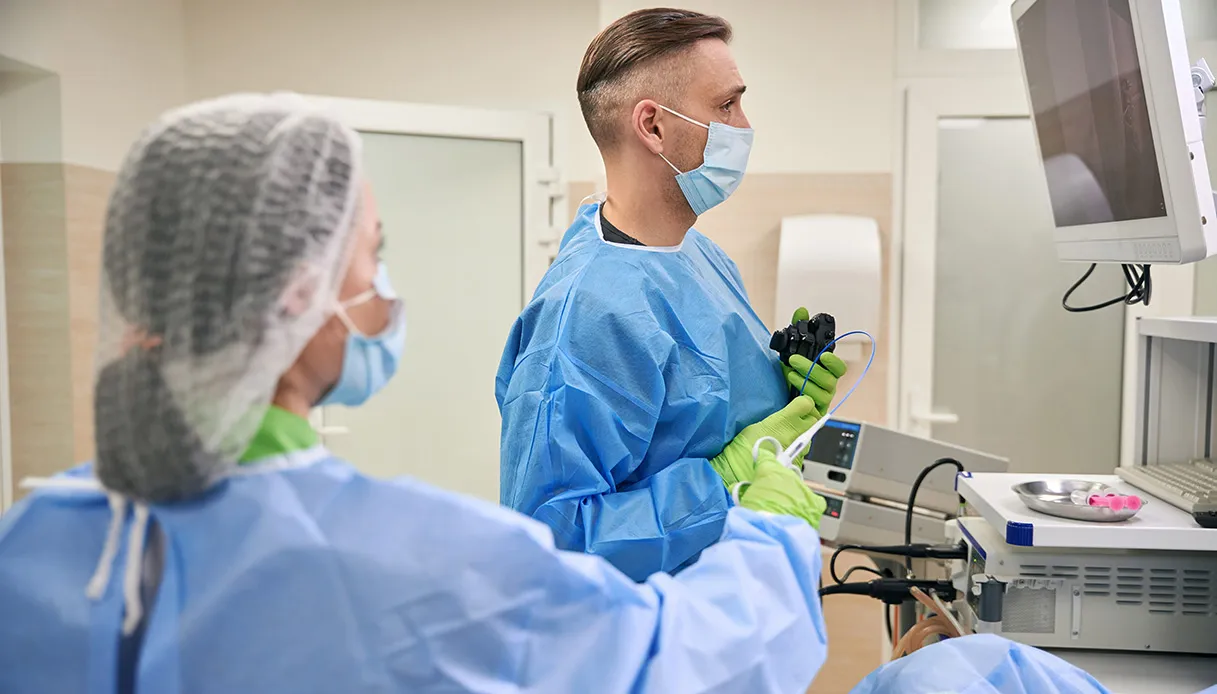
Fine diagnostics, which allows us to detect with maximum precision lesions of the mucosa of viscera such as the stomach, esophagus, colon and rectum, has been a reality for some time. And already today, in Italy, the performances are certainly excellent. But as is happening in various fields of medicine, to make diagnostic procedures and the definition of the potential causes of what the operator observes even more precise and to encourage increasingly targeted interventions, the help of Artificial Intelligence can prove to be extremely important.
In this sense, there are new developments in the area which indicate that to improve the diagnostic quality of endoscopic procedures, various gastroenterology and digestive endoscopy departments have already integrated advanced Artificial Intelligence (AI) systems. In Italy, over 2.5 million digestive endoscopy tests are carried out every year, specifically esophagogastroduodenoscopies, often simply defined as gastroscopies, and colonoscopies.
Increasing precision
The AI systems already operational are now capable of analyzing endoscopic images in real time, identifying suspicious areas, supporting the specialist in the early detection of polyps and mucosal lesions and finally transforming the management perspectives of digestive system diseases. But it’s not enough. Some of these systems analyze endoscopic frames in real time (up to 54,000 in a colonoscopy) to flag suspicious areas with a sensitivity of up to 99.7%. This was remembered by the experts of the Italian Society of Gastroenterology and Digestive Endoscopy (SIGE), who dedicated a session to the topic within the National Congress of Digestive Diseases, promoted by the Italian Federation of Societies of Digestive System Diseases (FISMAD), held in Rome.
It has been demonstrated that the use of AI to support endoscopy increases sensitivity and accuracy in the detection of lesions and is able not only to identify, but also to provide a predictive analysis of the characteristics of the lesions, guiding the gastroenterologist’s decisions in real time; reduces inter-operator variability and promotes greater uniformity in the quality of endoscopic procedures, raising standards of care nationwide.
Taking stock is Cristiano Spada, Professor of Gastroenterology and Director of the Surgical Digestive Endoscopy Unit at the (DISMeC) Fondazione Policlinico Gemelli IRCCS.
“This translates into substantial benefits for patients who receive more accurate and early diagnoses resulting in timely treatments resulting in potentially greater protection from neoplastic risk. AI is destined to become a pillar in improving diagnostic quality, in the safety of clinical pathways and in reducing performance inequalities between operators, with significant benefits for patients’ health”.
Check the situation
Obviously, when talking about artificial intelligence, we need to consider various aspects that come into play. And above all, we must always keep in mind that the introduction of these systems must take place in a controlled manner. Italian institutions also recognize the strategic importance of AI in diagnostic imaging, including endoscopy.
“The Superior Council of Health, in a publication of the Ministry of Health, underlines the need to introduce AI systems in a controlled, scientifically validated manner and consistent with the principles of security, transparency and protection of sensitive data, laying the foundations for high-level national governance. In this context, an ever-increasing integration of AI in the context of national healthcare must necessarily include economic and cultural investments that pass through the implementation and promotion of secure digital infrastructures; the adoption of national and European standards (such as the AI Act) to guarantee quality, safety and reliability in AI-based devices; active collaboration with scientific societies to define guidelines on the appropriate use of AI”.
Spada specifies.
Artificial Intelligence and uses in gastroenterology
It is clear from the experts how much and in what way intestine analyzes are especially linked to the use of Artificial Intelligence systems in endoscopy. In this sense, for colorectal cancer, AI is used in particular for the automatic detection of polyps and adenomas during colonoscopy (CADe – Computer Aided Detection) with consequent improvement of the ADR (Adenoma Detection Rate) and reduction of missed lesions.
“Data in the literature suggests that during a colonoscopy assisted by artificial intelligence systems, up to 13–30% more polyps can be identified compared to standard colonoscopy (without AI)”
underlines the expert.
On the front of stomach tumors, the fifth cause of death from cancer in the world and accidents in Italy with 14 thousand new cases per year, where AI intervenes in the automatic detection and early diagnosis of preneoplastic or neoplastic lesions in gastroscopy as well as the “in vivo” characterization of the lesions (CADx). Other diseases of the digestive system affected by the growing use of AI systems, in addition to tumors of the liver, biliary tract and pancreas with the automatic analysis of ultrasound, CT and MRI images – approximately 13,000 new cases per year in Italy of liver cancer and approximately 14,000 of pancreatic cancer – concern the 250,000 patients affected in Italy by chronic intestinal inflammatory diseases but also that 60-65% of the population Italian woman who reports recurrent digestive disorders linked to irritable bowel syndrome.









