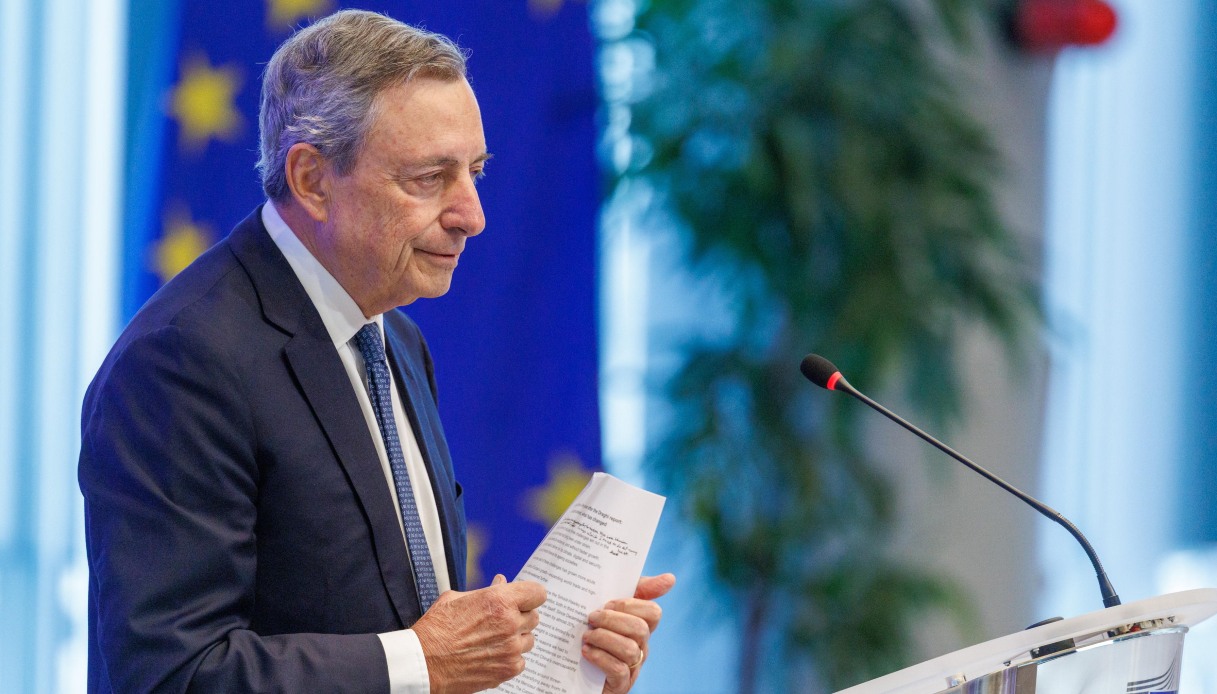
During the conference one year after the Draghi report, the former Prime Minister and author of the report itself, Mario Draghi, criticized the work of the European Union hard. The former Governor of the ECB has accused the institutions of not being able to act with speed and the governments of the member countries of not having understood the severity of the moment that Europe is going through.
Draghi reiterated what has been written a year ago in his report, underlining the need for a common debt to make investments in highly productive sectors, which at national level the individual states do not seem able to perform. He also spoke of the automotive, as an example of the sector in which EU regulations did not achieve the desired objectives.
Draghi attacks the EU, slow and smug
The former Prime Minister, in the presence of the president of the European Commission Ursula von der Leyen, explained what works and what is not yet up to par, in the way the EU relates to the citizens:
Citizens and European companies appreciate the diagnosis, the clear priorities and the action plans. But they also express a growing frustration. They are disappointed by the slowness of the EU. They see us unable to keep up with the speed of change elsewhere. They are ready to act, but they fear that governments have not understood the severity of the moment.
Draghi therefore recognizes the EU’s vision capacity, which places precise objectives and outlines clear action plans, but hardly criticizes the cumbersome and slowness of the decision -making process: “Too often there are excuses for this slowness and this is complacency. It is necessary to be a new speed and results within months, not of years” said the former Governor of the ECB.
The perspective of common debt
During his speech, Draghi also returned to talk about the possibility that the EU emits more debt securities, in order to collect great sums of money:
It is necessary to consider a common debt for common projects, both at the EU level and between a coalition of Member States, to amplify the benefits of coordination. The joint emission would not magically expand the tax space. But it would allow Europe to finance larger projects in sectors that increase productivity where national spending is no longer enough.
Draghi has therefore also opened to the possibility that the EU as an institution is not issued to issue securities, but also coalitions of Member States. This would weaken the role of the Commission, which could not indicate how to spend the money collected, but would eliminate the problem of the opposition of the so -called frugal states, such as the Nordic countries or the Netherlands, which consider the perspective of a common European debt by virtue of their financial situation unacceptable, better than that of States such as France or Italy.
Investments and greater rapidity are necessary, according to Dragons, to respond to the changes that come from the outside, from US duties to Chinese competition: “Our growth model is disappearing” warned the former Prime Minister during his speech.
The failure of the Green Deal on the automotive
To clarify his position, Draghi used the example of emissions regulations in the automotive sector.
In some sectors, such as the automotive one, the objectives placed by the EU are based on conditions that are no longer valid. The deadline of 2035 for zero emissions to the exhaust had been conceived to trigger a virtuous circle: clear objectives would have pushed investments in charging infrastructures, made the internal market grow, stimulated innovation and made the cheapest electrical models. It was expected that batteries and microchips develop parallel. But this did not happen.
Draghi underlines how European automotive companies, engaged in resisting a strong market crisis, have not invested in new technologies such as the EU would have expected and in fact refused to follow the commission’s indications, continuing to ask for changes to the established emissions constraints.