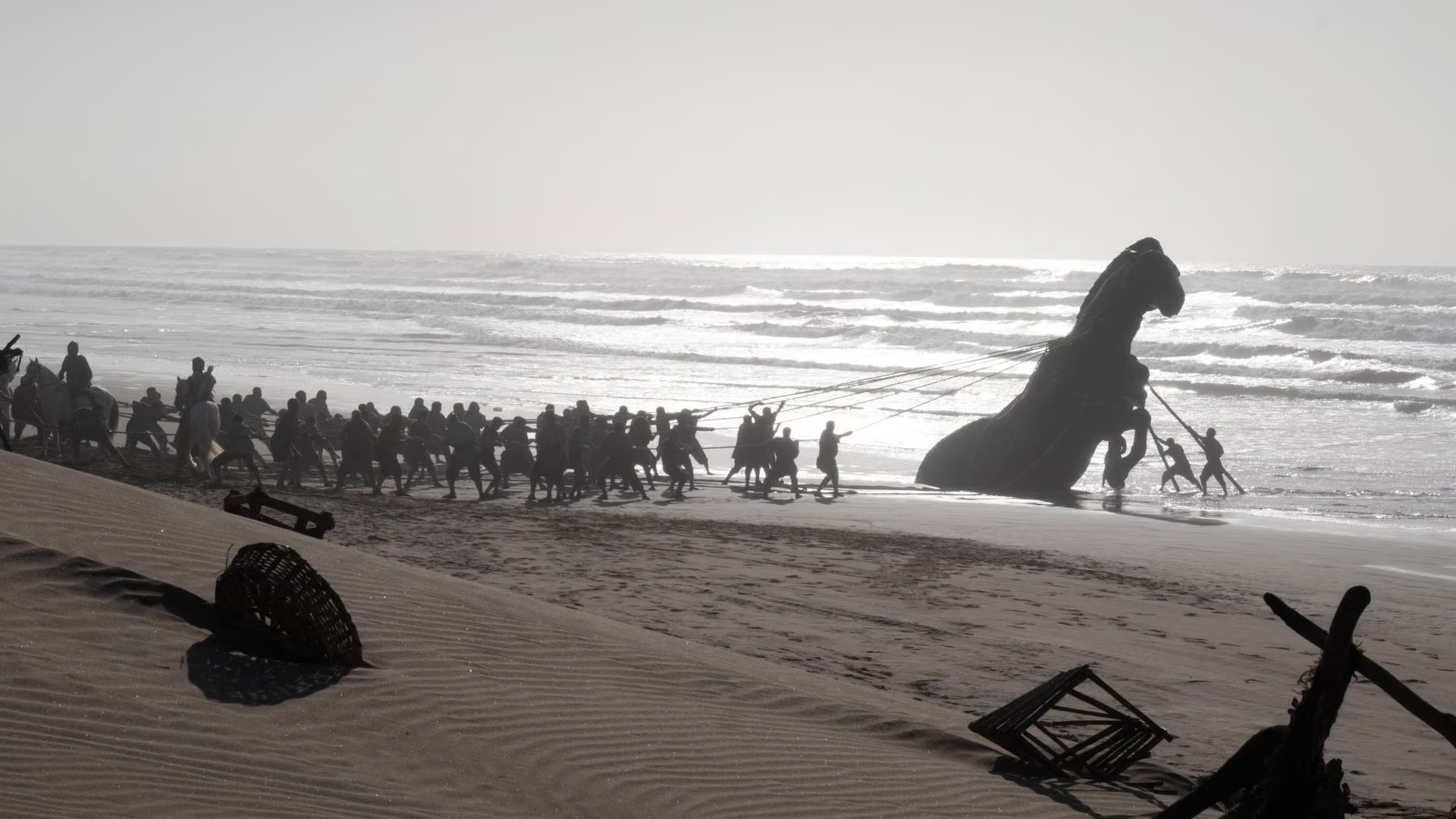
THE’Odyssey by Christopher Nolan, released today July 16, 2026, is the film everyone is talking about. Epic, drama, vertigo, pain, there is nothing missing from this work which sees Matt Damon in the role of Odysseus, Anne Hathaway in the role of Penelope, and then Tom Holland, Zendaya, Robert Pattinson, Charlize Theron, Elliot Page and Lupita Nyong’o. A huge cast for an unprecedented visual poem, which rereads (and rewrites) the myth composed by Homer, one of the founding texts of Western culture. In short, very high expectations and, as always with Nolan, a fair amount of fuss before the release.
This is because when a director takes a poem from almost three thousand years ago and brings it to the screen, the most interesting part is almost never the protagonist, but rather the characters who surround him, those who occupy a few lines in the poem and who in the cinema can become central, strategic and decisive.
This is the case of two, or rather three, roles entrusted to Elliot Page and Lupita Nyong’o, apparently secondary, but in reality fundamental to understanding how Nolan decided to tell the exile and the war that Odysseus is fighting within himself. The role of Elliot Page and those of Lupita Nyong’o become the faces beyond which we observe the true Odysseus, with his doubts, his faults, his humanity.
SPOILER WARNING! From here on we talk about narrative segments of the film and the characters
Who really is Sinone played by Elliot Page in Nolan’s Odyssey
As we said, inOdyssey by Nolan we can observe Elliot Page taking on the role of Sinone, and Lupita Nyong’o playing two roles, both that of Helen and her sister Clytemnestra. But who are these characters? Let’s take a step back. THE’Odyssey tells the ten years that Odysseus takes to return to his Ithaca, crossing seas, storms, clashing with Cyclopes, giants, sorceresses, mermaids. The war is over and in the poem it is often taken up and sung as a story that the characters pronounce and exchange years later.
Perhaps Sinone is a name that says little, considering that in the collective imagination the fall of Troy is all condensed in the image of the wooden horse. In reality it is Sino himself who convinces the Trojans to bring the horse into the city.
This is because the young Greek, mentioned in Virgil’s Aeneid, left alone on purpose on the beach, pretends to be a deserter and tells the Trojans that the horse is an offering to Athena. It is a lie so well constructed that it works, so much so that the Trojans decide to welcome that imposing object, which for them becomes victory, salvation and later ruin.
In the traditional story, Sinone, aware of the deception in which he participated, is a cog that continues to turn even after having triggered the catastrophe. Nolan instead changes the cards. In the film we watch Sinone die just as he is delivering the horse as a gift to the Trojans, at the exact moment his lie is about to come true. Nolan’s Sinone is “betrayed” by the enterprise conceived by Odysseus, as if the deception that opens the gates of Troy also took away the only person who had made it possible.
An element that will lead Odysseus, in the film, first to doubt the horse’s ruse, and then to be increasingly convinced that behind that act actually lies a profanation, a violation of divine law. When the horse is delivered, that moment transforms an act of devotion, a votive offering to Athena, into a weapon of extermination.
In other words, the victory obtained by deception is scarred in condemnation. Nolan will return a lot to this theme, to the responsibility he feels in inhabiting Odysseus and to the corruption of customs that this choice then turns out to generate. In this sense, the scene in which Odysseus meets Sinone in Hades contains all the failure, the finiteness, the defeat of a man who must deal with the human price that his war choices have entailed. A price that does not only concern the individual and which in truth marks the crisis of an entire civilization.
The Double Face of War: Helen and Clytemnestra by Lupita Nyong’o
At the same time we find the excellent Lupita Nyong’o in a double role, that of Helen of Troy, and that of her sister Clytemnestra. According to the myth they are daughters of Leda, queen of Sparta, and of different fathers. Tradition has it that Helen was born from Zeus and Clytemnestra from the mortal Tyndareus. These two women in turn marry two brothers, Helen marries Menelaus, king of Sparta, while Clytemnestra marries Agamemnon, king of Mycenae. We all know Elena’s story,”the face that made a thousand ships sail”, the passion for Paris who leads her to Troy, and Menelaus who, to get her back, calls together the Greek kings and begins the siege.
Instead Clytemnestra has a completely different story, she is the other half, perhaps even darker. While Agamemnon fights in Troy, she remains in Mycenae and contemplates her revenge. This is because at the beginning of the expedition, to gain the favor of the gods, Agamemnon chooses to sacrifice their daughter, Iphigenia. So, when the king returns victorious and triumphant, she awaits him and kills him.
The thresholds that Odysseus must cross
Helen and Clytemnestra are exactly the two ends of the war, the two elliptical fires, one triggers it and the other collects its blood. And they are fundamental for Odysseus himself who encounters the ghost of Agamemnon in the afterlife and who warns him, inviting him to return with extreme caution in Ithaca. With his return home Agamemnon met his end and the house that was supposed to welcome him actually caused his death. Clytemnestra’s tale exists to cast her shadow over Penelope. For him Ithaca is an idealized, dreamed, forgotten, suffered, scarred place, and like all places that become sentimental spaces it risks never completely coinciding with the reality that awaits him.
This is why these characters, apparently marginal, are actually crucial to trigger the true stakes of the film, they are long shadows, thresholds that Odysseus crosses and which favor the transition between what a man can imagine, create and unleash and what history will continue to remember.