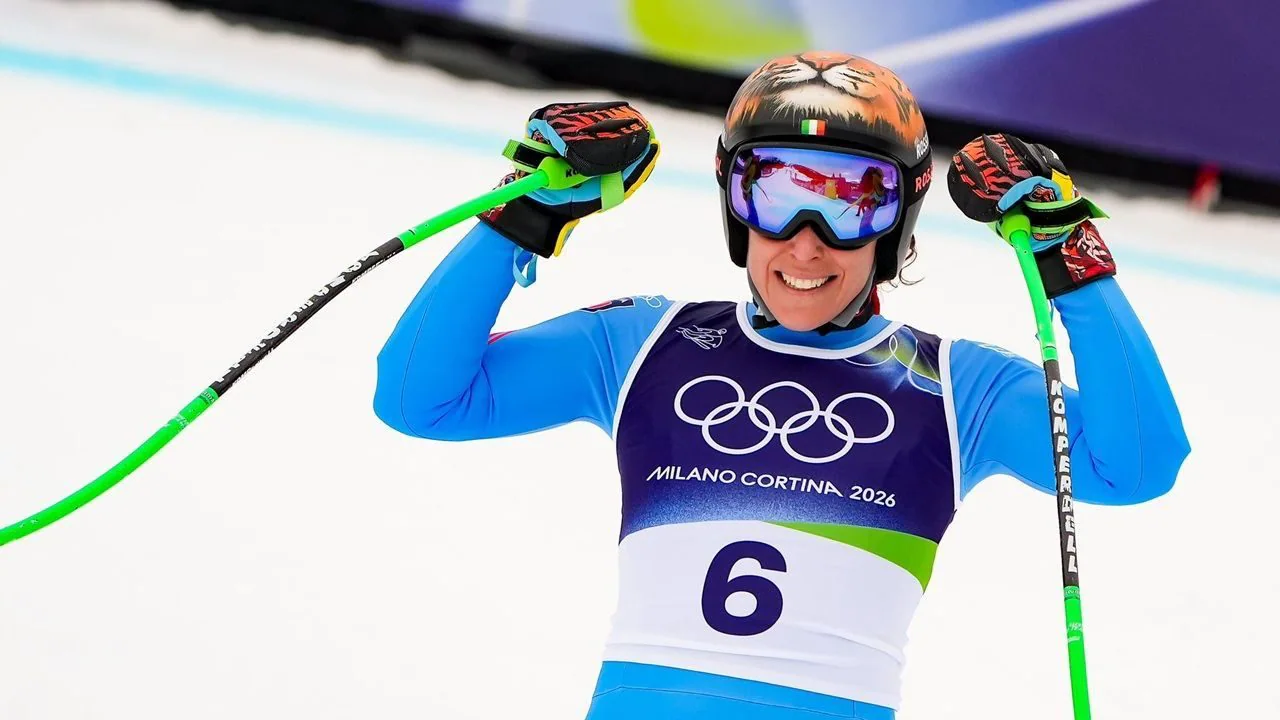
“I would trade the two golds for life before the injury.” The feat of Federica Brignone, double champion in downhill and giant slalom at the Milan-Cortina Winter Olympic Games, is contained in this sentence. Very powerful. The last 10 months of the 35-year-old from Valle d’Aosta are the symbol of sporting resilience. A film story, for real: an important production company, in fact, will tell the 315 days of the “Tiger” from hell to paradise in Cortina. Let’s try to retrace the stages of Brignone’s epic return, clarifying the clinical and rehabilitation path of the La Salle phenomenon.
Hell: the injury at Alpe Lusia and the two operations
Continuing the Dante metaphor, Federica’s hell began on April 3, 2025, at the Italian Championships at Alpe Lusia. A “minor” race after having won the World Cup with great fanfare. A mocking fate. The diagnosis of the disastrous fall in the second heat is dramatic: a multi-fragmentary displaced fracture of the tibial plateau and the head of the fibula of the left leg with a rupture of the cruciate. It is difficult to imagine a recovery for the home Olympics, also thanks to the identity card. The skier born in 1990 is transported by helicopter to Trento. The medical team of Fisi (Italian Winter Sports Federation) decides to operate on her immediately at the La Madonnina clinic in Milan. At the head of the intervention was No. 1 of the medical commission Andrea Panzeri who, at the end of the track in Cortina, once the feat had taken place, spoke of a “miracle”.
The operation involves the insertion of a plate and 7-8 screws to contain the fracture: Federica will take them to the Olimpia delle Tofane track. But it doesn’t end there: on July 29th there will be a second operation, in arthroscopic arthrolysis, again in Milan, which allows the stiffening of the knee to be corrected. The athlete who belongs to the military sports group of the Carabinieri did not bend it beyond ninety degrees. The clinical journey ends in the summer, but in the meantime purgatory has already begun.
Purgatory: 100 days at J Medical in Turin and the return to the snow
As Eurosport tells us, Federica Brignone got back on her feet (literally) thanks to J Medical in Turin. The skier entrusted herself to the Italian center of excellence to pursue her Olympic dream (as did 18-year-old Flora Tabanelli, who won bronze in the Freeski Big Air after breaking her cruciate on November 6). The facility, located inside the Allianz Stadium, home of Juventus, offers a wide range of services, ranging from diagnostics to specialist medicine, from rehabilitation to sports medicine. Brignone spent more than 100 days in Turin, forcing only when it was necessary to force, finding increasingly convincing answers.
It is the most delicate moment: the blue girl lives day by day, listening to her body. “In re-education the critical moment was to find the balance between how much to load, how much to bend – explains Panzeri – The bone and ligaments had to heal”. Federica is followed by Federico Bristot (with a past already in Fisi), Luca Stefanini, Marco Freschi (also ex Fisi) and Giovanni Bianchi, doctor of the Elite group (i.e. Brignone, Goggia and Bassino). With her, in every single step, also her brother-coach Davide. Turin is close to home, Brignone lives between pain and infiltrations.
The first ski trip to Cervinia, on a Wednesday at the end of November, among amateur skiers, is hailed as a liberation after the long months of “re-education”. Here comes Darwin Pozzi, physio of the Elite group, who follows her in the last two months towards the Olympics, again in collaboration with Bristot. “In December I put my touring skis back on and went to the slopes. At first it was a disaster. After two weeks I started to see some light, but it was tough. Every day I thought I couldn’t make it”. It’s almost time to ascend to heaven.
On 22 December Fede receives the tricolor from Mattarella: at that point the decision is made. On January 20th at Plan de Corones she placed sixth in the giant slalom 292 days after the injury. He has one last Cup race, the Crans-Montana super-G: eighteenth. The fashion show in Cortina on the shoulders of Amos Mosaner is the first real breath of fresh air after impossible months. The Tiger smiles. In the downhill race he doesn’t take risks: tenth. In the last few days he confesses that he has had pain and that he has interrupted some training sessions. It is in doubt for the Olympic super-G until the Fisi statement arrives. Faith is there.
Paradise: two golds in three days, the tiger in the elite of alpine skiing
What happens on 12 and 15 February, respectively in the Super-G and giant slalom races (315 and 318 days after the injury to the Italian Championships), on the Olimpia delle Tofane slope in Cortina d’Ampezzo is already sports history. Before Brignone only two men had managed to win Olympic golds in these disciplines, Markus Wasmeier (super-G/giant double at Lillehammer 19494) and Hermann Maier (double gold at Nagano ’98).
When the giant arrives, Hector and Stjernesund, her direct opponents who have just been beaten, bow before her. An image that will remain indelible in the memories of many Italians. At 35 years and 216 days, she is also the oldest skier to win a medal for the most precious metal at the Winter Games. With eight screws in the knee. Unfortunately, euphoria, however, leaves room for pain, which is omnipresent. “The plan for the days to come involves going to J Medical, seeing how things are going. Then I’ll decide what to do. So far I’ve held out, I’ve taken anti-inflammatories every day, but from now on that’s enough. Either my leg holds up, and I can ski more or less without having to relieve inflammation of my leg every time, or…”. The life of a champion is beautifully, yet terribly, complicated.