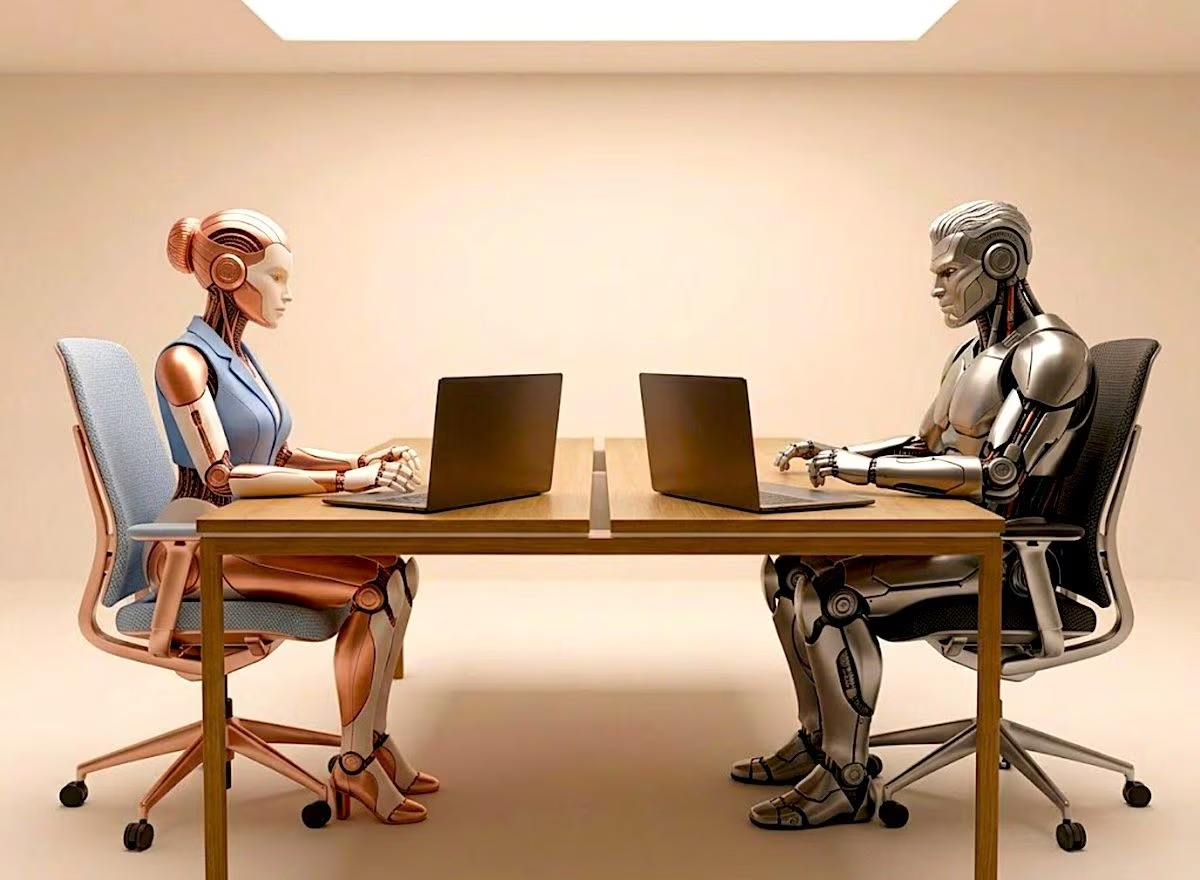
An AI agent who presented as a man was paid about 10% more than an AI agent who presented as a woman, despite the two using the same technology and performing the same tasks. It is the result of a curious study, entitled Human-like and evil? How AI assistant design relates to trust and monetary reward at work in VR conducted by the University of Limerick, Ireland, which shows how gender biases can also influence the way we interact with AI.
To reach this conclusion, the researchers involved 189 people in an office recreated in virtual reality, in which participants could carry out activities simulating a work situation. Each of these participants, both men and women, was asked to collaborate with several AI assistants and, upon completion of the tasks, to use real money to determine how much to pay for the work performed by the assistants. Let’s analyze in more detail how the study was conducted and the results obtained.
Both male and female participants paid the male AI agent Johan more
Among the different possibilities offered to the 189 study participants were a text-based chatbot, a desktop robot and two agents designed to have a more human-like appearance. The latter were called Johan and Johanna and introduced themselves as a man and a woman respectively.
Interestingly, apart from the names by which they were presented to the participants, the two agents were exactly identical: they used the same basic functionality and the same artificial intelligence model, GPT-4-1106-preview developed by OpenAI. This means that agents Johan and Johanna were capable of performing the same tasks and had the same technology behind them. Neither was better than the other at any task.
And although participants rated the work of both agents similarly, when it came time to award financial compensation to the two, Johanna received about 10 percent less compensation than Johan. Even more interestingly, both men and women paid the AI agent presented as a woman less than the male AI agent. Johan was also perceived as more human-like than his “colleague” Johanna.
This result contrasts with what many participants had stated during interviews conducted before starting the experiment. Most of them claimed to have no interest whatsoever in the gender of the assistant, saying that there would be no differences in treatment influenced by the gender with which the AIs presented themselves. In the behaviors observed during the test, however, this neutrality did not manifest itself entirely, as we have just commented.
We tend to transfer our prejudices onto artificial intelligences: the experiment
As Mary Hausfeld, co-author of the study, explained, the experiment makes one fact clear: we tend to consider artificial intelligence as something neutral, but when we design a system by attributing human characteristics to it we can end up transferring onto it the same assumptions and prejudices that we use in relationships with other people. These are the words of the researcher:
What’s striking about our findings is that the technology behind these AI agents was exactly the same, but people didn’t treat them the same. We often think of AI as something neutral, but the way we design and present these systems can activate the same assumptions and biases that exist in our interactions with other people.
The risk, according to the researchers, is therefore that old inequalities are simply reproduced within a new environment, the virtual one.