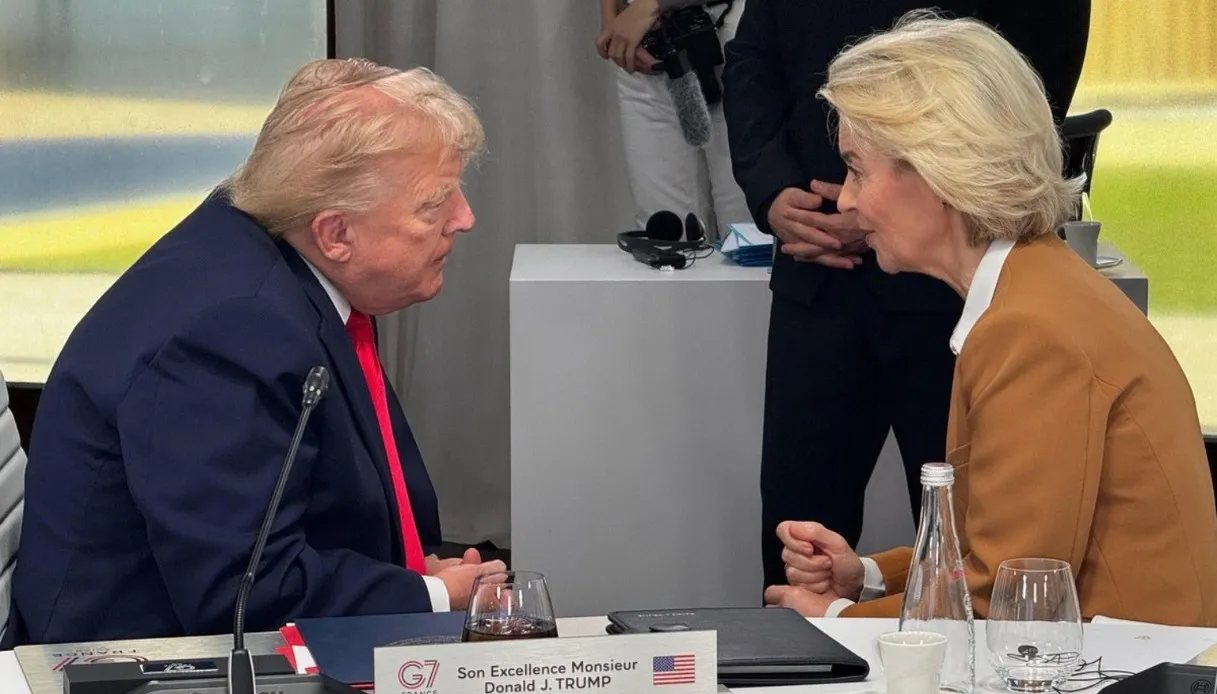
The definitive green light from the European Union has arrived for the tariff agreement with the United States, closing a negotiation lasting more than a year and formalized between 2025 and 2026 within the framework of transatlantic cooperation. The agreement, already approved by the European Parliament and the Council, implements the tariff commitments shared with Washington and aims to stabilize trade relations between the two sides of the Atlantic.
The legislative package intervenes on one of the most sensitive areas of exchange between the EU and the USA: the policy of tariffs on industrial and agri-food goods. The new rules will come into force after formal approval by the European institutions and will remain applicable until the end of the decade.
What does the EU-US tariff agreement provide in detail?
The agreement is based on a principle of progressive and controlled opening of transatlantic trade.
On the European front, the central point is the reduction or elimination of duties on a vast range of US industrial goods, with easier access to the EU market also for agricultural and fisheries products from the United States. The declared objective is to strengthen the predictability of trade and reduce the risk of new tariff tensions.
The United States, however, maintains a more selective approach. They retain protection tools on sectors considered strategic such as steel, automotive and some technological supply chains, instead granting targeted reductions and temporary suspensions of existing duties.
The central element of the agreement are the safeguard clauses provided by the EU, according to the concessions:
- they may be suspended in the event of violations or new protectionist measures on the American side;
- they must be periodically reviewed;
- they expire in 2029, with the possibility of renewal.
An agreement perhaps economically unbalanced for Europe
The agreement produced an unbalanced compromise. The European Union significantly opens its market to US products, especially industrial and agri-food, while the United States maintains a higher level of protection. The result is an asymmetric dynamic: greater liberalization entering the EU, more limited opening towards European exports.
In practical terms, Brussels aims above all to guarantee stability and continuity to trade flows, avoiding tariff escalations that could damage the more export-oriented European economies. Washington, on the contrary, also uses the agreement as negotiating leverage, preserving margins of internal protection.
The result is a defined balance functional but not symmetrical: reduces uncertainty, but leaves open the issue of the different protection capacity of the respective markets.
The Italian production sectors most exposed to US duties
For Italy, the effects of the agreement are concentrated above all on the sectors most exposed to exports to the United States.
The first is agri-food, the pillar of Made in Italy. Wine, cheese, olive oil and pasta represent some of the main Italian exports to the American market. In this sector, any tariff or non-tariff barriers can directly impact the competitiveness of products, with immediate effects on exports.
This is followed by the fashion sector, one of the most representative of the Italian industry. The US market is among the main non-European outlets for clothing, leather goods and accessories. In this case, even small increases in tariff-related costs can be reflected in final demand.
The automotive sector is mainly exposed indirectly. Italy is an integral part of European supply chains, in particular through components, and is therefore affected by the tariff dynamics that affect the entire European sector in relations with the United States.
Finally, pharmaceuticals, which however represents a special case. It is less vulnerable to duties in the strict sense, but more exposed to regulatory and market access dynamics, while remaining a strategic sector for national exports to the USA.