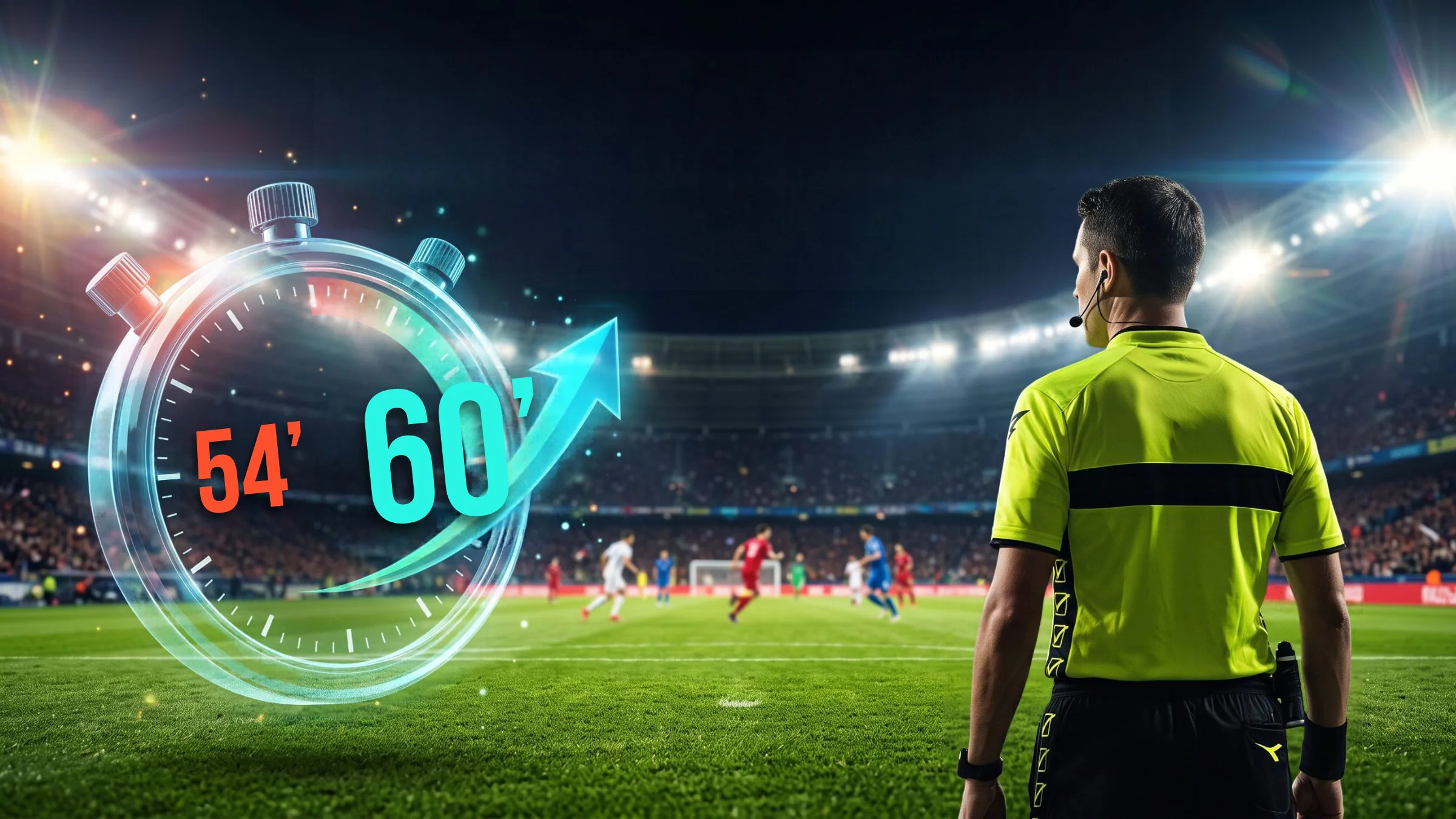
A football match lasts 90 minutes, but the ball is not always in motion for the entire duration of the match. Between fouls, substitutions, injuries and moments dedicated to restarting the game, a significant part of regulation time passes without the teams actually being able to play. In Serie A 2026/27, however, this balance seems to have changed. According to data released by the Lega Serie A and illustrated by the AIA, after the first five matchdays the average effective time, i.e. the period in which the ball is actually playable, rose to 59 minutes and 24 seconds, compared to 53 minutes and 39 seconds recorded in the same period of the previous season.
It means almost six more minutes of real play per match, an increase that brings the Italian championship close to the threshold of 60 actual minutes and which illustrates a broader change: there are fewer interruptions, greater continuity and higher-paced football. But what enabled this increase? The answer does not only concern the regulations: the new indications of the IFAB, the international body that establishes the rules of the game of football, applied in Italy through the AIA (Italian Referees Association), together with the new technical line adopted by the referees, had an impact.
The innovations involve various match situations, from the management of players who receive medical treatment on the pitch to the timing of substitutions, through to greater speed in restarting play such as throw-ins and goalkeeper clearances. The first data of the season also show a decrease in fouls called per game, cards, penalties awarded and VAR interventions, leading to a significant reduction in wasted time on the pitch.
In Serie A, almost 6 more actual minutes are played compared to 2025/26: how is this possible?
The increase in effective time represents one of the most significant innovations of this start of the championship. In the first five matchdays of the 2026/27 Serie A, the ball remained in play for an average of 5 minutes and 45 seconds longer per game compared to the same period of the previous season, with an increase of approximately 11%. To understand the extent of the change, just consider that the current almost 60 actual minutes are equivalent to around two-thirds of the regular 90 minutes, without counting added time.
A particularly significant example comes from Atalanta-Bologna, a match on the second day in which, again according to the Math & Sport data published by Lega Serie A, 70 minutes of actual play were achieved, the highest value recorded in the first five days. Furthermore, already after the first four rounds, the data illustrated by the AIA had shown an increase of more than 5 minutes and 30 seconds compared to the previous two seasons.
Various factors contribute to explaining this greater continuity, from the new provisions of the IFAB against wasting time to the technical line adopted by the referees, aimed at favoring the game and avoiding interruptions due to less significant contacts. The intended objective is to increase the time the ball is actually in play.
The new IFAB rules: how do you combat wasting time?
Also promoting greater continuity of the game are the new provisions introduced by the IFAB (International Football Association Board), the international body that establishes the rules of football, and implemented in Italy by the AIA (Italian Referees Association). The changes, in force from 1 July 2026, therefore do not only concern Serie A, but have been designed to counteract wasting time in football in general.
One of the main changes concerns substitutions. According to the Circular no. 1 of the AIA for the 2026/27 season, the replaced player must leave the pitch within 10 seconds of the display of the scoreboard, unless prevented due to injuries or safety reasons. If he does not respect this limit, the substitute player cannot enter immediately and the team is forced to restart the game with one man less, at least until the first interruption following one minute after the restart.
The provisions on accidents also change. A player who receives medical attention on the pitch or whose injury causes the game to be interrupted must generally leave and wait one minute after play has resumed before being allowed to re-enter. There are exceptions, for example for goalkeepers, serious injuries and those caused by fouls punished with a warning or expulsion.
Finally, to avoid delays in throw-ins and goal kicks, the referee can start a 5-second countdown when he believes a team is deliberately wasting time. If the ball is not put back into play within the limit, the throw-in passes to the opponents, while the goal kick is transformed into a corner kick for the opposing team.
Fewer fouls and penalties, more goals and no 0-0: the numbers for Serie A 2026/27
In addition to the new IFAB provisions, the refereeing line adopted in Serie A also favors the continuity of matches, aimed at allowing actions to continue without blowing the whistle for less significant contacts. As explained by Daniele Orsato, head of the National Referees Commission, the objective is «encourage the game of football and not whistle the slightest contact».
According to official data from the AIA, in the first five matchdays the average of fouls called dropped from 26.23 to 22.60 per match, a reduction of 13.84% compared to 2025/26, reaching a value even lower than the 23.28 of the Premier League. The number of penalty kicks conceded has also decreased, just 2, compared to 9 in the previous season, 14 in 2024/25 and 16 in 2023/24. Warnings went from an average of 3.53 to 3.03 per game, compared to over 4 in the previous two championships, while sending offs fell to 2, compared to 5 in 2025/26 and 6 recorded in each of the previous two seasons.
VAR interventions are also less frequent. In the first four matchdays, only one On Field Review was recorded, i.e. a review by the referee on the monitor, compared to 6 in 2025/26 and 8 in each of the two previous seasons. The Overrules, i.e. the corrections made through the VAR without reviewing the monitor, have instead dropped to 2, compared to 5 last championship and 6 in the previous two years.
The change also affects offensive production. In the first five matchdays the average of goals scored rose from 2.32 to 2.9 per game, surpassing that of the Premier League (2.8) and Ligue 1 (2.7), and approaching the Spanish Liga (3.0). The average shots per game also increased, from 25 to 29, and the expected goals (xG), the indicator that measures the probability of scoring based on the characteristics of the opportunities created, went from 2.61 to 3.17.
Another significant fact concerns the results: in the first five matchdays not even a 0-0 was recorded. To find a similar precedent we need to go back to the 1949/50 season, when the first goalless draw only came on the seventh matchday, in Milan-Lazio.