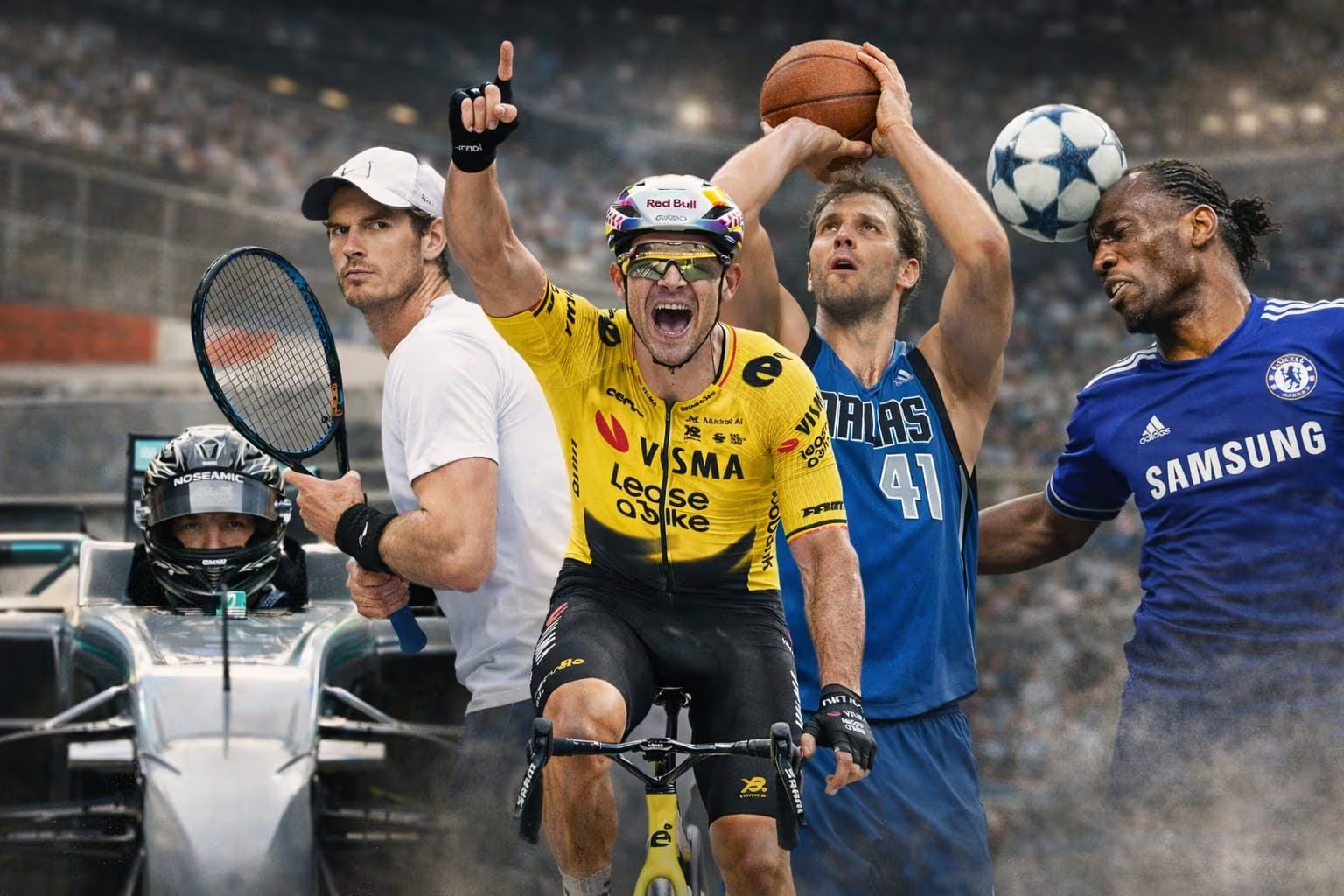
There’s something heartbreaking about always being there, one step away from the finish line, without ever touching it. On Sunday 12 April 2026, Wout van Aert won the Paris-Roubaix road cycling race at his seventh attempt, beating world champion Tadej Pogačar in a sprint. The Belgian was visibly moved, and it’s not difficult to understand why: behind that victory there were years of “wrong” medals, of podiums without the top step, of nicknames like “Donald Duck”.
But van Aert is not alone. In the history of sport there are athletes who have built extraordinary careers in the shadow of victory, accumulating second places like scars, and then exploding in a single moment capable of redeeming everything. Who are the other eternal seconds who then won? Let’s discover the stories of Van Aert’s “brothers”: Nico Rosberg, Andy Murray, Dirk Nowitzki and Didier Drogba.
Wout van Aert, the cyclist who overcame bad luck and won in Paris-Roubaix
From 2020 to 2025, van Aert collected second places (almost 50) in an almost surreal sequence: twice at the World Championships in 2020, then at the Tour of Flanders, at the Tokyo Olympics, at Paris-Roubaix in 2022 and again at the World Championships in 2023. In between, serious injuries, criticism and the burden of being perpetually considered inferior to the two dominators of his era, Mathieu van der Poel and Tadej Pogačar.
Then, in the spring of 2026, everything changes. After a very hard and unpredictable Roubaix, van Aert appears at the entrance to the Velodrome side by side with Pogačar. It is the moment he had already experienced many times, but with an always different ending. This time, however, there is no hesitation: he starts first, controls the sprint and wins. In a few seconds a script that seemed to have been written for years breaks down. It is not just a victory, but the end of a narrative: that of the eternal second.
Murray and the victory against the “Big Three” in tennis
The case of Andy Murray is perhaps the most emblematic of all. He lost his first four Slam finals, three to Federer and one to Djokovic. The turning point came at the 2012 US Open, where he beat Djokovic in five sets in a final that lasted almost 5 hours, becoming the first Briton to win a Slam since 1936. Murray’s problem was not talent, but contemporaneity: he was the fourth best tennis player of an era dominated by three absolute champions.
Seven years and 82 days after first reaching No. 2 in the world, Murray became No. 1: no one in the history of men’s tennis had ever waited so long to take that final step towards glory. He got there in November 2016, after a year in which he won 9 tournaments and lost 4 in the final. Murray is also the first tennis player to have won two Olympic gold medals in singles, in London 2012 and Rio 2016. In his career he has beaten the “Big Three” – Federer, Nadal and Djokovic – 30 times in total: no other player other than them has managed to do better. Yet, for years, he was remembered above all for the titles he hadn’t won.
Driver Rosberg: win the title and retire from Formula 1
In Formula 1, few have embodied the figure of the eternal second with the same intensity as Nico Rosberg. For years, the German Mercedes driver shared the garage with Lewis Hamilton, one of the best ever, often being eclipsed in the media even when his performances were excellent. After two second places in the world championship in 2014 and 2015, the 2016 season became his personal revenge.
Rosberg started 2016 by winning the first four races of the season. After ups and downs in the middle part, he managed to manage the lead until the last race in Abu Dhabi. There the perfect paradox was achieved: winning the world title by finishing second in the race.
However, the story has a surprising ending. Just five days after winning the title, Rosberg announced his retirement from racing, aged just 31. A rational choice considering how much those seasons of rivalry had consumed him: he had achieved what he had worked for all his life, and he now felt empty.
Dirk Nowitzki, 13 years of waiting for an NBA ring
In basketball, the story of the eternal seconds has one of its most symbolic protagonists in Dirk Nowitzki. The German big man from the Dallas Mavericks has been one of the most dominant players in the NBA for over a decade, capable of scoring with disarming ease thanks to his iconic kick. fadeaway one-legged shot. Already in 2007 he became the first European basketball player to receive the MVP award in the history of the NBA. Yet the ring was missing.
The 2005-2006 season was that of the first NBA final, in which Dallas was defeated by the Miami Heat 4-2. Five years later, in the rematch against the same Heat, redemption arrived. During the 2011 final, despite an infection with a 100°F fever in Game 4, Nowitzki scored the decisive basket to tie the series at 2-2 and Dallas went on to win the series in 6 games. Nowitzki was awarded Finals MVP by averaging 26 points and nearly 10 rebounds per game, shaking off the “soft” label.
Drogba and the Champions League
There are careers that seem built around a missed appointment. Didier Drogba’s Champions League campaign has been like this for years: near misses, searing eliminations and the constant feeling of always being one step away from history. With Chelsea he experienced some of the most controversial European nights of the 2000s, such as the final they lost in 2008, after being sent off in extra time, or the controversies in the semi-final the following year.
Then 2012 arrives, and the script suddenly changes. In the final against Bayern Munich, Chelsea are down and seem destined for yet another disappointment. In the 88th minute, however, Drogba rose higher than anyone and headed the goal to make it 1-1. It’s a moment, but it’s enough to overturn years of narrative. The match goes to penalties, and this time the weight does not crush him: it is he who kicks the last penalty, beating Manuel Neuer and giving Chelsea the first Champions League in their history.
In just a few minutes, Drogba goes from being the symbol of missed opportunities to the protagonist of the final won. An entire career compressed into a header and a penalty, as if everything that had come before only served to prepare for that moment.