The historic agreement between the European Union and the United Kingdom for the border of Gibraltar, a territory under British control but at the center of a long dispute with Spain for over 300 years, applies from today, Wednesday 15 July 2026.
The treaty, signed yesterday 14 July, eliminates the so-called “Verja”, i.e. the physical barrier between Gibraltar and Spain, simplifying travel for around 15,000 cross-border workers who cross the border every day and around 300,000 inhabitants of the neighboring Spanish province.
Be careful, however: Gibraltar will not become part of the Schengen area (which provides for the free movement of people): border controls will simply be held at the airport and port, with the Spanish authorities having the final say on the issuing and renewal of residence permits in the territory.
For the moment, however, the provisions of the agreement will apply provisionally, awaiting official ratification by the European Parliament, which will put an end to over four years of negotiations, closing the last chapter left open after Brexit.
What the historic agreement between the EU and the United Kingdom provides on the border with Spain
The heart of the agreement is the removal of the “Verja”, the physical barrier that separated Gibraltar from Spain and which the Spanish government defined as “the last wall of continental Europe”. Concretely, the treaty introduces the free movement of people between Campo de Gibraltar (the neighboring Spanish “district”) and Gibraltar: therefore, passport controls at the land border disappear.
This is a change that closely affects around 15,000 cross-border workers who cross that border every day (more than half of Gibraltar’s entire workforce) and around 300,000 inhabitants of the Spanish province.
Be careful, however: Gibraltar will not formally become part of the Schengen area: external border controls will therefore not disappear, they will simply move. More specifically, border controls will be carried out from Spain at the airport and port of Gibraltar, according to the rules of the Schengen area and the Spanish authorities will have the final say on the issuing and renewal of residence permits.
On the goods front, the treaty establishes a customs union between the EU and the UK with regards to Gibraltar. Spain will carry out customs checks on incoming goods and will also take care of checks on the baggage of travelers heading to the European Union and Gibraltar. The aim is to remove any physical barriers to the movement of goods between the territory and the rest of the EU, while protecting the integrity of the single market and the financial interests of the Union.
Another chapter is the fiscal one: Gibraltar will have to apply an indirect tax equivalent to VAT (until now never applied by Gibraltar), starting from 15% and completing convergence with European rates within three years. The treaty also provides specific rules on tobacco in line with European regulations, to avoid economic distortions.
Among other measures, the agreement finally provides for adaptation to community environmental legislation (with a common environmental impact assessment mechanism), guarantees for cross-border workers with a level of protection similar to that provided for in the post-Brexit Withdrawal Agreement and the creation of a joint financial mechanism for training and employment in the region.
However, the agreement does not touch on the issue of sovereignty: the text expressly specifies that the agreement does not prejudice the positions on sovereignty and jurisdiction of Spain and the United Kingdom.
How the agreement was reached: from Brexit to today
The problems with the management of the border between Spain and Gibraltar have become more complex after Brexit and the exit of the United Kingdom from the European Union: in 2016, among other things, 96% of Gibraltarians voted to remain in the EU, an overwhelming percentage that reflected the economic and daily dependence of this territory on Spain and the single market.
Among other things, the Trade and Cooperation Agreement between the EU and the United Kingdom (the so-called Trade and Cooperation Agreement), signed on 30 December 2020 and entered into force on 1 May 2021, did not include Gibraltar. The concrete risk was that of a “hard border”, a rigid border with systematic controls which would have had devastating consequences for the local economy and for the thousands of people who cross the border every day.
On 31 December 2020, on the eve of formal exit, Spain and the United Kingdom reached a preliminary political agreement outlining the framework for a future treaty on Gibraltar. In October 2021, the Council of the EU authorized the opening of negotiations, entrusting the European Commission with the role of negotiator on behalf of the Union. From that moment, long and complex negotiations began, made difficult by the politically delicate nature of the issue.
Negotiations dragged on for over four years, with a key role played by Spain (despite not being a formal party to the agreement, signed between the EU and the UK). In particular, the socialist government of Pedro Sánchez, less tied to the Spanish nationalist rhetoric on the territorial claim of Gibraltar, favored the achievement of a compromise.
The negotiations concluded on 12 December 2025 and the definitive text of the treaty was published on 26 February 2026. The signature, as mentioned, took place yesterday 14 July 2026 in Brussels, with provisional application starting today, 15 July 2026.
Because Gibraltar is British
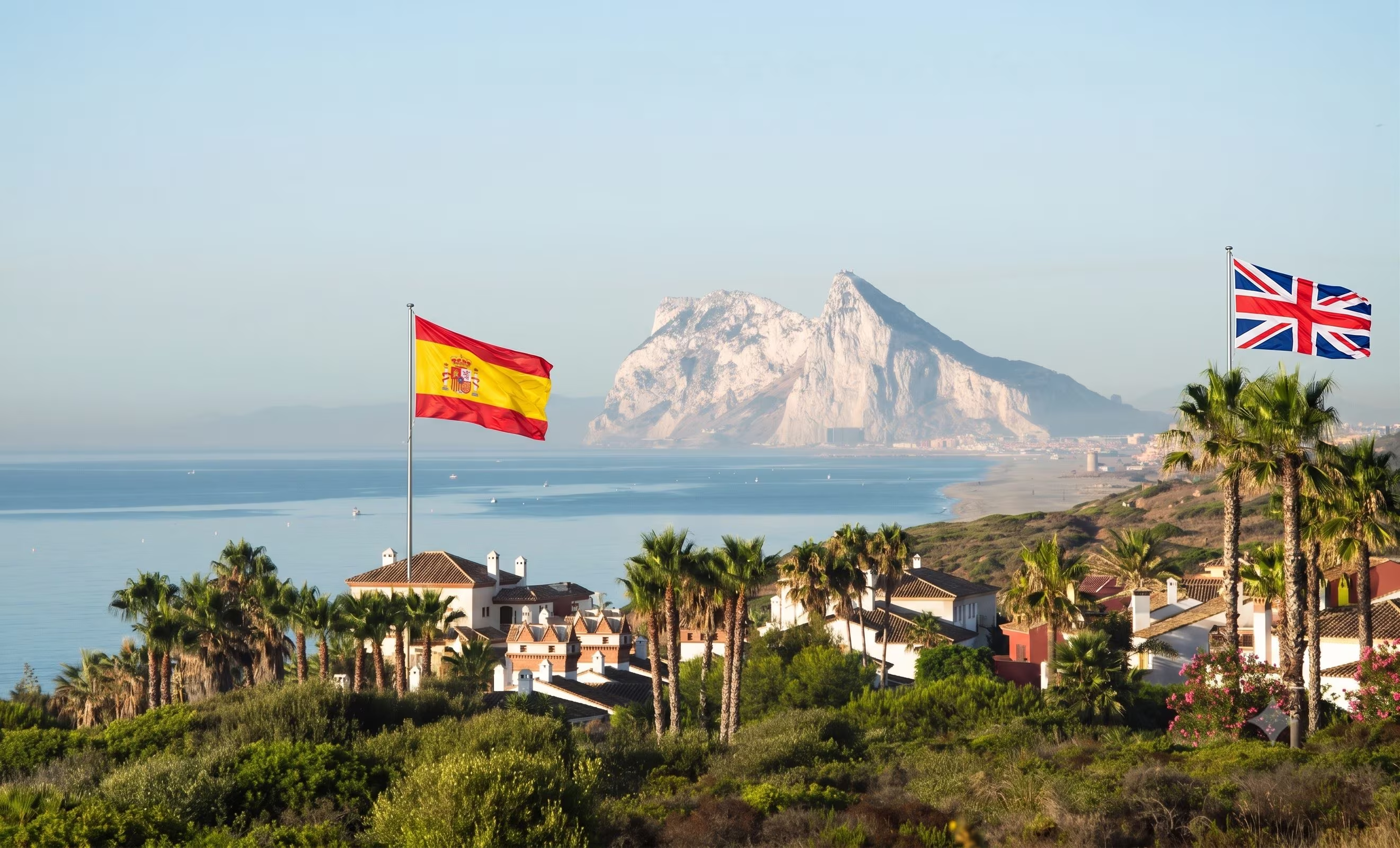
But why is Gibraltar British if it is physically located in Spain? Gibraltar’s history as a British territory begins in the context of the War of the Spanish Succession, at the beginning of the eighteenth century. The Rock of Gibraltar, which dominates the strait of the same name between the Atlantic Ocean and the Mediterranean Sea, was conquered during the conflict and its passage from the Spanish to the British Crown was formalized with the Treaty of Utrecht in 1713.
For England, which aspired to establish itself as a naval power of the first rank, controlling that point meant keeping watch over the very important commercial traffic of the Mediterranean and being able to strike, if necessary, the fleets of Spain and France.
From that moment Gibraltar became a pillar of the British maritime empire. Its strategic importance grew further after 1869, with the opening of the Suez Canal: whoever controlled the Strait of Gibraltar effectively controlled access to the Mediterranean and, through it, the route to Asia. During the Cold War, the Fortress then served as a base for NATO naval units and the US Sixth Fleet.
Spain, however, never stopped claiming Gibraltar. For Madrid it is an unredeemed territory, an open historical wound which, over the centuries, has fueled a particularly strong rhetoric of “reconquista” in the phases of more heated nationalism. The Gibraltarians, however, have never shown any interest in returning to Spanish sovereignty: in the 2002 referendum, 99% of the inhabitants expressed themselves against the hypothesis of shared sovereignty between London and Madrid.
Today, Gibraltar enjoys the highest degree of autonomy of all the British Overseas Territories, with its own self-government. However, it remains dependent on the United Kingdom for foreign policy and international relations, which is why negotiations on the treaty were conducted by Foreign Office British, with the participation of a delegation from the local government of Gibraltar to guarantee that the negotiations respected the will of the citizens of the Rock.
It is also the only British territory in the Mediterranean area (with the exception of the bases in Cyprus) which guarantees London a projection capacity on the Mediterranean and is also historically accessible to US naval forces by virtue of the “special relationship” between the two countries.